기본 콘텐츠로 건너뛰기

HEADLINE DESK

DKBEE.COM 최신 주요 리포트

최신 기사를 불러오는 중입니다...

LATEST INSIGHTS

분야별 심층 분석

Honey Producers Resist Deforestation in the Impenetrable Chaco (Spanish)


Honey Producers Resist Deforestation in the Impenetrable Chaco (Spanish)


The Qom community and Creole groups in Argentina have found a source of employment and a means of resisting deforestation in the organic honey they send to the United States and Europe. Argentina is the world's third largest exporter of this product.

Of the 20,000 species of bees in the world, two honey producers predominate in the Argentine Chaco: Apis mellifera (of European origin) and Meliponas (native). The native Chaco forest offers up to eight months of flowering for beekeeping, and its native species, such as mistol, carob, and quebracho—rich in pollen and nectar—flower at different times of the year, allowing many beekeepers to make a living from beekeeping or generate a second income.

However, native forest lands have been put at risk by the advance of the agricultural frontier, with massive clearings for soybean cultivation.



As a nonprofit journalism organization, we depend on your support to fund more than 170 reporting projects every year on critical global and local issues. Donate any amount today to become a Pulitzer Center Champion and receive exclusive benefits!
Miel para resistir a la deforestación en el Impenetrable Chaqueño


La comunidad Qom y grupos criollos han encontrado en la miel orgánica que envían a Estados Unidos y a Europa una salida laboral y una resistencia al desmonte. Argentina es el tercer exportador mundial de este producto

Para adentrarse hacia el ecosistema del Gran Chaco, hay que evitar las lluvias: muchos de sus caminos y rutas son de tierra árida y fácilmente se corre el riesgo de empantanarse. En este bosque seco subtropical de 49 millones de hectáreas, ubicado al noroeste de la Argentina, las señales para comunicarse o guiarse por GPS son casi inexistentes. Silvia Godoy, una apicultora de la comunidad originaria qom, da indicaciones a la vieja usanza para llegar donde vive: “Doblas hacia la izquierda, a medio camino de tierra hay un cartel blanco, y más adelante está mi casa”. Esta mujer, de cabello largo y tez morena, no usa su traje protector. Dice que las abejas nunca le dejan su aguijón: “No es que te pican, ellas defienden su hogar”.

Godoy nació y creció en Pampa del Indio, un municipio ubicado a 220 kilómetros de Resistencia, capital de la provincia del Chaco. Cuenta que de su familia heredó 20 hectáreas de monte nativo: “Mi madre nos crio en este monte. Somos seis hermanos muy unidos que amamos nuestra cultura. Aprendimos a trabajar y vivir de nuestras tierras y conservamos la cosmovisión originaria, al igual que nuestra lengua qom l’aqtaqa. Hoy, sus tierras de monte nativo quedaron atrapadas por el avance de la frontera agropecuaria, con desmontes masivos para el cultivo de soja. “Muchas veces vinieron a ofrecerme dinero por mis árboles o tierras, pero siempre me negué”, cuenta.
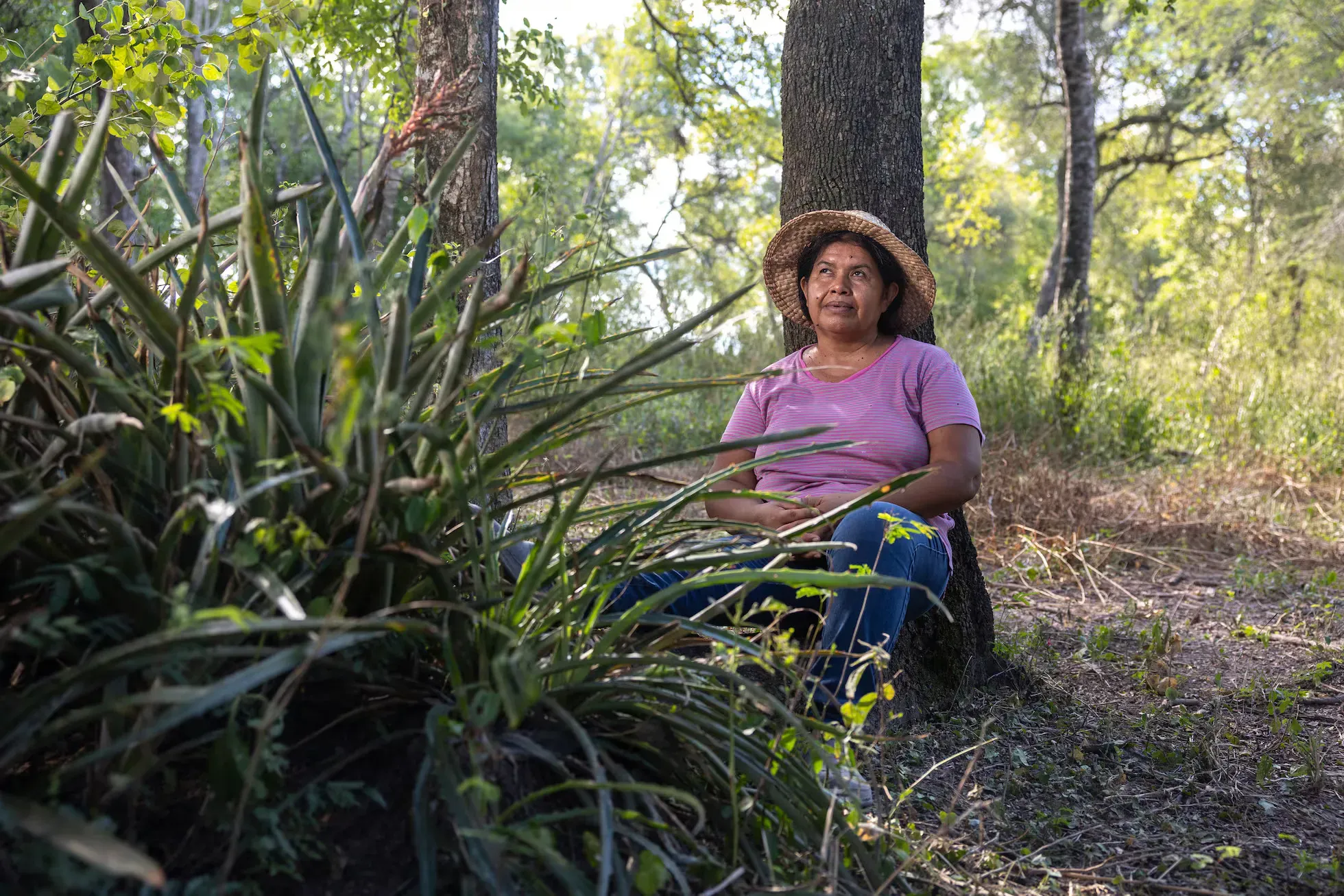
Silvia Godoy, en la comunidad Qom, en febrero de 2025. Foto por Sofía López Mañán. Argentina.

De las 20.000 especies de abejas que existen en el mundo, en el Chaco Argentino predominan dos productoras de miel: las Apis mellifera (de origen europeo) y las Meliponas (nativas). El monte nativo chaqueño ofrece a la apicultura hasta ocho meses de floración, y sus especies nativas, como el mistol, los algarrobos o los quebrachos —ricos en polen y néctar— florecen en diferentes épocas del año, permitiendo a muchos apicultores vivir de la apicultura o generar un segundo ingreso económico.
Las abejas, polinizadoras primordiales


La familia de Godoy se dedica desde hace treinta años a la producción de miel y es referente en el cuidado de las especies Meliponas, unas abejas muy delicadas, sin aguijón, de manejo sencillo y con gran arraigo en las comunidades originarias. Su miel es más líquida, ácida y aromática. Las comunidades originarias ancestralmente le dan un uso medicinal para bajar inflamaciones o cicatrizar heridas, pero también la comercializan. Suelen anidar en colmenas naturales en los árboles de especies nativas chaqueñas. Cuando se traslada ese nido a colmenas racionales, las familias apicultoras construyen pequeñas cajas diseñadas con maderas de especies nativas para que puedan volver a anidar. “De árboles talados hemos rescatado varios nidos de abejas meliponas”, explica Silvia, mientras camina hacia la sombra que le da el quebracho. Este árbol nativo, emblema del monte chaqueño, es rico en néctar y de crecimiento lento, y alcanza su madurez a los 80 o 100 años, y desde hace décadas sufre la sobreexplotación de su madera.

En Argentina, desde el año 2007, rige la Ley de Bosques Nativos. Su función es clasificar aquellas zonas con alto valor de conservación y cuáles presentan valor medio o bajo. Según el biólogo Matías Mastrángelo, experto en conservación y biodiversidad, con la aplicación de la ley y la conservación del Gran Chaco, cada provincia ha experimentado avances y retrocesos. “El sector que prioriza la producción sin considerar el impacto ambiental ni social, es el que más daño provoca, sin generar mejoras reales en la vida de las comunidades que habitan estos ecosistemas”, considera.
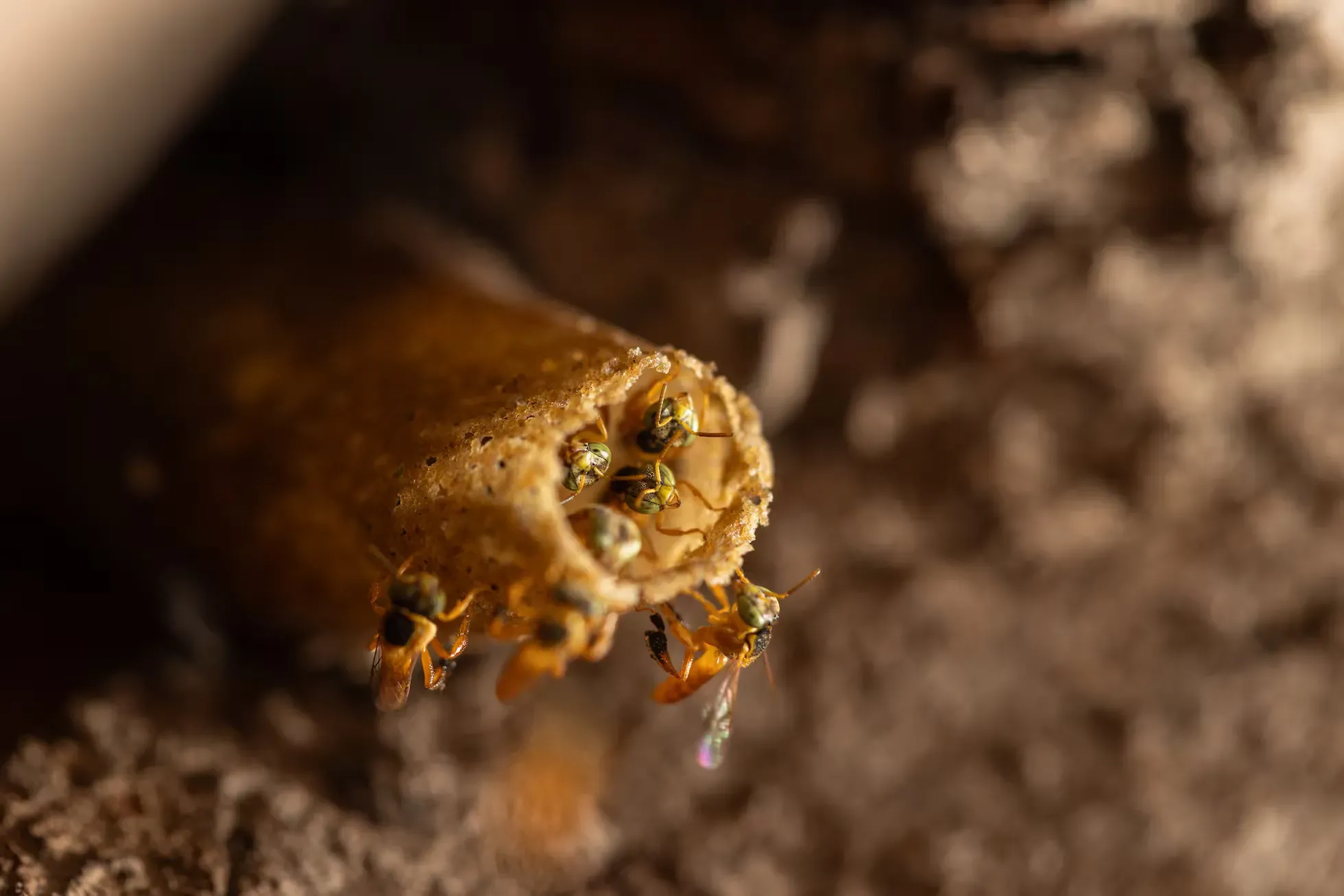
Meliponario de Silvia Godoy, en Pampa del Indio. Foto por Sofía López Mañán. Argentina.

La vida rural chaqueña representa el 10% del total de su población y enfrenta desafíos complejos. Como no existe transporte público que comunique las zonas urbanas con las rurales, las opciones de movilidad por los áridos caminos de tierra son motocicletas, largas caminatas o agruparse en automóviles. Los servicios esenciales —luz, agua y gas— son intermitentes o escasos y la población vive de lo que le da el monte.
La profundización de los desmontes


Los recientes números publicados por la ONG Greenpeace indican que, en los últimos cinco años, el Gran Chaco argentino perdió 167.684 hectáreas de bosque nativo, provocando un impacto cada vez más negativo en la biodiversidad y en su población rural. Las temperaturas aumentan, rozando en ocasiones los 50 grados, y las sequías son cada vez más extensas. En ciertas zonas del monte chaqueño, las oportunidades laborales son prácticamente inexistentes y abundan las ofertas para talar árboles nativos en condiciones precarias y por pagos que están por debajo de la línea de la pobreza.

La población rural chaqueña vive de lo que le da el bosque: su cosecha, los animales, las artesanías y la apicultura. Esta última ha transformado sus formas de vida. El hecho de encontrar en la miel una alternativa digna y más rentable, les brindó mejores ingresos económicos y, al mismo tiempo, fortaleció el valor que le dan a su monte, fomentando su arraigo a la tierra natal. “La apicultura nos enseñó a respetar al otro, a unir y transformar ideas. Este trabajo en conjunto nos permitió concretar proyectos que beneficiaron a toda la comunidad, y aprendimos a pensar y a crear de manera colectiva”, comenta Silvia Godoy.

La apicultora Ely Astorga, en el Gran Chaco. Foto por Sofía López Mañán. Argentina.

Para saber cuál es una buena miel, hay que tener en cuenta su aroma, sabor y valor, y también su etiqueta. Argentina produce hasta 75.000 toneladas de miel convencional cada año y 600 toneladas de miel orgánica, y exporta alrededor del 90% de esa producción. Según la FAO, es el tercer exportador de miel a nivel mundial. Este liderazgo se sustenta en la trazabilidad y certificación que otorga el Estado Nacional, confiable para más de 20 destinos internacionales. Estados Unidos es el principal comprador, con el 60% de las exportaciones, seguido por Europa —principalmente Alemania, España y Francia— que concentra el 40% restante, desplazando así al mercado de China. Esta producción también depende de factores como el cambio climático, las prácticas no sostenibles en el uso del suelo y la invasión de especies exóticas, que afectan directamente al monte chaqueño.

La apicultura del Chaco tiene décadas en la región; sin embargo, fue en 2011 cuando se lanzó su Plan apícola provincial. El objetivo principal fue crear fuentes laborales para aquellas personas que viven en zonas rurales y aumentar la cantidad y calidad de miel. Esto generó la construcción y puesta en marcha de salas de extracción, así como la formación de técnicos en las diferentes localidades que rodean el monte, impulsando un movimiento socioeconómico y cultural que actualmente reúne a 1.000 apicultores de miel convencional. “Para nosotros siempre fue una muy buena entrada económica”, explica Godoy.
Vivir “de las flores”, una resistencia poética


Sin embargo, no fue hasta 2017 que el Ministerio de Ambiente de la provincia del Chaco inició su camino hacia la certificación de miel orgánica. Eso implicó adaptarse a reglas estrictas de los mercados internacionales como evitar químicos de síntesis y transgénicos, someterse a inspecciones periódicas del Servicio Nacional de Sanidad y Calidad Agroalimentaria, asegurar la separación física entre la miel convencional y la orgánica, y cumplir con las normativas específicas de cada destino de exportación. La provincia logró ser la mayor exportadora a nivel nacional. Las fuentes oficiales y regionales señalan que el 25% de sus apicultores están especializados en miel orgánica y tienen alrededor de 13.600 colmenas certificadas, mientras que otras provincias de Argentina llegan a un máximo de 5.000. Además, obtienen un 30% más de beneficio económico con respecto a la miel convencional.
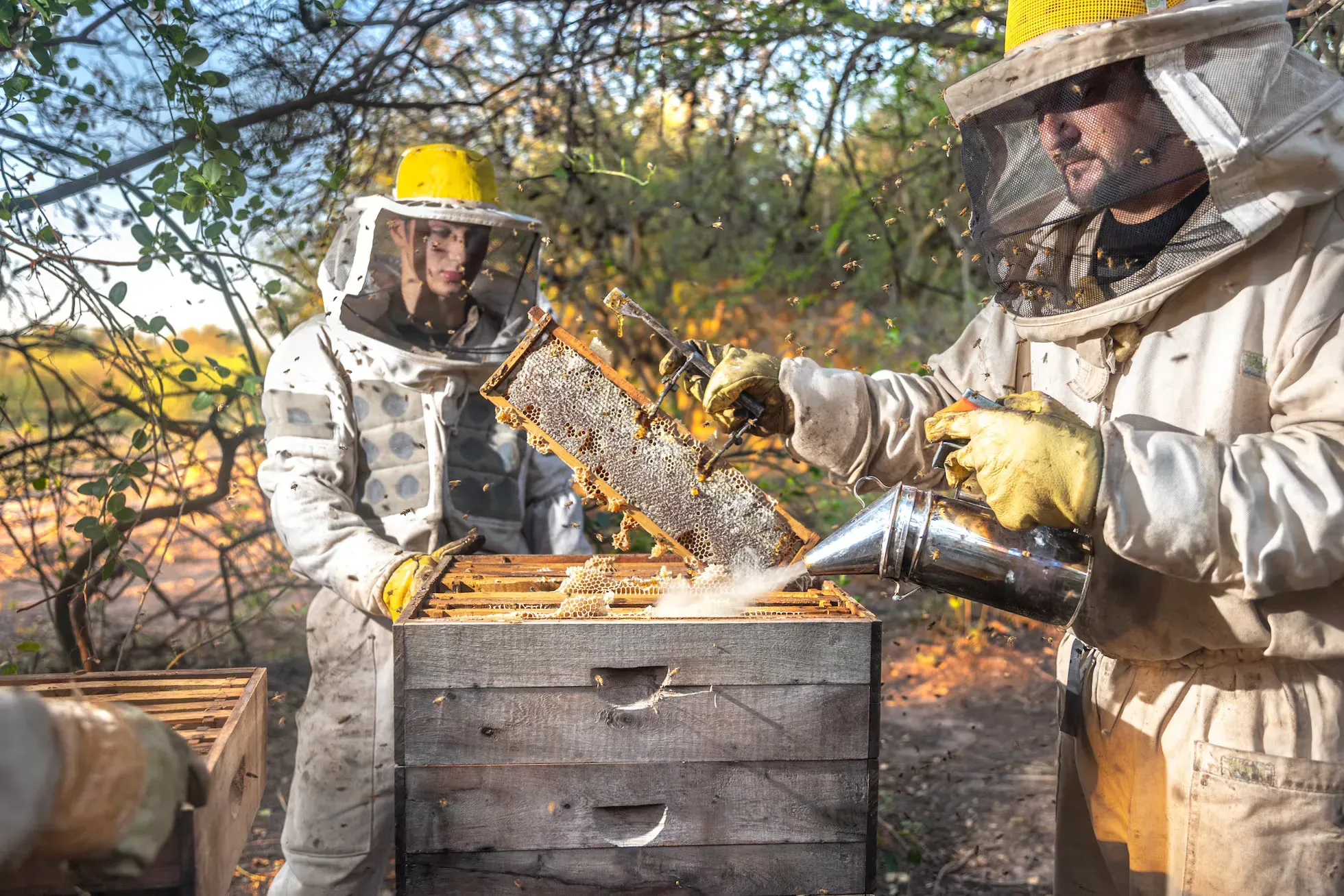
Apicultores de Miraflores durante la primera cosecha del 2024, en octubre. Foto por Sofía López Mañán. Argentina.

Las personas que viven en su bosque nativo conocen la importancia de su biodiversidad y son conscientes de que puede seguir dándoles vida. Los apicultores rurales suelen decir que “viven de las flores”, una forma de resistencia poética que también transmiten a sus hijos o niños de las comunidades y escuelas rurales, al enseñarles el valor de la apicultura en las instituciones educativas, armando pequeñas granjas.

En el monte aún se construye una vida compartida, con las personas y la naturaleza. Las visitas para conocer esta ecorregión están marcadas por lo que el clima ofrece, al igual que la vida de sus habitantes. Al amanecer, la brisa fresca invita a trabajar la tierra, cosechar o estudiar; al mediodía, la actividad se suspende y se retoma cuando el sol comienza a bajar. Para los apicultores, el compás de sus vidas lo marca la biodiversidad del Gran Chaco Argentino, comprendiendo que, son actores fundamentales para protegerlo y demostrar, también, la importancia de que las leyes de protección ambientales que existen en el país, se cumplan, para que todo lo vivo de este pulmón verde sea respetado.

댓글

이 블로그의 인기 게시물

From our August Home and Garden publication: Columbia Gorge Beekeepers: Megachilinae / Leafcutter

 From our August Home and Garden publication: Columbia Gorge Beekeepers: Megachilinae / Leafcutter From our August Home and Garden publication: Columbia Gorge Beekeepers: Megachilinae / Leafcutter Summer is in full swing! Hopefully you have ventured outside exploring the flora that brings beauty to the Columbia Gorge area. Have you seen any native bees visiting their grocery store — the flowers and plants? Native bees are out foraging for nectar and pollen to support their brood (babies). Each egg must have a bit of nectar and a splash of pollen. Honey bees, on the other hand, forage not only for their brood but sustenance for the long winter months ahead. The native bee’s queen hibernates through the wintry season, only surviving one year. Thus, the need for nectar stores is unnecessary. There exists a symbiotic relationship between pollinators and the flora surrounding their habitat. The plants and flowers rely on pollinators to move pollen from the flower’s anther (male part) to...

She Was Dying—Then a Swarm of Stinging Bees Healed Her

She Was Dying—Then a Swarm of Stinging Bees Healed Her One sunny day, Ellie Lobel, who had a Ph.D. in nuclear physics and three children, was attacked by a horde of Africanized bees, commonly called “killer” bees. Lobel shielded her eyes and expected to have a deadly anaphylactic reaction, she said in a 2015 BBC article describing her experience. The 45-year-old English woman was in palliative care in California because she was dying from Lyme disease. She had stepped outside to experience some sunshine and peace when the bees attacked. Swollen and in pain, Lobel expected the end was imminent. At least, that’s what she thought. Fifteen years earlier, Lobel had unknowingly endured a tick bite. The tick carried the bacteria Borrelia burgdorferi, which causes Lyme disease. If caught in time, Lyme disease is treatable with antibiotics, though the bacteria are known to sneak around the immune system and even cause flare-ups long after apparent recovery. Borrelia burgdorferi can travel e...

BeeArc Project: Pioneering a Sustainable Future for Bees and Humans

BeeArc Project: Pioneering a Sustainable Future for Bees and Humans In the picturesque village of Goathland, near Whitby, a groundbreaking initiative, the £5m BeeArc project, has taken flight. Designed for environmental activists, concerned citizens, and curious minds, this project delves into the intricate challenges faced by honeybees and, by extension, humanity. In an era of unprecedented change and instability, the honeybee finds itself at a critical juncture. Colony Collapse Disorder, where bees abandon their hives en masse, has wreaked havoc globally, with a staggering 40% disappearance in the US in 2014. The crisis is not just a distant woe; it's affecting honeybees locally, threatening their very existence. James Fearnley, founder and project director, passionately states, “The honeybee is at the end of its tether. The colonies are literally falling apart.” Drawing on 30 years of research, Fearnley proposes a revolutionary approach – harnessing natural medicines from honeyb...

Non-contact exposure to dinotefuran disrupts honey bee homing by altering MagR and Cry2 gene expression

  Non-contact exposure to dinotefuran disrupts honey bee homing by altering  MagR  and  Cry2  gene expression Dinotefuran is known to negatively affect honeybee ( Apis mellifera ) behavior, but the underlying mechanism remains unclear. The magnetoreceptor ( MagR , which responds to magnetic fields) and cryptochrome ( Cry2 , which is sensitive to light) genes are considered to play important roles in honey bees’ homing and localization behaviors. Our study found that dinotefuran, even without direct contact, can act like a magnet, significantly altering  MagR  expression in honeybees. This non-contact exposure reduced the bees’ homing rate. In further experiments, we exposed foragers to light and magnetic fields, the  MagR  gene responded to magnetic fields only in the presence of light, with  Cry 2 playing a key switching role in the magnetic field receptor mechanism ( MagR–Cry2 ). Yeast two-hybrid and BiFc assays confirmed an interactio...

What to do if you see a bee on the ground, according to an expert

What to do if you see a bee on the ground, according to an expert You've no doubt seen bees buzzing around flowers or even nestling among blades of grass, but when you spot them chilling on the pavement it can raise various questions – not least: "Are they okay?" Even if they are still alive – the average lifespan of workers is just four to six weeks – bumblebees occasionally end up on the ground for of a variety of reasons. Amy Ross, a senior ecologist for Kent Wildlife Trust , explains to Yahoo UK why this happens and, more crucially, what you can do to help them. What type of bees are they? There are more than 250 species of bees native to the UK. (Getty Images) It's important to note that there are more than 250 species of bees native to the UK – 24 of which are bumblebees. Bumblebees can be identified using this helpful chart from the Bumblebee Conservation Trust and are more than likely the kind you'll spot on the ground. What's more, around 70% of th...

10 deadliest bees you should never mess with

  10 deadliest bees you should never mess with Bees play a vital role in pollination and ecosystems, but not all are the gentle garden visitors we imagine. Some bees—and wasp-like relatives—pack a powerful sting, show extreme aggression, or defend their nests with deadly force.  Whether it’s their painful venom, swarming behavior, or territorial nature, these species are not to be taken lightly. From tropical rainforests to suburban backyards, they command respect. In this list, we explore the world’s top 10 deadliest bee and bee-like species you should never provoke, complete with their nicknames, regions, threat levels, and evolutionary origins. Dangerous bees  found across the world including  Yellow Jacket , Warrior Wasp, and more 1. Africanised  Honey Bee  – “The Killer Bee” One of the most dangerous stinging insects in the world, the Africanised honey bee is found across South and Central America and parts of the southern U.S.  These bees are ext...

Suncheon Bay: A Triumph for Environmental Stewardship and Migratory Bird Conservation

  Suncheon Bay: A Triumph for Environmental Stewardship and Migratory Bird Conservation Nestled in the heart of Haeryong-myeon, Suncheon-si, Jeollanam-do, the scenic 92m high hill on the 1st of January provides a breathtaking panorama of Suncheon Bay. The awe of around 10 tourists is palpable as they gaze down from two Yongsan observatories onto the vast expanse below, where approximately 400 cranes gracefully take flight over 2,800 ha of pristine mudflats and reed fields. The Suncheon Bay Eco-Friendly Project In 2006, Suncheon City, in collaboration with its citizens, embarked on an ambitious eco-friendly project when Suncheon Bay earned recognition in the Ramsar Convention—an international treaty for wetland protection. Over the years, the project has yielded remarkable results, with the number of whooping cranes doubling in just four years. Preserving Biodiversity Through Strategic Initiatives To safeguard the ecosystem, preventive measures were implemented against diseases like...

The £15 Billion Climate Bill: The Screams of a Concrete Megacity and Its Structural Paradox

  The £15 Billion Climate Bill: The Screams of a Concrete Megacity and Its Structural Paradox     Subtitle : London’s suffocating dual crisis of urban heat islands and flash floods reveals a systemic mismatch between local responsibility and central funding. Adapting to the new normal demands an overhaul of urban planning, not just cosmetic greening. 1. Prologue: The Surface of the Crisis and the Hidden Paradox London, the cradle of the Industrial Revolution and the epicenter of modern global finance, is now confronting a profound climate paradox. A stark report by Central London Forward (CLF) warns that without "drastic action at all levels of government," the British capital could face an astronomical climate bill of up to £15 billion annually by 2050. This is not a distant, abstract warning; it is a tangible, compounding debt that has already begun eroding the city’s infrastructure and threatening the survival of its residents. The cruelest paradox of this climate shif...

Giant hail threat increases for Australian cities as climate warms

Giant hail threat increases for Australian cities as climate warms In short: Hailstorms will become more frequent in Brisbane, Sydney and Canberra, while the risk of "giant" hail will increase for others, including Melbourne and Perth. The new study by the University of New South Wales shows the relationships between a warming climate and the severity of hailstorms across most major Australian cities. What's next? The study's lead researcher, Dr Tim Raupach, says it is imperative to reduce emissions, but Australia also needs to consider the increased risk from hail damage in its building codes. The frequency of "giant" hail and the number of hail days in a season could increase substantially for multiple Australian cities as the climate warms, a new study has found. The University of New South Wales study modelled the severity of hailstorms for the current and future climate across Australia's most hail-prone major cities, including Brisbane, the Sydney...

콘크리트 메가시티의 비명, 150억 파운드의 기후 고지서가 던진 경고

  콘크리트 메가시티의 비명, 150억 파운드의 기후 고지서가 던진 경고     부제목 : 런던의 숨을 막는 '도시 열섬'과 홍수의 복합 위기, 중앙-지방 간 재정 미스매치가 만들어낸 기후 적응의 제도적 딜레마. 단순한 녹지 조성을 넘어선 구조적 패러다임 전환이 시급하다. 1. 프롤로그: 현상의 표면과 숨겨진 역설 산업혁명의 발상지이자 현대 금융의 중심지인 런던이 거대한 기후 역설에 직면했다. 중앙런던포워드(CLF)의 최신 보고서는 오는 2050년까지 런던이 매년 최대 150억 파운드(한화 약 25조~26조 원 규모)에 달하는 천문학적인 기후 변화 비용을 지불해야 할 것이라고 경고했다. 이는 단순히 미래의 막연한 경고가 아닌, 이미 도시의 인프라와 시민의 생존을 위협하기 시작한 가시적 위기다. 여기서 발견되는 기후 변화의 가장 잔인한 역설은, 인류가 자연을 통제하고 밀도를 극대화하여 구축한 ‘가장 효율적인 공간’인 대도시가 역설적으로 기후 재난에 ‘가장 취약한 고리’로 전락했다는 점이다. 폭염과 홍수, 가뭄이라는 삼중고는 대도시의 고밀도 인프라를 타고 증폭되며, 도시의 경제적 축적을 순식간에 비용과 부채로 치환하고 있다. 2. 심층 메커니즘: 본질을 움직이는 구조적 역학 관계 런던을 위협하는 기후 위기의 핵심에는 고도로 집약된 물리적 구조와 대기 역학의 상호작용이 자리 잡고 있다. 대표적인 현상이 바로 '도시 열섬(Urban Heat Island, UHI) 효과'다. 콘크리트와 아스팔트로 뒤덮인 메가시티는 태양광 에너지를 흡수하는 열용량(Heat Capacity)이 천연 녹지에 비해 압도적으로 높다. 여기에 고층 빌딩이 형성하는 이른바 '도시 협곡(Urban Canyon)' 현상은 바람길을 막아 대기 순환을 저해하고, 인공 열과 복사열을 지표면 근처에 가두어 둔다. 그 결과 런던 중심부는 외곽 지역에 비해 기온이 최대 10도 이상 치솟는 극단적인 열적 불균형을 보인다. 문제는 이 열적 메커니즘이 수문학적(Hydrolo...