기본 콘텐츠로 건너뛰기

HEADLINE DESK

DKBEE.COM 최신 주요 리포트

최신 기사를 불러오는 중입니다...

LATEST INSIGHTS

분야별 심층 분석

New beekeeping program helps prison inmates heal through nature: 'Already producing honey'


New beekeeping program helps prison inmates heal through nature: 'Already producing honey'


At Pondville Correctional Center in Norfolk, Massachusetts, some incarcerated individuals are adding a beekeeper’s veil to their standard-issue uniforms.

It’s part of a new pilot program, in which a select number of individuals participate in a hands-on curriculum that teaches them the science of beekeeping.

Volunteer Susan Goldwitz, a 75-year-old retired English teacher, made a donation to the state’s Department of Corrections to make the program possible. Now, she’s taking what was once a personal hobby and turning it into a life-changing opportunity for community members who are incarcerated.
Susan Goldwitz (left) speaks to a partner from Pondville Correctional Center. Photo courtesy of Massachusetts Department of Corrections

“What makes a good beekeeper is someone who can plan and have impulse control, who can focus, be mindful, calm and curious. They need to be involved in nature, be interested in themself and others, and have empathy,” Goldwitz told Mass Live.

“These were qualities that I realized that people I was teaching at the correctional facilities would benefit from — it’s exactly what I want my students who are incarcerated to be learning about.”

Earlier this year, the program’s partner company, Best Bees, delivered two hives containing 40,000 bees to the facility. Since then, Goldwitz and other correctional staff have monitored the hives and surveyed interest from the incarcerated individuals.
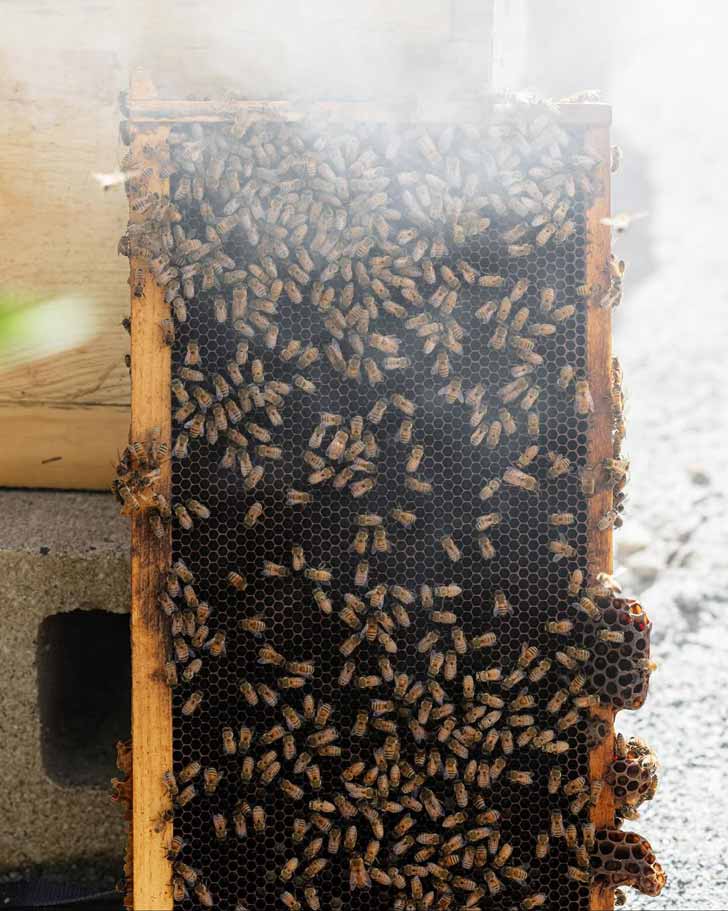
One of the two hives currently in place at the facility. Photo courtesy of Massachusetts Department of Corrections

“They’ve been asking tens and tens — hundreds — of questions about how they can get into the program,” Joseph Salvucci, director of treatment and classification at the facility, told MassLive.

“It’s generating a lot of interest, and that’s the main goal: to generate interest and curiosity and, hopefully, turn this into a skill that they can utilize when they get out.”

Those wanting to join the program only have to meet a few prerequisites: They must pass a screening for bee allergies, and should be within 18 months of their release or parole. The goal is to have them all onboarded to the program by February 2026.

The ultimate vision is to allow about a dozen individuals to take part in the program each year, learning in both a classroom setting and in the outdoor environment.
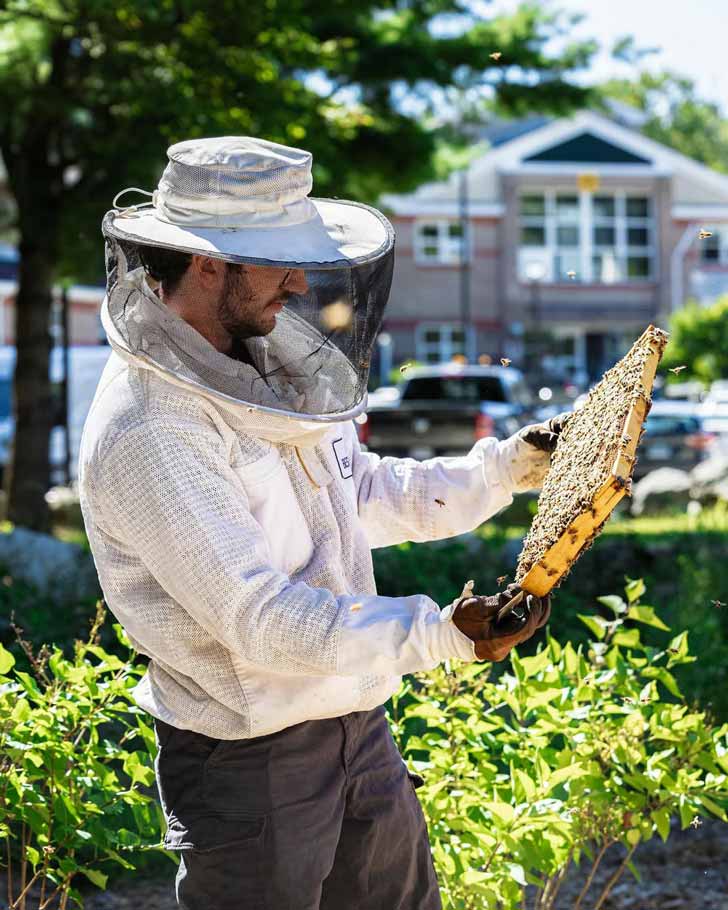
Right now, incarcerated individuals are not yet part of the program and the hives are being tended to by experts. Soon, they will be onboarded. Photo courtesy of Massachusetts Department of Corrections

In the program, individuals will receive training in caring for beehives, collecting honey, and learning about the environment. They’ll also learn about insects and ecosystems, gaining both useful skills and scientific knowledge that can help them access opportunities once they’ve completed their sentences.

It’s not the only program like this offered to the inmates; Pondville Correctional Center also has other pre-release programs for incarcerated individuals, like assistance-dog training, English-language workshops, training for automotive work, and more.

“This particular program is unique because it gets folks outside and engaging with nature, giving them an opportunity to develop skills that help when they re-enter back into the communities,” Department of Corrections Commissioner Shawn Jenkins said.

“As a leader in recidivism reduction, the DOC continually evaluates new programs and the possible ways we can grow. We know beekeeping programs have been successful in other correctional agencies across the country,” Jenkins added.
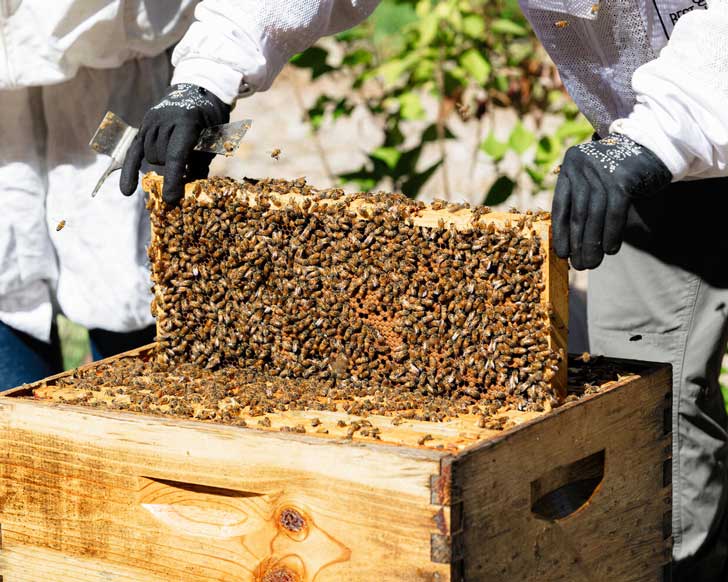
The hives are already producing honey. Photo courtesy of Massachusetts Department of Corrections

In addition to helping with re-entry, the beehives are also an interconnected part of the facility’s fruit and vegetable garden, which is also tended to by volunteers and incarcerated individuals.

The bees help pollinate the plants, allowing even more produce to be grown and harvested. Since August of this year, more than 400 pounds of produce have been donated to a local food bank in the area.

Hives are also thriving and producing honey early into the program, with experts from Best Bees harvesting and providing it to the facility for use in its culinary programming.

“Having a hive at the Pondville facility allows us to share the inspiration of honeybees with people who might not otherwise have that opportunity,” Paige Mulhern, director of brand at Best Bees, said in a statement.

“This hive has become a unique point of connection — linking our beekeepers, the incarcerated individuals, and the bees in a shared experience of resilience and interconnectedness.”
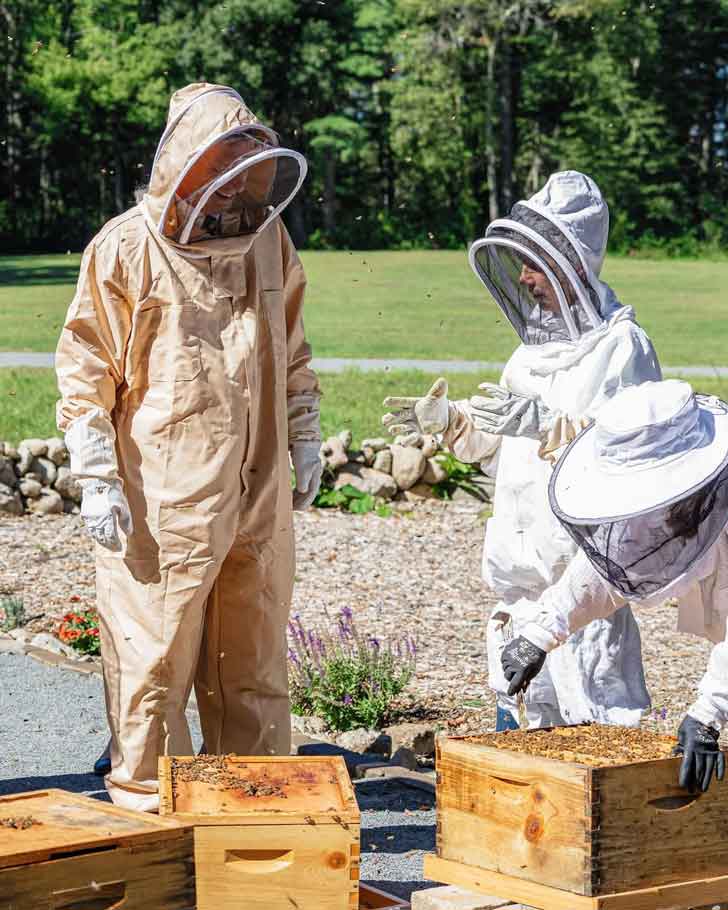
The program will ideally be in full swing by February. Photo courtesy of Massachusetts Department of Corrections

For Goldwitz, that’s the real lesson: Nature as a vehicle for healing.

“It is not just learning entomology, it is not just learning about insects and science. Bees are a catalyst and a metaphor for the way people can work together and individually toward the benefit of the whole community,” Goldwitz said.

“This program is a step toward healing and incorporating nature into the process.”

댓글

이 블로그의 인기 게시물

From our August Home and Garden publication: Columbia Gorge Beekeepers: Megachilinae / Leafcutter

 From our August Home and Garden publication: Columbia Gorge Beekeepers: Megachilinae / Leafcutter From our August Home and Garden publication: Columbia Gorge Beekeepers: Megachilinae / Leafcutter Summer is in full swing! Hopefully you have ventured outside exploring the flora that brings beauty to the Columbia Gorge area. Have you seen any native bees visiting their grocery store — the flowers and plants? Native bees are out foraging for nectar and pollen to support their brood (babies). Each egg must have a bit of nectar and a splash of pollen. Honey bees, on the other hand, forage not only for their brood but sustenance for the long winter months ahead. The native bee’s queen hibernates through the wintry season, only surviving one year. Thus, the need for nectar stores is unnecessary. There exists a symbiotic relationship between pollinators and the flora surrounding their habitat. The plants and flowers rely on pollinators to move pollen from the flower’s anther (male part) to...

She Was Dying—Then a Swarm of Stinging Bees Healed Her

She Was Dying—Then a Swarm of Stinging Bees Healed Her One sunny day, Ellie Lobel, who had a Ph.D. in nuclear physics and three children, was attacked by a horde of Africanized bees, commonly called “killer” bees. Lobel shielded her eyes and expected to have a deadly anaphylactic reaction, she said in a 2015 BBC article describing her experience. The 45-year-old English woman was in palliative care in California because she was dying from Lyme disease. She had stepped outside to experience some sunshine and peace when the bees attacked. Swollen and in pain, Lobel expected the end was imminent. At least, that’s what she thought. Fifteen years earlier, Lobel had unknowingly endured a tick bite. The tick carried the bacteria Borrelia burgdorferi, which causes Lyme disease. If caught in time, Lyme disease is treatable with antibiotics, though the bacteria are known to sneak around the immune system and even cause flare-ups long after apparent recovery. Borrelia burgdorferi can travel e...

BeeArc Project: Pioneering a Sustainable Future for Bees and Humans

BeeArc Project: Pioneering a Sustainable Future for Bees and Humans In the picturesque village of Goathland, near Whitby, a groundbreaking initiative, the £5m BeeArc project, has taken flight. Designed for environmental activists, concerned citizens, and curious minds, this project delves into the intricate challenges faced by honeybees and, by extension, humanity. In an era of unprecedented change and instability, the honeybee finds itself at a critical juncture. Colony Collapse Disorder, where bees abandon their hives en masse, has wreaked havoc globally, with a staggering 40% disappearance in the US in 2014. The crisis is not just a distant woe; it's affecting honeybees locally, threatening their very existence. James Fearnley, founder and project director, passionately states, “The honeybee is at the end of its tether. The colonies are literally falling apart.” Drawing on 30 years of research, Fearnley proposes a revolutionary approach – harnessing natural medicines from honeyb...

Non-contact exposure to dinotefuran disrupts honey bee homing by altering MagR and Cry2 gene expression

  Non-contact exposure to dinotefuran disrupts honey bee homing by altering  MagR  and  Cry2  gene expression Dinotefuran is known to negatively affect honeybee ( Apis mellifera ) behavior, but the underlying mechanism remains unclear. The magnetoreceptor ( MagR , which responds to magnetic fields) and cryptochrome ( Cry2 , which is sensitive to light) genes are considered to play important roles in honey bees’ homing and localization behaviors. Our study found that dinotefuran, even without direct contact, can act like a magnet, significantly altering  MagR  expression in honeybees. This non-contact exposure reduced the bees’ homing rate. In further experiments, we exposed foragers to light and magnetic fields, the  MagR  gene responded to magnetic fields only in the presence of light, with  Cry 2 playing a key switching role in the magnetic field receptor mechanism ( MagR–Cry2 ). Yeast two-hybrid and BiFc assays confirmed an interactio...

What to do if you see a bee on the ground, according to an expert

What to do if you see a bee on the ground, according to an expert You've no doubt seen bees buzzing around flowers or even nestling among blades of grass, but when you spot them chilling on the pavement it can raise various questions – not least: "Are they okay?" Even if they are still alive – the average lifespan of workers is just four to six weeks – bumblebees occasionally end up on the ground for of a variety of reasons. Amy Ross, a senior ecologist for Kent Wildlife Trust , explains to Yahoo UK why this happens and, more crucially, what you can do to help them. What type of bees are they? There are more than 250 species of bees native to the UK. (Getty Images) It's important to note that there are more than 250 species of bees native to the UK – 24 of which are bumblebees. Bumblebees can be identified using this helpful chart from the Bumblebee Conservation Trust and are more than likely the kind you'll spot on the ground. What's more, around 70% of th...

10 deadliest bees you should never mess with

  10 deadliest bees you should never mess with Bees play a vital role in pollination and ecosystems, but not all are the gentle garden visitors we imagine. Some bees—and wasp-like relatives—pack a powerful sting, show extreme aggression, or defend their nests with deadly force.  Whether it’s their painful venom, swarming behavior, or territorial nature, these species are not to be taken lightly. From tropical rainforests to suburban backyards, they command respect. In this list, we explore the world’s top 10 deadliest bee and bee-like species you should never provoke, complete with their nicknames, regions, threat levels, and evolutionary origins. Dangerous bees  found across the world including  Yellow Jacket , Warrior Wasp, and more 1. Africanised  Honey Bee  – “The Killer Bee” One of the most dangerous stinging insects in the world, the Africanised honey bee is found across South and Central America and parts of the southern U.S.  These bees are ext...

Suncheon Bay: A Triumph for Environmental Stewardship and Migratory Bird Conservation

  Suncheon Bay: A Triumph for Environmental Stewardship and Migratory Bird Conservation Nestled in the heart of Haeryong-myeon, Suncheon-si, Jeollanam-do, the scenic 92m high hill on the 1st of January provides a breathtaking panorama of Suncheon Bay. The awe of around 10 tourists is palpable as they gaze down from two Yongsan observatories onto the vast expanse below, where approximately 400 cranes gracefully take flight over 2,800 ha of pristine mudflats and reed fields. The Suncheon Bay Eco-Friendly Project In 2006, Suncheon City, in collaboration with its citizens, embarked on an ambitious eco-friendly project when Suncheon Bay earned recognition in the Ramsar Convention—an international treaty for wetland protection. Over the years, the project has yielded remarkable results, with the number of whooping cranes doubling in just four years. Preserving Biodiversity Through Strategic Initiatives To safeguard the ecosystem, preventive measures were implemented against diseases like...

The £15 Billion Climate Bill: The Screams of a Concrete Megacity and Its Structural Paradox

  The £15 Billion Climate Bill: The Screams of a Concrete Megacity and Its Structural Paradox     Subtitle : London’s suffocating dual crisis of urban heat islands and flash floods reveals a systemic mismatch between local responsibility and central funding. Adapting to the new normal demands an overhaul of urban planning, not just cosmetic greening. 1. Prologue: The Surface of the Crisis and the Hidden Paradox London, the cradle of the Industrial Revolution and the epicenter of modern global finance, is now confronting a profound climate paradox. A stark report by Central London Forward (CLF) warns that without "drastic action at all levels of government," the British capital could face an astronomical climate bill of up to £15 billion annually by 2050. This is not a distant, abstract warning; it is a tangible, compounding debt that has already begun eroding the city’s infrastructure and threatening the survival of its residents. The cruelest paradox of this climate shif...

Giant hail threat increases for Australian cities as climate warms

Giant hail threat increases for Australian cities as climate warms In short: Hailstorms will become more frequent in Brisbane, Sydney and Canberra, while the risk of "giant" hail will increase for others, including Melbourne and Perth. The new study by the University of New South Wales shows the relationships between a warming climate and the severity of hailstorms across most major Australian cities. What's next? The study's lead researcher, Dr Tim Raupach, says it is imperative to reduce emissions, but Australia also needs to consider the increased risk from hail damage in its building codes. The frequency of "giant" hail and the number of hail days in a season could increase substantially for multiple Australian cities as the climate warms, a new study has found. The University of New South Wales study modelled the severity of hailstorms for the current and future climate across Australia's most hail-prone major cities, including Brisbane, the Sydney...

Decoding the Cold: Understanding the Dynamics of Cold Snaps and Waves

  Decoding the Cold: Understanding the Dynamics of Cold Snaps and Waves As we brace ourselves for an impending cold snap, it's crucial to demystify the nuances between a fleeting chill and a more prolonged, impactful cold wave. Meteorologically speaking, these are two distinct phenomena, each with its own characteristics and potential consequences. 🌬️❄️ Cold Snap vs. Cold Wave:  🔄🌡️ When the cold lingers for a brief period, typically 1-2 days, we label it a cold snap. It's transient and relatively mild. However, when the cold persists for three days or more, spreading its influence far and wide, we term it a cold wave. This distinction is pivotal as it helps us gauge the severity and duration of the impending chill. Siberian Cold Snap: A Tidal Wave of Cold Waves:  🌊❄️ Drawing a metaphorical comparison to a tidal wave, the Siberian cold snap ebbs and flows, resembling the rhythmic patterns of a tide. This upcoming cold snap is poised to be a formidable cold wave, impac...