기본 콘텐츠로 건너뛰기

HEADLINE DESK

DKBEE.COM 최신 주요 리포트

최신 기사를 불러오는 중입니다...

LATEST INSIGHTS

분야별 심층 분석

Banks retreat from climate change commitments – but it’s business more than politics

 Banks retreat from climate change commitments – but it’s business more than politics

Another business-led effort to fight climate change is unraveling.

On Aug. 27, 2025, the Net-Zero Banking Alliance suspended its activities after several major U.S. and European banks backed out.

While most observers are blaming the strong political backlash in the U.S. against climate change action and sustainable investing, we believe the banks didn’t need much of a push: These net-zero alliances never made much business sense and were not particularly effective at fighting climate change. Indeed, for us the puzzle was why they had flourished in the first place.

To examine their rise and fall, we recently conducted a research project that encompassed interviews with more than 80 executives from various financial institutions, activist organizations and oil and gas companies.

Powerful allies grasped climate risks

The Net-Zero Banking Alliance was founded in 2021. Members agreed to limit lending to carbon-intense sectors so that total greenhouse gas emissions from companies in the banks’ loan portfolios are close to zero by 2050.

This target aligned with the goals of the Paris Agreement but was not binding and lacked clear shorter-term targets and plans. Similar net-zero networks were established for insurance, asset management and other financial areas, all under the umbrella of the United Nations Environment Program’s Finance Initiative. Over the past 16 months, the insurance and asset managers’ alliances have also suspended their activities.

These net-zero alliances were built on the premise that climate risk equals financial risk and that the challenge requires a collective response. Their goal was to leverage the power of finance to push companies to decarbonize their products and processes.

Key financial regulators, central banks and a few of the largest asset managers propelled these alliances because they perceived that climate change poses serious long-term systemic risks to markets and economies around the world. Influential figures such as Larry Fink, the CEO of BlackRock, the world’s largest asset manager, and former Bank of England head Mark Carney, now the prime minister of Canada, lent legitimacy to these initiatives.

Some environmental groups also supported these alliances as a smart strategy to pressure companies on climate. Many other financial institutions then joined the net-zero bandwagon, but our research revealed that they didn’t do so because of concern about climate-related financial risks. Rather, they felt an array of pressure from peers, investors, activists, regulators and even their families.

Many people we interviewed mentioned reputational risk as a key driver and saw a low-carbon transition as inevitable, driven by regulation, technological innovation and consumer demand. This was the Biden era, with billions of dollars flowing to clean energy through the Inflation Reduction Act.

The burgeoning field also spawned a specialized but lucrative industry of data providers and consultants who actively marketed carbon management, disclosure and broader sustainability services. The global market for sustainability data and software was estimated at more than US$1 billion in 2024 and growing rapidly.

Climate strategy and sustainability reporting was the fastest-growing business sector for accounting and consulting firms. And asset managers were happy to collect higher fees for funds screened for sustainability – even though these funds have not outperformed the broader market.

These vested interests spurred continued expansion of net-zero networks. Indeed, at its peak in 2024, the Net-Zero Banking Alliance included over 140 members globally with $74 trillion in estimated total assets, representing over 40% of global banking assets.
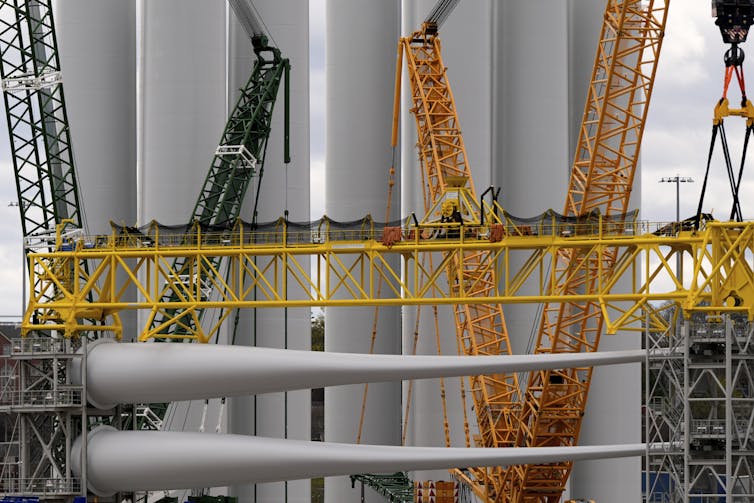
wind turbine components await assembly on a pier in connecticut
The Trump administration has canceled several offshore wind farm projects, such as one that’s nearly complete and intended to serve Rhode Island and Connecticut – though its fate is still in court. AP Photo/Julia Demaree Nikhinson

Political backlash

Given the size and scope of these net-zero networks, what triggered their rapid collapse?

One major factor, of course, was the political backlash against anything connected with climate action and sustainable investing following the 2024 election of President Donald Trump.

Finance officials in more than 20 U.S. states have demanded that major asset managers restrict the use of environment, social and governance benchmarks, accusing them of eroding “traditional fiduciary duty” and claiming they hurt investors.

In August, 23 Republican attorneys general accused organizations created to set standards for corporate climate disclosures of operating an anticompetitive “climate cartel” and violating antitrust laws.

Fossil fuels – too lucrative to abandon

While the political pressure in the U.S. has indeed been intense, the collapse of net-zero networks and the broader corporate retreat from climate commitments is largely due to the continued profitability of fossil fuels and the high costs and risks of deep decarbonization. Investors and banks, of course, want to keep on financing profitable companies and avoid pressuring their clients to take risky measures.

Oil companies such as BP and Shell that had relatively strong climate targets suffered financially as a result, prompting them to retreat from these targets and shift capital from renewable projects back toward fossil fuels. High energy prices in the wake of the Russia-Ukraine war made the sector even more lucrative. Low-carbon fuels and processes for industries such as aviation, steel and cement are still very expensive.

Moreover, the Trump administration is abolishing most subsidies for clean energy and freezing permits for offshore wind, while easing regulations and opening more land for oil and gas exploration.

These economic incentives made it hard for the banking alliance to reduce financing for fossil fuels – and the money has kept on flowing into oil and gas projects.

European banks that sharply cut funding to fossil fuel companies saw their business diverted to other banks and to private, nonbank sources of finance, which has soared in the past two years. Facing this loss of business, major banks’ lending to oil and gas companies surged in 2024, driving loans to a three-year high of $869 billion.

The costs of membership in the net-zero alliances also increased over time, with the adoption of stricter standards that called for specific plans and timelines for ending fossil fuel financing entirely. The new standards also required loan recipients to disclose Scope 3 emissions, which include emissions from a company’s suppliers and customers.

Managers in financial institutions told us that the increasingly complex and demanding requirements were generating strong pushback from their clients. We also heard that membership was turning from a reputational asset to a liability, as activist organizations called out the hypocrisy of continued fossil fuel lending despite their commitments to phasing it out.

Ignoring climate change’s long-term risks

Although banks are rushing back to finance fossil fuel projects, these loans typically have long terms of 10 to 25 years. This means they carry the risk that an eventual transition to clean energy will make these projects worthless, “stranded assets.” One study estimates that investors are currently exposed to more than $1 trillion in potential losses.

Why do banks often ignore these risks?

Our interviewees mentioned the organizational silos that separate analysts who assess climate risks from the loan originators. In other words, the employees deciding where to lend money may not be talking to the team that best understands the long-term risks. Moreover, current risk assessment tools are quite crude and don’t generate the quantitative metrics that loan underwriters want.

Finally, loans are increasingly repackaged and sold, or securitized, into the larger corporate debt market, obscuring the risks.

Climate risks are real and growing

The Net-Zero Banking Alliance isn’t disappearing entirely. The group is currently deciding on whether to restructure into a much weaker “framework initiative” that provides voluntary guidance instead of binding commitments.

And some banks leaving the alliance have stated that they will maintain their climate goals and sustainability policies.

But climate risks are real and growing. The Boston Consulting Group recently estimated that just the physical risks – floods, drought and wildfires – could cost companies up to 25% of their profits by 2050 and substantially cut global GDP.

A transition to a low-carbon economy will cost trillions of dollars and create massive disruption – as well as opportunities – as new technologies and companies emerge. The longer that action is delayed, the greater the risks to the planet – and of more drastic shocks to the global economy and financial system.

댓글

이 블로그의 인기 게시물

From our August Home and Garden publication: Columbia Gorge Beekeepers: Megachilinae / Leafcutter

 From our August Home and Garden publication: Columbia Gorge Beekeepers: Megachilinae / Leafcutter From our August Home and Garden publication: Columbia Gorge Beekeepers: Megachilinae / Leafcutter Summer is in full swing! Hopefully you have ventured outside exploring the flora that brings beauty to the Columbia Gorge area. Have you seen any native bees visiting their grocery store — the flowers and plants? Native bees are out foraging for nectar and pollen to support their brood (babies). Each egg must have a bit of nectar and a splash of pollen. Honey bees, on the other hand, forage not only for their brood but sustenance for the long winter months ahead. The native bee’s queen hibernates through the wintry season, only surviving one year. Thus, the need for nectar stores is unnecessary. There exists a symbiotic relationship between pollinators and the flora surrounding their habitat. The plants and flowers rely on pollinators to move pollen from the flower’s anther (male part) to...

She Was Dying—Then a Swarm of Stinging Bees Healed Her

She Was Dying—Then a Swarm of Stinging Bees Healed Her One sunny day, Ellie Lobel, who had a Ph.D. in nuclear physics and three children, was attacked by a horde of Africanized bees, commonly called “killer” bees. Lobel shielded her eyes and expected to have a deadly anaphylactic reaction, she said in a 2015 BBC article describing her experience. The 45-year-old English woman was in palliative care in California because she was dying from Lyme disease. She had stepped outside to experience some sunshine and peace when the bees attacked. Swollen and in pain, Lobel expected the end was imminent. At least, that’s what she thought. Fifteen years earlier, Lobel had unknowingly endured a tick bite. The tick carried the bacteria Borrelia burgdorferi, which causes Lyme disease. If caught in time, Lyme disease is treatable with antibiotics, though the bacteria are known to sneak around the immune system and even cause flare-ups long after apparent recovery. Borrelia burgdorferi can travel e...

BeeArc Project: Pioneering a Sustainable Future for Bees and Humans

BeeArc Project: Pioneering a Sustainable Future for Bees and Humans In the picturesque village of Goathland, near Whitby, a groundbreaking initiative, the £5m BeeArc project, has taken flight. Designed for environmental activists, concerned citizens, and curious minds, this project delves into the intricate challenges faced by honeybees and, by extension, humanity. In an era of unprecedented change and instability, the honeybee finds itself at a critical juncture. Colony Collapse Disorder, where bees abandon their hives en masse, has wreaked havoc globally, with a staggering 40% disappearance in the US in 2014. The crisis is not just a distant woe; it's affecting honeybees locally, threatening their very existence. James Fearnley, founder and project director, passionately states, “The honeybee is at the end of its tether. The colonies are literally falling apart.” Drawing on 30 years of research, Fearnley proposes a revolutionary approach – harnessing natural medicines from honeyb...

Non-contact exposure to dinotefuran disrupts honey bee homing by altering MagR and Cry2 gene expression

  Non-contact exposure to dinotefuran disrupts honey bee homing by altering  MagR  and  Cry2  gene expression Dinotefuran is known to negatively affect honeybee ( Apis mellifera ) behavior, but the underlying mechanism remains unclear. The magnetoreceptor ( MagR , which responds to magnetic fields) and cryptochrome ( Cry2 , which is sensitive to light) genes are considered to play important roles in honey bees’ homing and localization behaviors. Our study found that dinotefuran, even without direct contact, can act like a magnet, significantly altering  MagR  expression in honeybees. This non-contact exposure reduced the bees’ homing rate. In further experiments, we exposed foragers to light and magnetic fields, the  MagR  gene responded to magnetic fields only in the presence of light, with  Cry 2 playing a key switching role in the magnetic field receptor mechanism ( MagR–Cry2 ). Yeast two-hybrid and BiFc assays confirmed an interactio...

10 deadliest bees you should never mess with

  10 deadliest bees you should never mess with Bees play a vital role in pollination and ecosystems, but not all are the gentle garden visitors we imagine. Some bees—and wasp-like relatives—pack a powerful sting, show extreme aggression, or defend their nests with deadly force.  Whether it’s their painful venom, swarming behavior, or territorial nature, these species are not to be taken lightly. From tropical rainforests to suburban backyards, they command respect. In this list, we explore the world’s top 10 deadliest bee and bee-like species you should never provoke, complete with their nicknames, regions, threat levels, and evolutionary origins. Dangerous bees  found across the world including  Yellow Jacket , Warrior Wasp, and more 1. Africanised  Honey Bee  – “The Killer Bee” One of the most dangerous stinging insects in the world, the Africanised honey bee is found across South and Central America and parts of the southern U.S.  These bees are ext...

What to do if you see a bee on the ground, according to an expert

What to do if you see a bee on the ground, according to an expert You've no doubt seen bees buzzing around flowers or even nestling among blades of grass, but when you spot them chilling on the pavement it can raise various questions – not least: "Are they okay?" Even if they are still alive – the average lifespan of workers is just four to six weeks – bumblebees occasionally end up on the ground for of a variety of reasons. Amy Ross, a senior ecologist for Kent Wildlife Trust , explains to Yahoo UK why this happens and, more crucially, what you can do to help them. What type of bees are they? There are more than 250 species of bees native to the UK. (Getty Images) It's important to note that there are more than 250 species of bees native to the UK – 24 of which are bumblebees. Bumblebees can be identified using this helpful chart from the Bumblebee Conservation Trust and are more than likely the kind you'll spot on the ground. What's more, around 70% of th...

Suncheon Bay: A Triumph for Environmental Stewardship and Migratory Bird Conservation

  Suncheon Bay: A Triumph for Environmental Stewardship and Migratory Bird Conservation Nestled in the heart of Haeryong-myeon, Suncheon-si, Jeollanam-do, the scenic 92m high hill on the 1st of January provides a breathtaking panorama of Suncheon Bay. The awe of around 10 tourists is palpable as they gaze down from two Yongsan observatories onto the vast expanse below, where approximately 400 cranes gracefully take flight over 2,800 ha of pristine mudflats and reed fields. The Suncheon Bay Eco-Friendly Project In 2006, Suncheon City, in collaboration with its citizens, embarked on an ambitious eco-friendly project when Suncheon Bay earned recognition in the Ramsar Convention—an international treaty for wetland protection. Over the years, the project has yielded remarkable results, with the number of whooping cranes doubling in just four years. Preserving Biodiversity Through Strategic Initiatives To safeguard the ecosystem, preventive measures were implemented against diseases like...

Giant hail threat increases for Australian cities as climate warms

Giant hail threat increases for Australian cities as climate warms In short: Hailstorms will become more frequent in Brisbane, Sydney and Canberra, while the risk of "giant" hail will increase for others, including Melbourne and Perth. The new study by the University of New South Wales shows the relationships between a warming climate and the severity of hailstorms across most major Australian cities. What's next? The study's lead researcher, Dr Tim Raupach, says it is imperative to reduce emissions, but Australia also needs to consider the increased risk from hail damage in its building codes. The frequency of "giant" hail and the number of hail days in a season could increase substantially for multiple Australian cities as the climate warms, a new study has found. The University of New South Wales study modelled the severity of hailstorms for the current and future climate across Australia's most hail-prone major cities, including Brisbane, the Sydney...

Decoding the Cold: Understanding the Dynamics of Cold Snaps and Waves

  Decoding the Cold: Understanding the Dynamics of Cold Snaps and Waves As we brace ourselves for an impending cold snap, it's crucial to demystify the nuances between a fleeting chill and a more prolonged, impactful cold wave. Meteorologically speaking, these are two distinct phenomena, each with its own characteristics and potential consequences. 🌬️❄️ Cold Snap vs. Cold Wave:  🔄🌡️ When the cold lingers for a brief period, typically 1-2 days, we label it a cold snap. It's transient and relatively mild. However, when the cold persists for three days or more, spreading its influence far and wide, we term it a cold wave. This distinction is pivotal as it helps us gauge the severity and duration of the impending chill. Siberian Cold Snap: A Tidal Wave of Cold Waves:  🌊❄️ Drawing a metaphorical comparison to a tidal wave, the Siberian cold snap ebbs and flows, resembling the rhythmic patterns of a tide. This upcoming cold snap is poised to be a formidable cold wave, impac...

“Global honey crisis”: Testing technology and local sourcing soars amid fraud and tampering concerns

  “Global honey crisis”: Testing technology and local sourcing soars amid fraud and tampering concerns The World Beekeeping Awards will not grant a prize for honey next year due to the “inability” to thoroughly test honey for adulteration. The announcement comes amid the rise of honey fraud in the EU, where a 2023 investigation found that 46% of 147 honey samples tested were likely contaminated with low-cost plant syrups.  Apimondia, the International Federation of Beekeepers’ Associations, organizes the event at its Congress, whose 49th edition will be held in Copenhagen, Denmark, in September 2025. The conference brings together beekeepers, scientists and other stakeholders. “We will celebrate honey in many ways at the Congress, but honey will no longer be a category, and thus, there will be no honey judging in the World Beekeeping Awards. The lessons learned from Canada 2019 and Chile 2023 were that adequate testing was impossible if we are to award winning honey at the Con...