기본 콘텐츠로 건너뛰기

HEADLINE DESK

DKBEE.COM 최신 주요 리포트

최신 기사를 불러오는 중입니다...

LATEST INSIGHTS

분야별 심층 분석

‘Bee buffets’: the pollinator pathways turning drab alleys into insect havens


‘Bee buffets’: the pollinator pathways turning drab alleys into insect havens


Take a closer look at the colourful plants dotted along an initially unassuming Bristol alleyway and you’ll see them teeming with insects. Bumblebees, hoverflies and ladybirds throng around a mixture of catmint, yarrow, geraniums and anemones. “It’s buzzing with pollinators now,” Flora Beverley says.

Just over a year ago, the alley we are walking down was a dreary, litter-strewn dumping ground. Now, thanks to the pollinator pathways project, it is filled with nectar-rich plants and bee hotels. Colourful murals line the walls. A neighbour and her son passing by stop to tell Beverley they watered the plants yesterday. The local people who helped to transform the pathways continue to maintain them too.
View image in fullscreenThe pollinator pathways project in Knowle, Bristol. Photograph: Adrian Sherratt/The Guardian

A trail runner and fitness influencer, Beverley started the project after a chronic illness left her unable to spend as much time running in the countryside. She wanted to bring more nature into her local community and, at the same time, help to connect important nearby habitats in Bristol including parks and the Northern Slopes nature reserve with insect-friendly corridors.

The project took off unexpectedly well and in the space of a year local groups have revamped seven alleyways around the south of the city. Most transformations take place over a weekend. Volunteers and mural artists pile in, and it is funded by small grants that Beverley – who does not get paid – applies for in her own time, street collections and donations from local businesses.

“The things that are good for nature tend to be very good for people too,” she says. “We’re lucky to have so many green spaces in Bristol, but there is a lack of connection between them. Habitat fragmentation is a big issue.”

UK wasp numbers soar after unusually warm and dry spring

Read more


Scientists are reporting catastrophic declines in insect numbers around the world. International reviews estimate annual losses globally of between 1% and 2.5% of total insect biomass every year. The drivers of the plummeting numbers vary, but include habitat loss, exposure to pesticides and the climate crisis. In the UK, ​a citizen science survey run by the conservation charity Buglife monitors bug splats on cars. It found a 63% decline in flying insects between 2021 and 2024.

There are many ways to help protect insects, some simple, others harder to achieve. Prof Dave Goulson from the University of Sussex says that creating more pollinator-friendly habitat in our cities is “a fairly easy win”.

“We already know that urban areas can be surprisingly good for pollinators compared to modern, intensive farmland,” he says. “If there were initiatives greening up gardens, parks, road verges, roundabouts, cemeteries, little alleys in Bristol, then it all adds up.

“And there’s no downside to having lots of wildflowers in our cities. As well as helping to conserve biodiversity, it connects people with nature. Kids can grow up surrounded by bumblebees, butterflies and birdsong.”

The Bristol alleyways project is the most local of actions, but it taps into a rich global movement. The US artist Sarah Bergmann coined the term “pollinator pathway” in 2007 for her project connecting Seattle University’s campus to Nora’s Woods via a corridor of native plants.

A huge network of community pollinator pathways has since sprung up across 300 towns in 24 states in the US and in Ontario, Canada. It began in 2017 when the conservationist Donna Merrill offered people near her home town of Wilton free native trees to form a passage of pollinator habitat that spanned the Connecticut-New York state line. Merrill was particularly inspired by Oslo’s “bee highway” created a few years before – a network of green rooftops, beehives and patches of insect-friendly plants that stretches across the city.

In the UK, Buglife is tackling the loss of pollinator habitat on a national scale through its B-Lines network, which is mapping a series of 3km-wide insect superhighways that crisscross the country, connecting the best remaining wildflower-rich areas. The charity has been working with farmers, landowners, wildlife organisations, businesses, local authorities and the public for more than 10 years to help fill at least 10% of each line with insect-friendly plants.
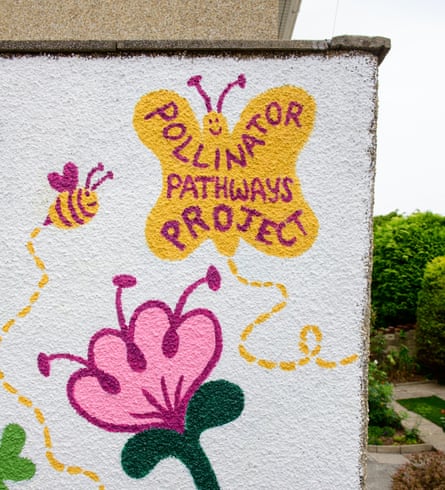
View image in fullscreenThe pollinator pathways project in Knowle, Bristol.
Photograph: Adrian Sherratt/The Guardian

The B-lines have already supported the population expansion of species such as the bilberry bumblebee in Shropshire and the small scabious mining bee in south-west England. Buglife invites pollinator projects to mark their initiatives across the insect superhighways on an online map, with more than 3,800 plotted so far.

The charity’s B-Lines officer, Rachel Richards, says the lines running north-south are particularly important for migrating species and those moving northwards as a result of the climate crisis.

“Reconnecting fragmented landscapes builds resilience,” she says. “As we see more fires and floods, it’s quite easy for an amazing site to be destroyed or partly destroyed. But if we have the stepping stones of wildflower-rich habitat, it can be colonised by insects from neighbouring sites.”

Back in Bristol, Beverley is hoping to expand her pollinator pathways project and make it as sustainable as possible. With hotter and drier summers expected, she has made sure to include a variety of hardy and drought-resistant plants in the alleyways. Weeds that might block accessibility are manually removed to prevent the council spraying herbicide.

After her videos of the alleyway transformations shared on social media attracted hundreds of thousands of views, she also plans to create a template for people outside Bristol to emulate.

In the meantime, the people living around the existing alleyways are eager to look after them. “The small amounts of litter that are dumped there get cleaned up really quickly because people know that it’s a wonderful space, and we want to keep it that way,” Beverley says. “It’s a bee buffet, and now the pollinators are coming in their masses.”

댓글

이 블로그의 인기 게시물

From our August Home and Garden publication: Columbia Gorge Beekeepers: Megachilinae / Leafcutter

 From our August Home and Garden publication: Columbia Gorge Beekeepers: Megachilinae / Leafcutter From our August Home and Garden publication: Columbia Gorge Beekeepers: Megachilinae / Leafcutter Summer is in full swing! Hopefully you have ventured outside exploring the flora that brings beauty to the Columbia Gorge area. Have you seen any native bees visiting their grocery store — the flowers and plants? Native bees are out foraging for nectar and pollen to support their brood (babies). Each egg must have a bit of nectar and a splash of pollen. Honey bees, on the other hand, forage not only for their brood but sustenance for the long winter months ahead. The native bee’s queen hibernates through the wintry season, only surviving one year. Thus, the need for nectar stores is unnecessary. There exists a symbiotic relationship between pollinators and the flora surrounding their habitat. The plants and flowers rely on pollinators to move pollen from the flower’s anther (male part) to...

She Was Dying—Then a Swarm of Stinging Bees Healed Her

She Was Dying—Then a Swarm of Stinging Bees Healed Her One sunny day, Ellie Lobel, who had a Ph.D. in nuclear physics and three children, was attacked by a horde of Africanized bees, commonly called “killer” bees. Lobel shielded her eyes and expected to have a deadly anaphylactic reaction, she said in a 2015 BBC article describing her experience. The 45-year-old English woman was in palliative care in California because she was dying from Lyme disease. She had stepped outside to experience some sunshine and peace when the bees attacked. Swollen and in pain, Lobel expected the end was imminent. At least, that’s what she thought. Fifteen years earlier, Lobel had unknowingly endured a tick bite. The tick carried the bacteria Borrelia burgdorferi, which causes Lyme disease. If caught in time, Lyme disease is treatable with antibiotics, though the bacteria are known to sneak around the immune system and even cause flare-ups long after apparent recovery. Borrelia burgdorferi can travel e...

BeeArc Project: Pioneering a Sustainable Future for Bees and Humans

BeeArc Project: Pioneering a Sustainable Future for Bees and Humans In the picturesque village of Goathland, near Whitby, a groundbreaking initiative, the £5m BeeArc project, has taken flight. Designed for environmental activists, concerned citizens, and curious minds, this project delves into the intricate challenges faced by honeybees and, by extension, humanity. In an era of unprecedented change and instability, the honeybee finds itself at a critical juncture. Colony Collapse Disorder, where bees abandon their hives en masse, has wreaked havoc globally, with a staggering 40% disappearance in the US in 2014. The crisis is not just a distant woe; it's affecting honeybees locally, threatening their very existence. James Fearnley, founder and project director, passionately states, “The honeybee is at the end of its tether. The colonies are literally falling apart.” Drawing on 30 years of research, Fearnley proposes a revolutionary approach – harnessing natural medicines from honeyb...

Non-contact exposure to dinotefuran disrupts honey bee homing by altering MagR and Cry2 gene expression

  Non-contact exposure to dinotefuran disrupts honey bee homing by altering  MagR  and  Cry2  gene expression Dinotefuran is known to negatively affect honeybee ( Apis mellifera ) behavior, but the underlying mechanism remains unclear. The magnetoreceptor ( MagR , which responds to magnetic fields) and cryptochrome ( Cry2 , which is sensitive to light) genes are considered to play important roles in honey bees’ homing and localization behaviors. Our study found that dinotefuran, even without direct contact, can act like a magnet, significantly altering  MagR  expression in honeybees. This non-contact exposure reduced the bees’ homing rate. In further experiments, we exposed foragers to light and magnetic fields, the  MagR  gene responded to magnetic fields only in the presence of light, with  Cry 2 playing a key switching role in the magnetic field receptor mechanism ( MagR–Cry2 ). Yeast two-hybrid and BiFc assays confirmed an interactio...

What to do if you see a bee on the ground, according to an expert

What to do if you see a bee on the ground, according to an expert You've no doubt seen bees buzzing around flowers or even nestling among blades of grass, but when you spot them chilling on the pavement it can raise various questions – not least: "Are they okay?" Even if they are still alive – the average lifespan of workers is just four to six weeks – bumblebees occasionally end up on the ground for of a variety of reasons. Amy Ross, a senior ecologist for Kent Wildlife Trust , explains to Yahoo UK why this happens and, more crucially, what you can do to help them. What type of bees are they? There are more than 250 species of bees native to the UK. (Getty Images) It's important to note that there are more than 250 species of bees native to the UK – 24 of which are bumblebees. Bumblebees can be identified using this helpful chart from the Bumblebee Conservation Trust and are more than likely the kind you'll spot on the ground. What's more, around 70% of th...

10 deadliest bees you should never mess with

  10 deadliest bees you should never mess with Bees play a vital role in pollination and ecosystems, but not all are the gentle garden visitors we imagine. Some bees—and wasp-like relatives—pack a powerful sting, show extreme aggression, or defend their nests with deadly force.  Whether it’s their painful venom, swarming behavior, or territorial nature, these species are not to be taken lightly. From tropical rainforests to suburban backyards, they command respect. In this list, we explore the world’s top 10 deadliest bee and bee-like species you should never provoke, complete with their nicknames, regions, threat levels, and evolutionary origins. Dangerous bees  found across the world including  Yellow Jacket , Warrior Wasp, and more 1. Africanised  Honey Bee  – “The Killer Bee” One of the most dangerous stinging insects in the world, the Africanised honey bee is found across South and Central America and parts of the southern U.S.  These bees are ext...

Suncheon Bay: A Triumph for Environmental Stewardship and Migratory Bird Conservation

  Suncheon Bay: A Triumph for Environmental Stewardship and Migratory Bird Conservation Nestled in the heart of Haeryong-myeon, Suncheon-si, Jeollanam-do, the scenic 92m high hill on the 1st of January provides a breathtaking panorama of Suncheon Bay. The awe of around 10 tourists is palpable as they gaze down from two Yongsan observatories onto the vast expanse below, where approximately 400 cranes gracefully take flight over 2,800 ha of pristine mudflats and reed fields. The Suncheon Bay Eco-Friendly Project In 2006, Suncheon City, in collaboration with its citizens, embarked on an ambitious eco-friendly project when Suncheon Bay earned recognition in the Ramsar Convention—an international treaty for wetland protection. Over the years, the project has yielded remarkable results, with the number of whooping cranes doubling in just four years. Preserving Biodiversity Through Strategic Initiatives To safeguard the ecosystem, preventive measures were implemented against diseases like...

The £15 Billion Climate Bill: The Screams of a Concrete Megacity and Its Structural Paradox

  The £15 Billion Climate Bill: The Screams of a Concrete Megacity and Its Structural Paradox     Subtitle : London’s suffocating dual crisis of urban heat islands and flash floods reveals a systemic mismatch between local responsibility and central funding. Adapting to the new normal demands an overhaul of urban planning, not just cosmetic greening. 1. Prologue: The Surface of the Crisis and the Hidden Paradox London, the cradle of the Industrial Revolution and the epicenter of modern global finance, is now confronting a profound climate paradox. A stark report by Central London Forward (CLF) warns that without "drastic action at all levels of government," the British capital could face an astronomical climate bill of up to £15 billion annually by 2050. This is not a distant, abstract warning; it is a tangible, compounding debt that has already begun eroding the city’s infrastructure and threatening the survival of its residents. The cruelest paradox of this climate shif...

Giant hail threat increases for Australian cities as climate warms

Giant hail threat increases for Australian cities as climate warms In short: Hailstorms will become more frequent in Brisbane, Sydney and Canberra, while the risk of "giant" hail will increase for others, including Melbourne and Perth. The new study by the University of New South Wales shows the relationships between a warming climate and the severity of hailstorms across most major Australian cities. What's next? The study's lead researcher, Dr Tim Raupach, says it is imperative to reduce emissions, but Australia also needs to consider the increased risk from hail damage in its building codes. The frequency of "giant" hail and the number of hail days in a season could increase substantially for multiple Australian cities as the climate warms, a new study has found. The University of New South Wales study modelled the severity of hailstorms for the current and future climate across Australia's most hail-prone major cities, including Brisbane, the Sydney...

Decoding the Cold: Understanding the Dynamics of Cold Snaps and Waves

  Decoding the Cold: Understanding the Dynamics of Cold Snaps and Waves As we brace ourselves for an impending cold snap, it's crucial to demystify the nuances between a fleeting chill and a more prolonged, impactful cold wave. Meteorologically speaking, these are two distinct phenomena, each with its own characteristics and potential consequences. 🌬️❄️ Cold Snap vs. Cold Wave:  🔄🌡️ When the cold lingers for a brief period, typically 1-2 days, we label it a cold snap. It's transient and relatively mild. However, when the cold persists for three days or more, spreading its influence far and wide, we term it a cold wave. This distinction is pivotal as it helps us gauge the severity and duration of the impending chill. Siberian Cold Snap: A Tidal Wave of Cold Waves:  🌊❄️ Drawing a metaphorical comparison to a tidal wave, the Siberian cold snap ebbs and flows, resembling the rhythmic patterns of a tide. This upcoming cold snap is poised to be a formidable cold wave, impac...