The scientist racing to save honeybees
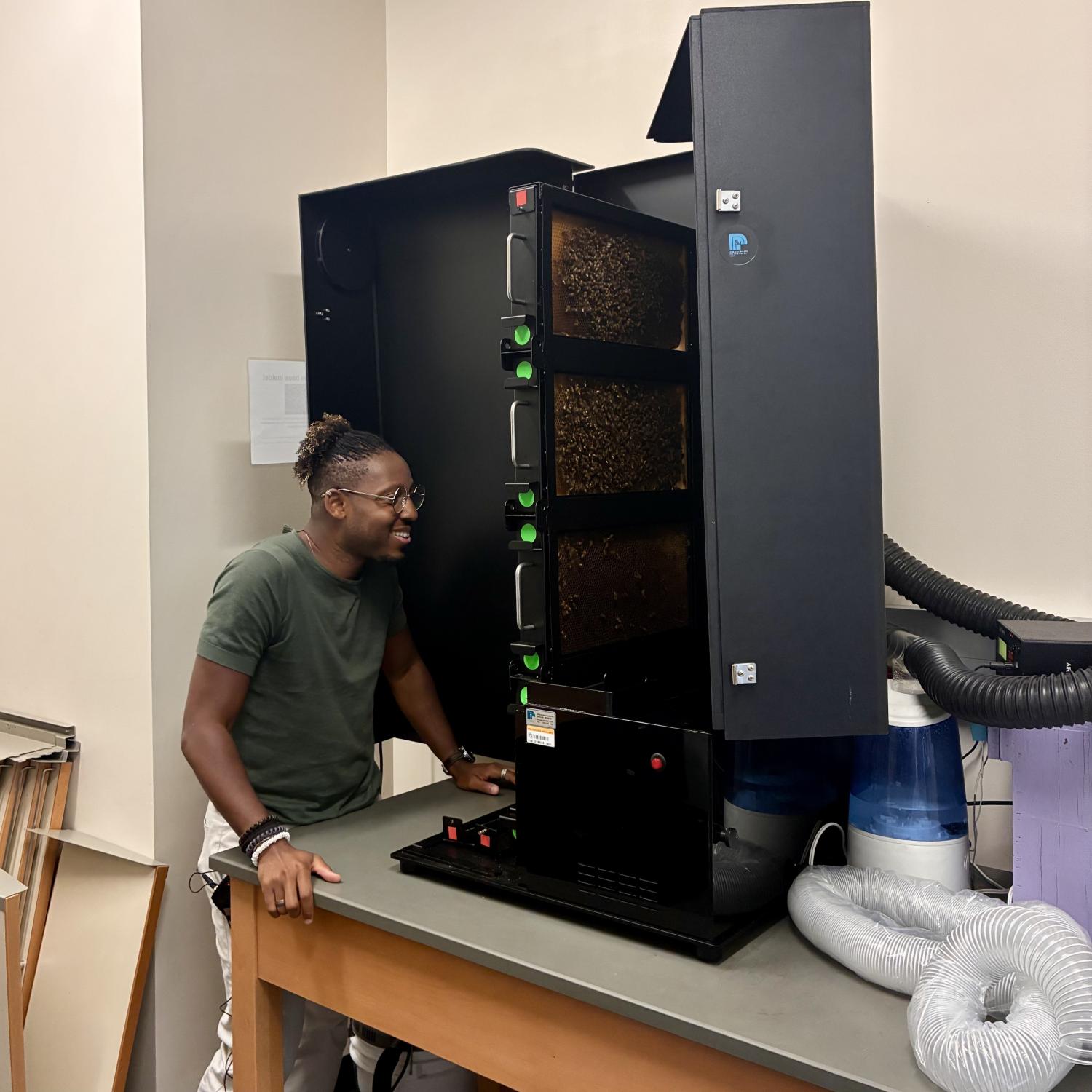
Credit: Credit: Patrick Campbell/CU Boulder
Samuel Ramsey is observing a hive he co-designed in his lab.
Newswise — July 2, 2025—Beekeepers across the United States have lost more than 62% of their honeybee colonies over the past winter, the worst die-off ever recorded. In some places, the number could reach 70%.
“We now have net losses of honeybees that will impact everything from honey production to foods that we consume on a regular basis,” said Samuel Ramsey, an entomologist in the Department of Ecology and Evolutionary Biology and the BioFrontiers Institute.
Ramsey added that a range of factors, including climate change, pesticides and nutritional deficiencies are likely contributing to the massive die-off. But at the heart of the crisis is a parasitic mite called Varroa destructor, which attacks bees’ fat bodies—the organ that regulates immunity, metabolism and pesticide tolerance.
Scientists have found that more than 98% of colonies in the United States already have varroa mites.
The parasite also makes all the other problems bees are dealing with worse. For example, the mites damage the honeybee’s ability to handle extreme temperatures. They also weaken the bee’s ability to fend off other bacterial or viral infections.
Ramsey and his team are searching for a solution. In recent years, they have traveled around the world to collect genetic data from every existing species of honeybee and to observe how they interact with their native parasites.
He has previously discovered that some honeybees in Southeast Asia, where varroa originated, are resistant to mites. The secret could lie in genes.
“Nature has done a spectacular job of solving problems that we are still trying to figure out how to solve. So instead of reinventing the wheel, it would be a much better idea for us to better conserve the organisms that have already figured out how to solve life's problems and study them,” Ramsey said.
There are also some actions people can take, he said. For example, planting native wildflowers could provide nutritious food for bees.
###
댓글
댓글 쓰기