Readers’ wildlife photos
Readers’ wildlife photos
We’re back, and with a text-and-photo contribution on beekeeping by Athayde Tonhasca Júnior. His prose is indented, and you can enlarge his photos by clicking on them.
No vacancies
Born in in the village of Breznica in the Austro-Hungarian empire (in today’s Slovenia), Anton Janša (1734-1773) would never have imagined that 20 May, his day of baptism (a proxy for his unknown birthday), would be celebrated around the world. Trained to be an artist, Anton’s true calling was honey bees. His innovative hive designs and books on beekeeping made him famous among his peers. In 2017, Slovenian beekeepers, backed by the Slovenian government, successfully lobbied the United Nations to designate 20 May as World Bee Day.
A 1973 postage stamp depicting Anton Janša © GetArchive:

Since then, more and more countries and people have joined World Bee Day celebrations. Inevitably, the event’s increasing visibility is a tempting opportunity for cashing in. As the day approaches, the more intense the peddling of bee-themed gin, beer, chocolate bars, fudge, skin creams, lip balms, clothing (“perfect for raising awareness”) and other items of marginal or imaginary connection to bees. The UN’s laudable initiative has another peculiarity: both the preservationist and commercialistic takes on World Bee Day focus largely on the European honey bee (Apis mellifera), giving limited coverage or ignoring altogether the ~20,000 other known species of bees, the members of the clade (a group of organisms sharing an ancestor) Anthophila. That’s unfortunate, as in many situations wild bees equal or surpass A. mellifera as providers of pollination services to wild plants and crops. Even more unfortunately, some initiatives towards the European honey bee are directed at self-promotion and public visibility, but are not guided by sound ecological principles.
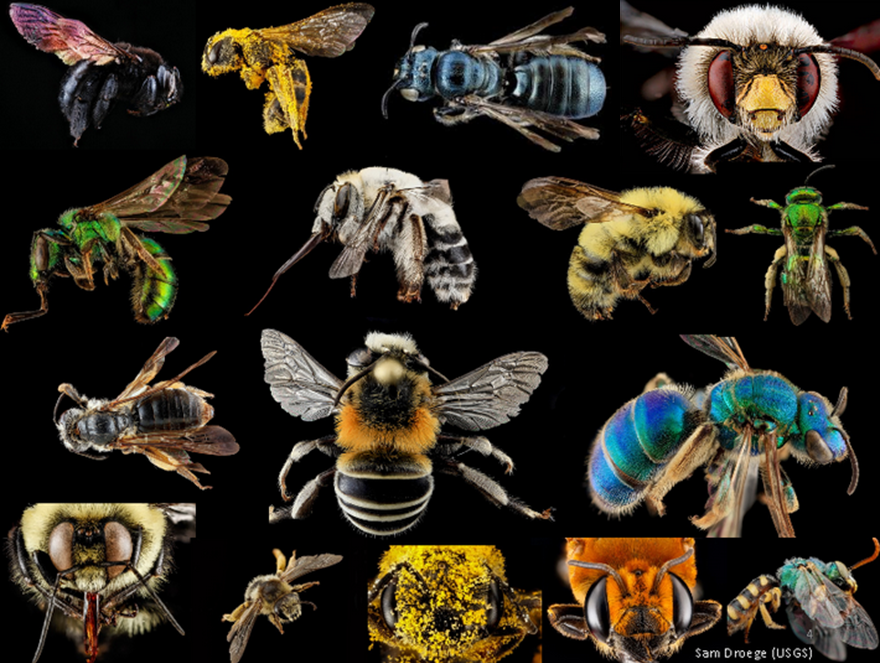
The clade Anthophila: essentially a group of vegetarian wasps (Engel et al., 2020) © USGS Native Bee Inventory and Monitoring Program:

Before we proceed, here’s a quiz: what do London’s Ritz Hotel, Buckingham Palace, Lambeth Palace and New York’s Empire State Building, Madison Square Garden and the Chrysler Building have in common, besides being famed? Answer: they all house apiaries on their roofs or adjacent structures. Rooftop beekeeping is not restricted to glamorous landmarks; roofs all over the world are being occupied by hives. The practice has been adopted by companies and organisations and enthusiastically publicised on World Bee Day. One commercial real estate business boasts having installed bee hives on some 2,500 buildings across North America and Europe for honey production and to serve as “biodiversity indicators”. Another property company gives away free hives to its clients “to help bees and boost office morale”.
A Rockefeller Center rooftop, home for thousands of honey bees © Jwilly77, Wikimedia Commons:

High-rise apiculture is perhaps the most stylish form of urban beekeeping, which is growing rapidly around the world. The activity accelerated in the mid-2000s, when we were bombarded daily with news about the imminent demise of honey bees, dragging mankind with them. Well-intentioned urbanites, concerned about the environment, honey bees and the future of humanity, saw beekeeping as an ideal way to help nature – a pleasant, virtuous hobby with a sweet reward with which to impress friends and neighbours.
Alas, the road towards these noble objectives has many potholes. The first is the misconception that the European honey bee is a species at risk. Despite the problems it faces in North America and Europe, beehives and beekeeping are thriving globally. Moreover, honey bees have been managed, moved around and selectively bred for thousands of years. For practical purposes, they are more appropriately treated as livestock than wildlife, an interpretation adopted by legal statutes around the world. The upshot is that a farm animal like the honey bee is not a suitable proxy for biodiversity.
Numbers of managed honey bee colonies, in millions, worldwide (A) and by geographical regions (B) © Osterman et al., 2021:

Honey bees are not endangered and are poor biodiversity indicators, but these are not good reasons to object to urban beekeeping. Trouble arises when there are too many honey bees.
Greater London is a good example of the problem. The city is packed with about 10 hives/km2 – for comparison, farmers keep 2.5 to 5 hives/km2 in crops highly dependent on pollinators such as almonds and apples. Each London hive needs the equivalent of 1 ha of borage (Borago officinalis) or 8.3 ha of lavender (Lavandula spp.) for their supplies of pollen and nectar (Alton & Ratnieks, 2016a): these figures are not sustainable for a significant portion of the city’s area. High hive densities and the proliferation of inexperienced beekeepers bring up another predicament: greater risk of diseases and parasites, which are the bane of honey bees around the world.
Estimated effect of beekeeping on a London’s 1-km grid based on available foraging plants (greenspaces) and number of honey bee colonies © Stevenson et al., 2020:

Honey bees taking food from each other is just the start of the problems caused by high numbers of hives.
When more than one species needs the same resource and there isn’t enough of it to go around, the species will compete for it. A growing body of evidence has shown that a range of wild bees get the raw end of the deal if they are forced to go up against honey bees for pollen and nectar. Honey bees forage up to 6 km from their nests, and they are very good at it. An average colony may collect up to 55 kg of pollen and hundreds of kilos of nectar every year, depending on floral abundance and climatic conditions (Seeley, 1985). These figures add up: a 40-hive apiary collects the pollen equivalent of four million wild bees at high season (June -August); that means that one hive gathers pollen sufficient to produce 100,000 progeny of an average solitary bee species (Cane & Tepedino, 2017).
The outcompeted wild bees are displaced or forced to shift to less rewarding plant species. Lower reproductive success, smaller body sizes and poor food gathering, all factors that reduce bees’ survival, are frequent outcomes of such interactions. These effects on wild pollinators have been recorded in London and other conurbations overcrowded with honey bees such as Berlin, Montreal, Paris and Zurich. Even more damming, more and more studies demonstrate that honey bees are vectors of parasites and diseases to wild bees, problems aggravated where honey bees are overabundant.
Effect of increasing honey bee abundance on species richness of all wild bees (A) and small wild bees (B) in Montreal, Canada. The coloured figures represent 95% confidence intervals © MacInnis et al., 2023:

Beekeeping promotes well-being, boosts confidence, enhances the feeling of accomplishment, creates opportunities for learning about the natural world and shared experiences with fellow beekeepers – besides the obvious asset of honey for pleasure or profit. But like many of life’s endeavours, there could be too much of a good thing. Densities of 3 to 3.5 hives/km2 have been suggested as precautionary levels to reduce honey bee impact on other species (MacInnis et al., 2023), but these figures are way lower than those found in cities around the world.
Beekeeping on U.S. Department of Agriculture headquarters rooftop in Washington, D.C. A healthy hive will house 50,000 bees by midsummer © USDA, Wikimedia Commons. U.S. Department of Agriculture (USDA) Agricultural Research Service Biological Science Technician Nathan Rice (in full bee protective suit and hat) and assisted by Biological Science Lab Technician Andy Ulsamer, they are the official beekeepers of the People’s Garden Apiary on the USDA Headquarters’ Whitten Building roof, in Washington, D.C., and are harvesting honey from two colonies on Friday, Sept. 5, 2014. The apiary serves to educate people about this type of pollinator.
These bees can be seen with the USDA Bee Watch camera stream video, of one of these colonies. The link to the camera and to learn more about this apiary and bees, please go to http://www.usda.gov/wps/portal/usda/usdahome?navid=usdabees.
USDA Photo by Lance Cheung.
Responsible beekeepers themselves have been warning about the harmful effects of unrestrained beekeeping on honey bees and wild bees, and have pointed out that creating/restoring/protecting flower patches are much more effective measures to help all pollinators. The rub is that planting flowers does not create the same opportunities for business and politicians to flaunt their green credentials.
In 2014, the Scottish Parliament announced to the world, with much fanfare, the installation of beehives on the building’s rooftop. Honey bee experts Karin Alton and Francis Ratnieks failed to be impressed: One cannot help but be cynical that the real motivation for the hive on the Scottish Parliament building was simply to give politicians a better image. As a way of helping honey bees it is of no value, and may well have had the unintended consequence of reinforcing the now widely held impression that politicians seem more concerned with spin over substance (Alton & Ratnieks, 2016b). Not to be outdone, the UK government quickly followed suit by placing a rooftop hive on, of all places, the headquarters of the department in charge of biodiversity and conservation (Defra). The purpose: “making its own contribution to combat bee declines”. You couldn’t make it up.
A genuine, disinterested bee guardian © Remember, Wikimedia Commons:

No vacancies
Born in in the village of Breznica in the Austro-Hungarian empire (in today’s Slovenia), Anton Janša (1734-1773) would never have imagined that 20 May, his day of baptism (a proxy for his unknown birthday), would be celebrated around the world. Trained to be an artist, Anton’s true calling was honey bees. His innovative hive designs and books on beekeeping made him famous among his peers. In 2017, Slovenian beekeepers, backed by the Slovenian government, successfully lobbied the United Nations to designate 20 May as World Bee Day.
A 1973 postage stamp depicting Anton Janša © GetArchive:

Since then, more and more countries and people have joined World Bee Day celebrations. Inevitably, the event’s increasing visibility is a tempting opportunity for cashing in. As the day approaches, the more intense the peddling of bee-themed gin, beer, chocolate bars, fudge, skin creams, lip balms, clothing (“perfect for raising awareness”) and other items of marginal or imaginary connection to bees. The UN’s laudable initiative has another peculiarity: both the preservationist and commercialistic takes on World Bee Day focus largely on the European honey bee (Apis mellifera), giving limited coverage or ignoring altogether the ~20,000 other known species of bees, the members of the clade (a group of organisms sharing an ancestor) Anthophila. That’s unfortunate, as in many situations wild bees equal or surpass A. mellifera as providers of pollination services to wild plants and crops. Even more unfortunately, some initiatives towards the European honey bee are directed at self-promotion and public visibility, but are not guided by sound ecological principles.
The clade Anthophila: essentially a group of vegetarian wasps (Engel et al., 2020) © USGS Native Bee Inventory and Monitoring Program:
Before we proceed, here’s a quiz: what do London’s Ritz Hotel, Buckingham Palace, Lambeth Palace and New York’s Empire State Building, Madison Square Garden and the Chrysler Building have in common, besides being famed? Answer: they all house apiaries on their roofs or adjacent structures. Rooftop beekeeping is not restricted to glamorous landmarks; roofs all over the world are being occupied by hives. The practice has been adopted by companies and organisations and enthusiastically publicised on World Bee Day. One commercial real estate business boasts having installed bee hives on some 2,500 buildings across North America and Europe for honey production and to serve as “biodiversity indicators”. Another property company gives away free hives to its clients “to help bees and boost office morale”.
A Rockefeller Center rooftop, home for thousands of honey bees © Jwilly77, Wikimedia Commons:


High-rise apiculture is perhaps the most stylish form of urban beekeeping, which is growing rapidly around the world. The activity accelerated in the mid-2000s, when we were bombarded daily with news about the imminent demise of honey bees, dragging mankind with them. Well-intentioned urbanites, concerned about the environment, honey bees and the future of humanity, saw beekeeping as an ideal way to help nature – a pleasant, virtuous hobby with a sweet reward with which to impress friends and neighbours.
Alas, the road towards these noble objectives has many potholes. The first is the misconception that the European honey bee is a species at risk. Despite the problems it faces in North America and Europe, beehives and beekeeping are thriving globally. Moreover, honey bees have been managed, moved around and selectively bred for thousands of years. For practical purposes, they are more appropriately treated as livestock than wildlife, an interpretation adopted by legal statutes around the world. The upshot is that a farm animal like the honey bee is not a suitable proxy for biodiversity.
Numbers of managed honey bee colonies, in millions, worldwide (A) and by geographical regions (B) © Osterman et al., 2021:

Honey bees are not endangered and are poor biodiversity indicators, but these are not good reasons to object to urban beekeeping. Trouble arises when there are too many honey bees.
Greater London is a good example of the problem. The city is packed with about 10 hives/km2 – for comparison, farmers keep 2.5 to 5 hives/km2 in crops highly dependent on pollinators such as almonds and apples. Each London hive needs the equivalent of 1 ha of borage (Borago officinalis) or 8.3 ha of lavender (Lavandula spp.) for their supplies of pollen and nectar (Alton & Ratnieks, 2016a): these figures are not sustainable for a significant portion of the city’s area. High hive densities and the proliferation of inexperienced beekeepers bring up another predicament: greater risk of diseases and parasites, which are the bane of honey bees around the world.
Estimated effect of beekeeping on a London’s 1-km grid based on available foraging plants (greenspaces) and number of honey bee colonies © Stevenson et al., 2020:

Honey bees taking food from each other is just the start of the problems caused by high numbers of hives.
When more than one species needs the same resource and there isn’t enough of it to go around, the species will compete for it. A growing body of evidence has shown that a range of wild bees get the raw end of the deal if they are forced to go up against honey bees for pollen and nectar. Honey bees forage up to 6 km from their nests, and they are very good at it. An average colony may collect up to 55 kg of pollen and hundreds of kilos of nectar every year, depending on floral abundance and climatic conditions (Seeley, 1985). These figures add up: a 40-hive apiary collects the pollen equivalent of four million wild bees at high season (June -August); that means that one hive gathers pollen sufficient to produce 100,000 progeny of an average solitary bee species (Cane & Tepedino, 2017).
The outcompeted wild bees are displaced or forced to shift to less rewarding plant species. Lower reproductive success, smaller body sizes and poor food gathering, all factors that reduce bees’ survival, are frequent outcomes of such interactions. These effects on wild pollinators have been recorded in London and other conurbations overcrowded with honey bees such as Berlin, Montreal, Paris and Zurich. Even more damming, more and more studies demonstrate that honey bees are vectors of parasites and diseases to wild bees, problems aggravated where honey bees are overabundant.
Effect of increasing honey bee abundance on species richness of all wild bees (A) and small wild bees (B) in Montreal, Canada. The coloured figures represent 95% confidence intervals © MacInnis et al., 2023:

Beekeeping promotes well-being, boosts confidence, enhances the feeling of accomplishment, creates opportunities for learning about the natural world and shared experiences with fellow beekeepers – besides the obvious asset of honey for pleasure or profit. But like many of life’s endeavours, there could be too much of a good thing. Densities of 3 to 3.5 hives/km2 have been suggested as precautionary levels to reduce honey bee impact on other species (MacInnis et al., 2023), but these figures are way lower than those found in cities around the world.
Beekeeping on U.S. Department of Agriculture headquarters rooftop in Washington, D.C. A healthy hive will house 50,000 bees by midsummer © USDA, Wikimedia Commons.
.jpg)
 U.S. Department of Agriculture (USDA) Agricultural Research Service Biological Science Technician Nathan Rice (in full bee protective suit and hat) and assisted by Biological Science Lab Technician Andy Ulsamer, they are the official beekeepers of the People’s Garden Apiary on the USDA Headquarters’ Whitten Building roof, in Washington, D.C., and are harvesting honey from two colonies on Friday, Sept. 5, 2014. The apiary serves to educate people about this type of pollinator.
These bees can be seen with the USDA Bee Watch camera stream video, of one of these colonies. The link to the camera and to learn more about this apiary and bees, please go to http://www.usda.gov/wps/portal/usda/usdahome?navid=usdabees.
USDA Photo by Lance Cheung.
Responsible beekeepers themselves have been warning about the harmful effects of unrestrained beekeeping on honey bees and wild bees, and have pointed out that creating/restoring/protecting flower patches are much more effective measures to help all pollinators. The rub is that planting flowers does not create the same opportunities for business and politicians to flaunt their green credentials.
In 2014, the Scottish Parliament announced to the world, with much fanfare, the installation of beehives on the building’s rooftop. Honey bee experts Karin Alton and Francis Ratnieks failed to be impressed: One cannot help but be cynical that the real motivation for the hive on the Scottish Parliament building was simply to give politicians a better image. As a way of helping honey bees it is of no value, and may well have had the unintended consequence of reinforcing the now widely held impression that politicians seem more concerned with spin over substance (Alton & Ratnieks, 2016b). Not to be outdone, the UK government quickly followed suit by placing a rooftop hive on, of all places, the headquarters of the department in charge of biodiversity and conservation (Defra). The purpose: “making its own contribution to combat bee declines”. You couldn’t make it up.
A genuine, disinterested bee guardian © Remember, Wikimedia Commons:


대화 참여하기