Let's talk about sex and the secret lives of honey bees
As Brian Scott tells it, the social structure of the honey bee is a striking mix of leadership, productivity and inactivity marked by brutal death — all depending upon sex.
Scott started working with bees as a hobbyist, just like the vast majority of beekeepers. He eventually separated from the corporate world, found a nice piece of land and launched Innisfil Creek Honey, where he works with his daughter and his wife and a seasonal full-time staff of six or seven others.
From there, he runs a business raising bees, keeping hives across Simcoe County to produce honey, bringing bees to farms where they pollinate crops, teaches beekeeping workshops and sells beekeeping supplies. They also collect bee pollen, create cosmetics from beeswax and create different varieties of honey.
“Our primary goal is breeding bees and providing bees to other beekeepers,” he explains. “We do a lot of teaching and mentoring … we teach about 300 new beekeepers annually and then we mentor about 3,000 people nationwide.”
An interesting aspect of the business is trucking the bees to local farms where they ‘hyper-pollinate’ crops, such as blueberries, which could double or even triple the yield. Collecting nectar from flowers is a byproduct of the pollination process through which they produce honey.
But even though Innisfil Creek Honey produces 160,000 pounds of honey every year, honey is not its primary focus.
It’s the bees, which they supply to honey beekeepers, that gets the primary attention. Their focus is to produce healthy bees to populate hives, which can each contain up to 60,000 bees.
Innisfil Creek runs 800 hives, with about 50,000 bees each — that adds up to about 40 million bees.
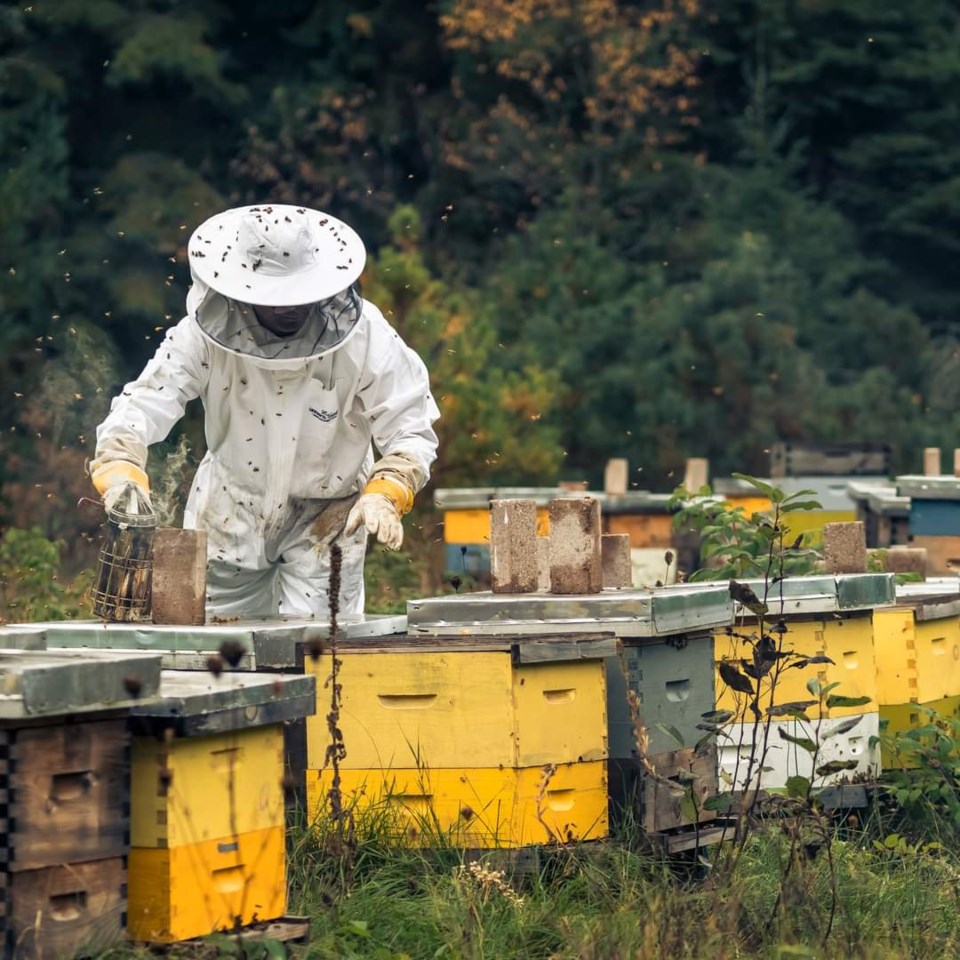 Brian Scott of Innisfil Creek Honey tends to his hives. | Image supplied
Since every one of those bees is a pollinator, the business’s secondary goal is providing bees for pollination which then provide the end product: the honey.
The focus on bee health, says Scott, results in a healthy honey harvest at the end of the year. He does that by locating the bees in sensitive locations, free of herbicides, pesticides and other dangers.
There’s an added benefit for any farmers in the area where the bees often help pollinate the crops.
The locations are chosen to ensure they’re safe for bees and that there are enough food resources, such as flowers, pastures, hay fields, ditches for the flowers and trees, either in forested areas or naturalized pastures, for proper nutrition.
The process includes monitoring for diseases and pest monitoring for parasites.
Scott, like most beekeepers, began working with bees as a hobby while he worked as an accountant and business manager. He was at it for well over a dozen years when the day job came to an end, providing the opportunity to turn his hobby into a business.
He describes it as a simple process that's easy to teach to others.
The key to bees is ensuring not to overpopulate a specific geographic area to ensure bees are not competing with each other for flowers, which is their food source. So Scott has hives on properties across the area, ensuring there are no more than 50 hives within five kilometres of other hives.
Instead of paying rent, he pays property owners with honey.
“Most people are happy to have bees on their property … and they’re happy to get a it of honey off their property without having to do the work," he says.
The vast majority of hives — some 95 per cent or more — consist of worker bees, who are all female. They raise the young, do all the pollination and keep the hives safe all in a life span of 45 days, but can live up to five months in the winter when they’re not working.
Every hive, of course, has a queen bee, which is bred specifically to be in charge. She produces all the eggs needed to populate the hives, laying up to 1,500 eggs in a day, beginning in the spring after mating once and slowing down in the fall.
And she can live up to five years.
She has a special process to raise the queen bee by laying the egg in a cell of the hive, carefully feeding it so it grows faster and larger.
New hives are created when half the bees fly out before the new queen hatches.
Drone or male bees are created in the spring and represents about five per cent of the bees in a hive. They mate in flight with the queen been and then promptly die.
Innisfil Creek is a large operation as far as beekeeping goes. Scott figures he needs 500 bee hives to make a living.
“The bee is very fun to work with and fascinating,” he says.
Honey is available at Innisfil Creek Honey on 10 Sideroad in the Cookstown area, Tuesday to Saturdays, with a self-serve honey shop always open at the gate. It’s also available at the 400 Market and local grocery stores.

댓글
댓글 쓰기