기본 콘텐츠로 건너뛰기

HEADLINE DESK

DKBEE.COM 최신 주요 리포트

최신 기사를 불러오는 중입니다...

LATEST INSIGHTS

분야별 심층 분석

Devastation on repeat: How climate change is worsening Pakistan's deadly floods


Devastation on repeat: How climate change is worsening Pakistan's deadly floods


Rescuers and relatives searched knee-deep in water for the body of one-year-old Zara. She'd been swept away by flash floods; the bodies of her parents and three siblings had already been found days earlier.

"We suddenly saw a lot of water. I climbed up to the roof and urged them to join me," Arshad, Zara's grandfather, said, showing the BBC the dirt road where they were taken from him in the village of Sambrial in northern Punjab in August.

His family tried to join him, but too late. The powerful current washed away all six of them.

Every year, monsoon season brings deadly floods in Pakistan.

This year it began in late June, and within three months, floods had killed more than 1,000 people. At least 6.9  million were affected, according to the United Nations agency for humanitarian affairs, OCHA.

The South Asian nation is struggling with the devastating consequences of climate change, despite emitting just 1% of global greenhouse gas emissions.

To witness its effects, the BBC travelled from the mountains of the north to the plains of the south for three months. In every province, climate change was having a different impact.

There was one element in common, though. The poorest suffer most.

We met people who'd lost their homes, livelihoods and loved ones – and they were resigned to going through it all again in the next monsoon.

Lakebursts and flash floods
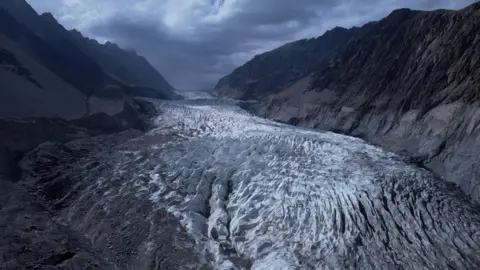
There are more than 7,000 glaciers in the high peaks of the Himalayas, Karakoram and Hindu Kush


Monsoon floods started in the north, with global warming playing out in its most familiar form in Pakistan-administered Gilgit-Baltistan.

Amid the high peaks of the Himalayas, Karakoram and Hindu Kush, there are more than 7,000 glaciers. But due to rising temperatures, they are melting.

The result can be catastrophic: meltwater turns into glacial lakes which can suddenly burst. Thousands of villages are at risk.

This summer hundreds of homes were destroyed and roads damaged by landslides and flash floods.

These "glacial lake outbursts" are hard to warn against. The area is remote and mobile service poor. Pakistan and the World Bank are trying to improve an early warning system, which often doesn't work because of the mountainous terrain.

Community is a powerful asset. When shepherd Wasit Khan woke up to rushing waters, with trailing chunks of ice and debris, he ran to an area with a better signal. He began warning as many villagers as he could.

"I told everyone to leave their belongings, leave the house, take their wives, children and elderly people and get away," he told BBC Urdu's Muhammad Zubair.

Thanks to him, dozens were saved.


The danger took a different form in the north-western province of Khyber Pakhtunkhwa.

In Gadoon, the BBC found hundreds of villagers digging through piles of rocks with their bare hands.

A cloudburst had caused a flash flood early in the morning, a local official said. That happens when a sudden updraft in humid, moist air leads to a heavy and localised burst of rain. The current washed away several homes and triggered a landslide.

Men from neighbouring villages rushed over to help, which was invaluable – but not enough. The excavators the villagers desperately needed were trapped in flooded roads, some blocked by massive rocks.

"Nothing will happen until the machines arrive," one man told the BBC.

Then a silence suddenly blanketed the area. Dozens of men stood still in one corner. The bodies of two children, soaked in dark mud, were pulled from under the rubble, and carried away.
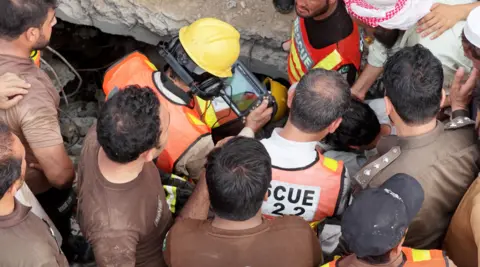
Rescuers and villagers search for survivors, after a flash flood swept away several houses in the village of Gadoon, in the province of Khyber Pakhtunkhwa


Scenes like this played out across the province, with rescuers delayed due to uprooted trees and major infrastructure being destroyed. A helicopter carrying aid crashed in the bad weather, claiming the lives of all crew on board.

Building on Pakistan's floodplains


In villages and cities, millions have settled around rivers and streams, areas prone to flooding. Pakistan's River Protection Act - which prohibits building within 200 ft (61m) of a river or its tributaries - was meant to solve that issue. But for many it's simply too costly to settle elsewhere.

Illegal construction makes matters worse.

Climate scientist Fahad Saeed blames this on local corruption and believes officials are failing to enforce the law. He spoke to the BBC in Islamabad, next to a half-built, four-storey concrete building as big as a car park - and right by a stream that he saw flood this summer, killing a child.
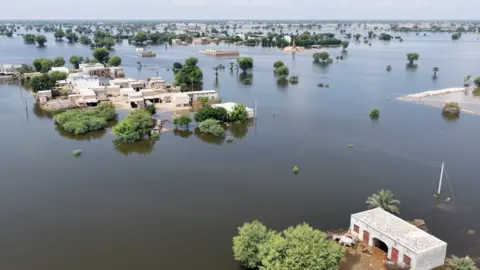
Pakistan has laws in place banning building near rivers, hoping to avoid homes like these being flooded in future


"Just a few kilometres from parliament and still such things happen in Pakistan," he says, visibly frustrated. "It's because of misgovernance, the role of the government is to be a watchdog."

Former climate minister Senator Sherry Rehman, who chairs the climate committee in Pakistan's Senate, calls it "graft", or simply "looking the other way" when permissions are given for construction in vulnerable areas.

The country's breadbasket submerged


By late August, further south in the province of Punjab, floods had submerged 4,500 villages, overwhelming "Pakistan's breadbasket", in a country that can't always afford to import enough food.

For the first time, three rivers - the Sutlej, Ravi and Chenab - flooded simultaneously, triggering the largest rescue operation in decades.

"It was the most important anomaly," said Syed Muhammad Tayyab Shah, the chief risk officer for the National Disaster Management Authority (NDMA).


In Punjab's capital, Lahore, the impact on wealthier and poorer communities was stark. The gated community of Park View City was inundated by the Ravi river, making its prized streets impossible to navigate. Residents of luxury homes were forced to evacuate.

Surveying the damage, two local men, Abdullah and his father Gulraiz, were convinced water would be drained soon, thanks to the area's property developer Aleem Khan, a federal minister.

"No problem, Aleem Khan will do it," Gulraiz told the BBC.

But for residents in the poorer neighbourhood of Theme Park, the floods were crushing. One officer told the BBC they kept having to rescue people who swam back to their homes when the water levels dropped, desperate to salvage whatever they could. But then the water would rise, leaving them stranded.

We saw one man returning from his house, an inflatable donut resting on his hip.
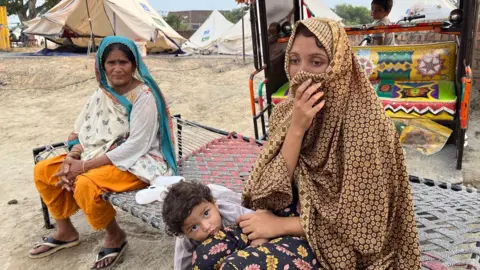
Sumera's home in Lahore's Theme Park neighbourhood was flooded. Weeks away from giving birth, she is living in a tent with her son Arsh


Some residents were moved to tents provided by the Alkhidmat Foundation Pakistan. Sitting outside in the summer heat, Sumera was weeks away from giving birth. She was extremely thin.

"My doctor says I need two blood transfusions this week," she said as she tried to keep hold of her toddler, Arsh.

Nearby, Ali Ahmad was balancing a small kitten he rescued from the floods on his shoulder. The boy was one of the few who had a mattress to sleep on.


By the end of monsoon season, the floods had displaced more than 2.7 million people in Punjab, the UN said, and damaged more than one million hectares of farmland.

Further south in Multan district, always hit hard by floods, the scale of the humanitarian crisis became even clearer, with tents lining dirt roads and highways.

Access to healthcare was already a challenge in rural areas of Pakistan, but once the floods hit, the challenge was unbearable for many women we met.

BBC Urdu's Tarhub Asghar met two sisters-in-law, both nine months pregnant. A doctor had warned them they weren't drinking enough water. They raised a bottle to explain. The water was completely brown.

The search for solutions

Yasmeen Lari has built homes she says are "climate-resilient" and made of natural materials such as bamboo and lime cement


Some are trying different solutions.

Architect Yasmeen Lari has designed what she calls "climate-resilient houses" in dozens of villages. In Pono, near Hyderabad, women showed the BBC huts they'd built themselves - a large circular building on wooden stilts. Dr Lari calls it their training centre and says families can move their belongings there and shelter.

But Dr Lari argues building an entire village on stilts would be unfeasible and too expensive. Instead, she says her designs ensure the roofs don't collapse, and that by using natural materials such as bamboo and lime concrete, the homes can be rebuilt quickly by the villagers themselves.

Pakistan has reached a point where "it's not about saving buildings; it's about saving lives," she says.

This is the reality for Pakistan. All the climate scientists and politicians the BBC spoke to warn of an increasingly worrying future.

"Every year the monsoon will become more and more aggressive," Syed Muhammad Tayyab Shah at the NDMA said. "Every year, there will be a new surprise for us."

As the country faces the growing and ever-changing challenges posed by climate change, in which the poorest are often the worst affected, there is one refrain from people returning to homes likely to flood next year: "I have nowhere else to go."

댓글

이 블로그의 인기 게시물

From our August Home and Garden publication: Columbia Gorge Beekeepers: Megachilinae / Leafcutter

 From our August Home and Garden publication: Columbia Gorge Beekeepers: Megachilinae / Leafcutter From our August Home and Garden publication: Columbia Gorge Beekeepers: Megachilinae / Leafcutter Summer is in full swing! Hopefully you have ventured outside exploring the flora that brings beauty to the Columbia Gorge area. Have you seen any native bees visiting their grocery store — the flowers and plants? Native bees are out foraging for nectar and pollen to support their brood (babies). Each egg must have a bit of nectar and a splash of pollen. Honey bees, on the other hand, forage not only for their brood but sustenance for the long winter months ahead. The native bee’s queen hibernates through the wintry season, only surviving one year. Thus, the need for nectar stores is unnecessary. There exists a symbiotic relationship between pollinators and the flora surrounding their habitat. The plants and flowers rely on pollinators to move pollen from the flower’s anther (male part) to...

She Was Dying—Then a Swarm of Stinging Bees Healed Her

She Was Dying—Then a Swarm of Stinging Bees Healed Her One sunny day, Ellie Lobel, who had a Ph.D. in nuclear physics and three children, was attacked by a horde of Africanized bees, commonly called “killer” bees. Lobel shielded her eyes and expected to have a deadly anaphylactic reaction, she said in a 2015 BBC article describing her experience. The 45-year-old English woman was in palliative care in California because she was dying from Lyme disease. She had stepped outside to experience some sunshine and peace when the bees attacked. Swollen and in pain, Lobel expected the end was imminent. At least, that’s what she thought. Fifteen years earlier, Lobel had unknowingly endured a tick bite. The tick carried the bacteria Borrelia burgdorferi, which causes Lyme disease. If caught in time, Lyme disease is treatable with antibiotics, though the bacteria are known to sneak around the immune system and even cause flare-ups long after apparent recovery. Borrelia burgdorferi can travel e...

BeeArc Project: Pioneering a Sustainable Future for Bees and Humans

BeeArc Project: Pioneering a Sustainable Future for Bees and Humans In the picturesque village of Goathland, near Whitby, a groundbreaking initiative, the £5m BeeArc project, has taken flight. Designed for environmental activists, concerned citizens, and curious minds, this project delves into the intricate challenges faced by honeybees and, by extension, humanity. In an era of unprecedented change and instability, the honeybee finds itself at a critical juncture. Colony Collapse Disorder, where bees abandon their hives en masse, has wreaked havoc globally, with a staggering 40% disappearance in the US in 2014. The crisis is not just a distant woe; it's affecting honeybees locally, threatening their very existence. James Fearnley, founder and project director, passionately states, “The honeybee is at the end of its tether. The colonies are literally falling apart.” Drawing on 30 years of research, Fearnley proposes a revolutionary approach – harnessing natural medicines from honeyb...

Non-contact exposure to dinotefuran disrupts honey bee homing by altering MagR and Cry2 gene expression

  Non-contact exposure to dinotefuran disrupts honey bee homing by altering  MagR  and  Cry2  gene expression Dinotefuran is known to negatively affect honeybee ( Apis mellifera ) behavior, but the underlying mechanism remains unclear. The magnetoreceptor ( MagR , which responds to magnetic fields) and cryptochrome ( Cry2 , which is sensitive to light) genes are considered to play important roles in honey bees’ homing and localization behaviors. Our study found that dinotefuran, even without direct contact, can act like a magnet, significantly altering  MagR  expression in honeybees. This non-contact exposure reduced the bees’ homing rate. In further experiments, we exposed foragers to light and magnetic fields, the  MagR  gene responded to magnetic fields only in the presence of light, with  Cry 2 playing a key switching role in the magnetic field receptor mechanism ( MagR–Cry2 ). Yeast two-hybrid and BiFc assays confirmed an interactio...

10 deadliest bees you should never mess with

  10 deadliest bees you should never mess with Bees play a vital role in pollination and ecosystems, but not all are the gentle garden visitors we imagine. Some bees—and wasp-like relatives—pack a powerful sting, show extreme aggression, or defend their nests with deadly force.  Whether it’s their painful venom, swarming behavior, or territorial nature, these species are not to be taken lightly. From tropical rainforests to suburban backyards, they command respect. In this list, we explore the world’s top 10 deadliest bee and bee-like species you should never provoke, complete with their nicknames, regions, threat levels, and evolutionary origins. Dangerous bees  found across the world including  Yellow Jacket , Warrior Wasp, and more 1. Africanised  Honey Bee  – “The Killer Bee” One of the most dangerous stinging insects in the world, the Africanised honey bee is found across South and Central America and parts of the southern U.S.  These bees are ext...

What to do if you see a bee on the ground, according to an expert

What to do if you see a bee on the ground, according to an expert You've no doubt seen bees buzzing around flowers or even nestling among blades of grass, but when you spot them chilling on the pavement it can raise various questions – not least: "Are they okay?" Even if they are still alive – the average lifespan of workers is just four to six weeks – bumblebees occasionally end up on the ground for of a variety of reasons. Amy Ross, a senior ecologist for Kent Wildlife Trust , explains to Yahoo UK why this happens and, more crucially, what you can do to help them. What type of bees are they? There are more than 250 species of bees native to the UK. (Getty Images) It's important to note that there are more than 250 species of bees native to the UK – 24 of which are bumblebees. Bumblebees can be identified using this helpful chart from the Bumblebee Conservation Trust and are more than likely the kind you'll spot on the ground. What's more, around 70% of th...

Suncheon Bay: A Triumph for Environmental Stewardship and Migratory Bird Conservation

  Suncheon Bay: A Triumph for Environmental Stewardship and Migratory Bird Conservation Nestled in the heart of Haeryong-myeon, Suncheon-si, Jeollanam-do, the scenic 92m high hill on the 1st of January provides a breathtaking panorama of Suncheon Bay. The awe of around 10 tourists is palpable as they gaze down from two Yongsan observatories onto the vast expanse below, where approximately 400 cranes gracefully take flight over 2,800 ha of pristine mudflats and reed fields. The Suncheon Bay Eco-Friendly Project In 2006, Suncheon City, in collaboration with its citizens, embarked on an ambitious eco-friendly project when Suncheon Bay earned recognition in the Ramsar Convention—an international treaty for wetland protection. Over the years, the project has yielded remarkable results, with the number of whooping cranes doubling in just four years. Preserving Biodiversity Through Strategic Initiatives To safeguard the ecosystem, preventive measures were implemented against diseases like...

Giant hail threat increases for Australian cities as climate warms

Giant hail threat increases for Australian cities as climate warms In short: Hailstorms will become more frequent in Brisbane, Sydney and Canberra, while the risk of "giant" hail will increase for others, including Melbourne and Perth. The new study by the University of New South Wales shows the relationships between a warming climate and the severity of hailstorms across most major Australian cities. What's next? The study's lead researcher, Dr Tim Raupach, says it is imperative to reduce emissions, but Australia also needs to consider the increased risk from hail damage in its building codes. The frequency of "giant" hail and the number of hail days in a season could increase substantially for multiple Australian cities as the climate warms, a new study has found. The University of New South Wales study modelled the severity of hailstorms for the current and future climate across Australia's most hail-prone major cities, including Brisbane, the Sydney...

Decoding the Cold: Understanding the Dynamics of Cold Snaps and Waves

  Decoding the Cold: Understanding the Dynamics of Cold Snaps and Waves As we brace ourselves for an impending cold snap, it's crucial to demystify the nuances between a fleeting chill and a more prolonged, impactful cold wave. Meteorologically speaking, these are two distinct phenomena, each with its own characteristics and potential consequences. 🌬️❄️ Cold Snap vs. Cold Wave:  🔄🌡️ When the cold lingers for a brief period, typically 1-2 days, we label it a cold snap. It's transient and relatively mild. However, when the cold persists for three days or more, spreading its influence far and wide, we term it a cold wave. This distinction is pivotal as it helps us gauge the severity and duration of the impending chill. Siberian Cold Snap: A Tidal Wave of Cold Waves:  🌊❄️ Drawing a metaphorical comparison to a tidal wave, the Siberian cold snap ebbs and flows, resembling the rhythmic patterns of a tide. This upcoming cold snap is poised to be a formidable cold wave, impac...

“Global honey crisis”: Testing technology and local sourcing soars amid fraud and tampering concerns

  “Global honey crisis”: Testing technology and local sourcing soars amid fraud and tampering concerns The World Beekeeping Awards will not grant a prize for honey next year due to the “inability” to thoroughly test honey for adulteration. The announcement comes amid the rise of honey fraud in the EU, where a 2023 investigation found that 46% of 147 honey samples tested were likely contaminated with low-cost plant syrups.  Apimondia, the International Federation of Beekeepers’ Associations, organizes the event at its Congress, whose 49th edition will be held in Copenhagen, Denmark, in September 2025. The conference brings together beekeepers, scientists and other stakeholders. “We will celebrate honey in many ways at the Congress, but honey will no longer be a category, and thus, there will be no honey judging in the World Beekeeping Awards. The lessons learned from Canada 2019 and Chile 2023 were that adequate testing was impossible if we are to award winning honey at the Con...