Quantifying the regional to global climate impacts of individual fossil fuel projects to inform decision-making
Quantifying the regional to global climate impacts of individual fossil fuel projects to inform decision-making
Abstract
Every additional tonne of carbon dioxide emissions adds to global warming1. This means that decisions to approve new fossil fuel projects represent pivotal moments in shaping Earth’s future climate trajectory. Yet, the specific additional global warming caused by project-level CO2 emissions, and the impacts of that warming, are rarely incorporated into decision-making on the acceptability of new fossil fuel projects. Here, we show how quantifying this additional warming enables concrete, foreseeable consequences to be identified and evaluated in a formal risk assessment framework. This approach reveals that major socioeconomic and environmental consequences can be attributed to CO2 emissions associated with individual fossil fuel projects, contrary to the pervasive unquantified claims of negligible risks by project proponents. Furthermore, as countries pursue rapid decarbonisation aligned to their Nationally Determined Contributions, the CO2 emissions from individual fossil fuel projects can, within decades, dominate and even exceed legislated national emission limits. The practical, future-focused approaches demonstrated here offer a critical bridge between climate science and decision-making, with immediate relevance to choices that will shape Earth’s climate for decades to centuries to come.
Introduction
Earth’s climate over the coming decades to centuries will be determined by cumulative global emissions of carbon dioxide (CO2)1 (Fig.1a). Limiting global CO2 emissions, and thereby limiting global warming, relies on cooperation, commitments and actions towards emission reductions that are implemented at national and sub-national scales2. Within these jurisdictions, the approval/permitting of new or extended fossil fuel extraction occurs on a project-by-project basis. This means that decisions with long-term commitments to future CO2 emissions and their consequences are made at a project-level, which on their own can appear to be too small to significantly influence global climate change. This raises a fundamental question in the nexus between science and decision-making: if every project is considered too small to matter, does that imply that no individual project bears responsibility for any climate change consequences?

a The near-linear relationship between cumulative CO2 emissions and human-caused global warming demonstrated for historical data (1850–2019) and future emission scenarios synthesised across the multi-model mean of CMIP6 simulations (2014–2050). Future scenarios are based on Shared Socioeconomic Pathways (SSPs) ranging from very low emissions (SSP1-1.9) to very high emissions (SSP5-8.5) futures. Data are from Fig. SPM.10 of ref. 1. b The same near-linear relationship is also evident for annual CO2 emissions and the additional human-caused warming each year, derived from the same datasets. Grey line in both panels shows the IPCC best estimate of the TCRE (0.45 °C of warming caused by 1000 GtCO2) and grey shading shows the 66–100% likelihood range of the TCRE (0.27 °C to 0.63 °C of warming caused by 1000 GtCO2).
Approval of new or extended fossil fuel projects considers many factors, including their anticipated greenhouse gas emissions. For example, in Australia, one of the world’s major fossil fuel producers3, the proponents of new fossil fuel projects are required to submit project proposals that detail their anticipated greenhouse gas emissions and associated impacts. There are established protocols for calculating and reporting greenhouse gas emissions of fossil fuel production and use4. However, there is no required or best-practice framework for quantifying the consequences of these anticipated emissions. Across a range of project proposals under various Australian jurisdictions, and multiple proponents including global carbon majors5,6, we demonstrate three pervasive areas where a climate-science basis is currently lacking in fossil fuel project proposal documents (Supplementary Table 1). Firstly, proponents consistently describe their project-level greenhouse gas emissions as negligible in the context of global emissions and as having an unquantifiable contribution to global warming. Secondly, because their global warming contribution is unquantified and assumed negligible, the climate change impacts of individual projects are also unquantified and assumed to be inconsequential. And thirdly, descriptions of project contributions to national or global emissions inventories fail to incorporate committed decarbonisation trajectories over the lifecycle of the proposed projects. Given the immediate risks of climate change, and the deep emission reductions required to meet national and international climate mitigation commitments, there is an urgent need for science-based tools that can support decision-making. Specifically, science-based approaches are needed to quantify the context and consequences of new fossil fuel projects at the point of their approval.
Bridging the divide between scientific evidence and decision-making requires frameworks that link greenhouse gas emissions to tangible consequences. The historical responsibility for climate warming, and its economic damages, has been established for nations7 and major fossil fuel companies6. The economic costs of future climate warming and associated changes in climate variability and extremes have also been projected8,9, and are expected to disproportionately impact poorer, low-latitude countries that are also often the least responsible for climate change. Scientific progress in quantifying and attributing climate change consequences is underpinning litigation claims worldwide6,10. But there remains a divide in bringing actionable scientific evidence into decision-making at a level that can play a role in reducing future climate harms. Using a case study approach, we demonstrate a simple and robust method for quantifying the additional global warming that can be anticipated from the CO2 emissions of individual fossil fuel projects. This is a critical step that then enables the specific, tangible consequences of a project to be quantified, which in turn can be used to assess whether the project’s risks are acceptable. We further illustrate the time-evolving context of project-level CO2 emissions with respect to Nationally Determined Contributions (NDC) to climate change mitigation, which enables proposals for new or extended fossil fuel projects to be evaluated alongside concurrent commitments to rapid emission reductions. The novelty and potential impact of our future-focused, project-level framework is that it brings the best-available scientific evidence into decision-making at the point where decisions are being made now that will commit future CO2 emissions for many decades to come. These are the decision points that will be critical to setting the world’s future climate trajectory.
Results
Quantifying CO2-induced warming
The IPCC 6th Assessment Report states that every additional tonne of CO2 emissions adds to global warming1. Following IPCC protocols, this statement in the Summary for Policymakers has been approved by all 195 IPCC member governments as an accurate representation of the scientific evidence assessed by the IPCC11. The statement is made in the context of evidence for the ‘Transient Climate Response to CO2 Emissions’ (TCRE); a simple yet robust metric that connects the primary cause of climate change (CO2 emissions) to its principal measure (the change in global mean surface temperature)12 (Fig. 1a). The IPCC assesses that the best estimate of the TCRE is that every 1000 billion tonnes (gigatonnes; Gt) of CO2 emissions causes 0.45 °C of additional warming, with a 66–100% likelihood of warming between 0.27 °C to 0.63 °C1. The robust evidence for this TCRE relationship spans process understanding, direct observations and climate model simulations11. The TCRE has been defined based on global cumulative CO2 emissions since 1850. It is the primary basis for determining the remaining carbon budgets that must not be exceeded if global warming is to be limited to particular policy relevant thresholds2,13,14, including the 1.5 °C ambition and the well-below 2 °C goal of the Paris Agreement15.
The near-linear increase in global temperatures due to ongoing CO2 emissions is expected (with high confidence) to continue over this century and for global warming up to at least 2 °C11. This is regardless of the intensity of future emissions, and includes the emission reduction pathways required to limit warming to well-below 2 °C (e.g., SSP1-1.9 and SSP1-2.6 emission scenarios; Fig. 1a). CO2 is well-mixed and long-lived in the atmosphere (Methods), and zero-CO2 emission scenarios demonstrate that the global warming caused by past CO2 emissions persists over many centuries, even after net CO2 emissions cease entirely16,17,18,19. The TCRE reflects the near-immediate climate warming response to CO2 emissions that persists for centuries, while over millennial and longer timescales the equilibrium response of the climate to elevated atmospheric CO2 concentrations results in further atmospheric surface warming as the energy budget balances across different parts of the Earth system, including the ocean20. In the future, the TCRE could become higher than current assessments if positive feedbacks within the Earth system are activated, amplifying the warming caused by anthropogenic CO2 emissions. For example, if human-generated CO2 emissions cause enough warming to exceed the tipping point for rapid permafrost thaw21, releasing large quantities of additional greenhouse gases into the atmosphere, then the resulting global warming would exceed expectations based solely on the TCRE relationship for anthropogenic CO2 emissions11. The TCRE is applied indiscriminately to all human-caused CO2 emissions, however in reality the relationship is more nuanced for CO2 emissions associated with land use change as these also involve associated changes in the land carbon sink and planetary surface albedo7.
The TCRE relationship provides a simple approach, based on robust scientific evidence, to quantify the additional global warming that can be anticipated due to individual fossil fuel projects. There is no assessed minimum emissions level where the TCRE relationship ceases to persist between CO2 emissions and the global warming they cause11. Process-based understanding of how CO2 acts as a greenhouse gas to cause climate warming extends down to the molecular level22,23,24,25,26. This implies that the near-linear relationship quantified for cumulative global CO2 emissions and total global warming should apply to any level of CO2 emissions that are made within the context where there is high confidence in the TCRE (i.e., fossil CO2 emissions made this century, and for global warming up to at least 2°C). Indeed, an equivalent near-linear relationship exists between annual anthropogenic CO2 emissions and additional human-caused warming each year14 (Fig. 1b). The TCRE has been used to quantify the annual and total contributions to historical global warming attributable to individual nations7. The application to quantify the additional warming caused by CO2 emissions from individual fossil fuel projects is equivalent in method and scale to this previously established use. This is consistent with the IPCC assessment that every additional tonne of CO2 emissions adds to global warming, and underpins the application of the TCRE at emission levels far smaller than the gigatonne scale used to quantify cumulative global CO2 emissions.
Additional warming from project-level emissions
Quantification of the additional warming caused by individual fossil fuel projects is a critical evaluation tool. To illustrate this, we use a case study of the Scarborough gas project that has recently been approved for development offshore of northwest Australia27 (Fig. 2). Liquified Natural Gas (LNG) production from the Scarborough and North Scarborough fields is currently expected to start in 2026 and continue for 31 years, with potential for further expansion or extension to other gas fields in the Greater Scarborough resource. The Scarborough Offshore Project Proposal27 defined the anticipated scope and environmental outcomes of the project as part of the regulatory approval process. This included estimates for routine greenhouse gas emissions related to the production, processing and consumption of Scarborough LNG. In its detailed impact evaluation, the report states that “it is not possible to link greenhouse gas emissions from Scarborough with climate change or any particular climate-related impact given that the estimated emissions associated with Scarborough are negligible in the context of existing and future predicted global greenhouse gas concentrations” (Supplementary Table 1)27. The consequence of greenhouse gas emissions from the Scarborough project was therefore evaluated by the project proponents as “negligible for all receptors”.
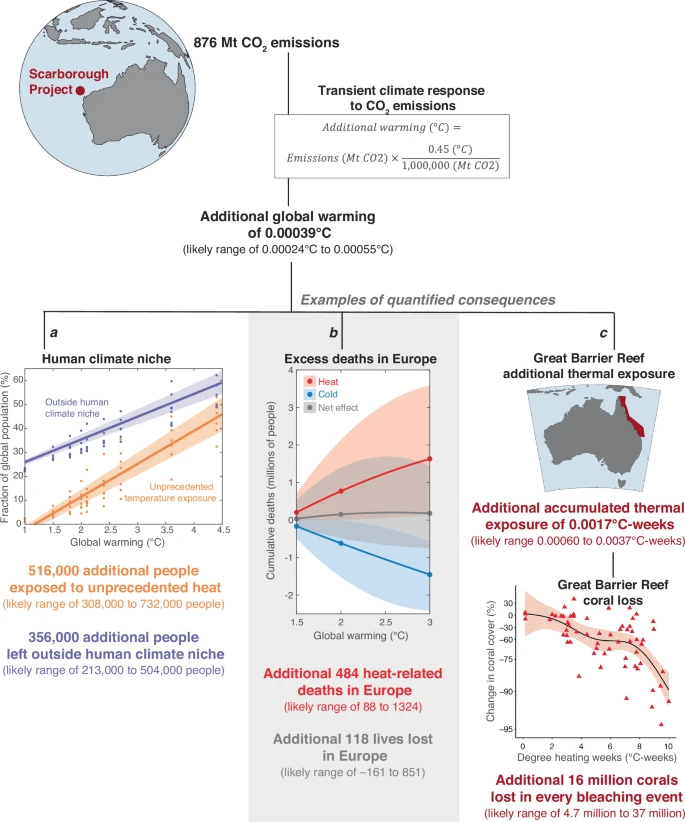
The approach is illustrated using the Scarborough offshore gas project as a case study but is applicable to any fossil fuel project. Emissions from the Scarborough project of 876 Mt CO2 can be anticipated (based on the TCRE) to cause a best estimate of 0.00039 °C of additional global warming. The consequences of this additional warming are expected to result in best estimates of, a an additional 516,000 people globally exposed to unprecedented heat and 356,000 left outside the human climate niche in a world with 9.5 billion people32 (Supplementary Fig. 1 also quantifies impacts for global populations of 6.9 billion and 11.2 billion people); b an additional 484 heat-related deaths in Europe, and a total of 118 additional lives lost in Europe (net effect) by the end of this century under a middle-of-the-road emissions pathway (SSP2-4.5)39 (Supplementary Fig. 2 also quantifies impacts under the high emissions SSP3-7.0 scenario); and, c additional thermal exposure in the Great Barrier Reef Marine Park (Supplementary Fig. 3) that results in an additional 16 million coral colonies lost in every future bleaching event on the Great Barrier Reef (lower panel after ref. 43). See Methods for calculation details, and text in the “quantifying consequences” section for more detailed descriptions of the examples illustrated in this figure.
The estimated greenhouse gas emissions from the Scarborough project total 876 million tonnes (Mt) of CO2 emissions over the anticipated lifetime of the project27. This incorporates CO2 emissions associated with offshore production, onshore processing and domestic and international use of Scarborough gas (Methods). Equation 1 quantifies the best estimate of the additional global warming caused by CO2 emissions from this project, based on the TCRE, as:
The best estimate is that the 876 Mt of CO2 emissions from this project will cause 0.00039 °C of additional global warming, with a 66–100% likelihood of causing global warming of between 0.00024 °C and 0.00055 °C (Fig. 2; Methods). While direct measurement of global mean temperature changes is not possible with this level of precision, the agreement across multiple, consistent and independent lines of high-quality evidence (i.e., robust evidence using IPCC calibrated language28) gives high confidence in the near-linear relationship between CO2 emissions and global warming that is quantified through the TCRE11. Thus, the additional warming that will be caused by CO2 emissions from the Scarborough project (or any other fossil fuel project) is knowable and can be quantified based on the anticipated CO2 emissions of the project.
Quantifying consequences
Quantification of the additional warming caused by individual fossil fuel projects enables tangible consequences of this additional warming to be quantified and evaluated in a risk assessment framework. A range of human, environmental and economic impacts are attributable to human-caused global warming. This includes evidence for severe impacts on human and natural systems that have already occurred at current levels of global warming29,30, and projected future warming that will continue to worsen the frequency and intensity of many climate change-related hazards1. These regional consequences in many cases scale with global warming levels, and hence, with CO2 emissions. They can therefore provide more relatable and relevant measures of climate change risks for decision-makers than quantification of additional global warming alone31. Here, we use examples of impacts that are known to be strongly associated with global warming to demonstrate a framework for quantifying tangible consequences of the additional warming caused by an individual fossil fuel project.
The human cost of global warming can be quantified by considering the number of people who will be left outside of the “human climate niche”32. The human climate niche describes the climate conditions in which human societies have historically thrived and is defined by the distribution of the human population with respect to mean annual temperature. This distribution is shaped by the effects of climate on people, and on the species and resources that sustain or challenge us, and has been highly consistent for millennia32,33. Unlike economic impact measures, the human climate niche framework for quantifying the human cost of global warming considers all lives as equal, regardless of wealth and is inclusive of those already alive and yet to be born32. The anticipated global population by the mid-21st century under middle-of-the-road socioeconomic pathways is around 9.5 billion people34. In a world with 9.5 billion people, every 1 °C of additional global warming is projected to cause a 13.8 ± 1.6% increase in the global population exposed to a local climate shift where the mean annual temperature exceeds 29 °C and is beyond the hot edge of the human climate niche32 (Fig. 2a; Supplementary Fig. 1a). Considering the full cold-to-hot distribution of the climate niche, as well as anticipated demographic change, allows for further quantification that 9.5 ± 1.0% of the global population will be left outside of the human climate niche for every 1 °C of additional global warming32. Based on these relationships, the 0.00039 °C (0.00024 °C–0.00055 °C likely range) of additional global warming caused by CO2 emissions from the Scarborough project will result in a best estimate of 516,000 people (308,000–732,000 likely range) being exposed to unprecedented heat, and 356,000 people (213,000–504,000 likely range) being left outside of the human climate niche (Fig. 2a; Methods).
One of the many consequences of exposure outside the human climate niche is increased mortality. At current levels of human-caused global warming, there has already been an observable and rapidly escalating rise in heat-related excess deaths35,36,37, including mass mortality events38. In many of the worst-affected regions of the world, principally developing nations with tropical (hot and humid) climates, robust data to quantify the human mortality burden of global warming is not yet available. In Europe, where suitable health data is available across 854 cities36, recent work has quantified that under a low mitigation and low adaptation scenario (SSP3-7.0), the death burden of climate change will increase by 49% this century39. Using the middle-of-the-road emissions and demographic scenario (SSP2-4.5) for projected European deaths (Fig. 2b, Supplementary Fig. 2a), it can be estimated that in Europe alone the additional climate warming caused by the Scarborough project will result in an additional 484 heat-related deaths by the end of this century (with a likely range of 88 to 1324 additional heat-related deaths; Methods). Heat-related excess deaths in Europe are projected to be most common in southern regions39, and when taking into account reduced cold-related deaths primarily in northern Europe, the net effect of additional warming caused by Scarborough project emissions is estimated to cost 118 lost lives (–161 to 851 likely range) in Europe alone.
Human-caused climate warming is also having detrimental consequences for natural systems that people value and depend upon. The Great Barrier Reef (GBR) is a UNESCO World Heritage site that is protected under Australian environmental laws40. The severe impact of human-caused global warming on coral reefs is evident in the newly emerging phenomenon of mass coral bleaching and mortality events41. The GBR has experienced six mass bleaching events during the last decade (2016, 2017, 2020, 2022, 2024, and 2025), caused by heat extremes that are beyond the range of natural climate variability42. These repeated bleaching events mean that the existential threat to the GBR ecosystem from human-caused climate warming is now being realised41,42,43,44. Back-to-back mass bleaching events have already occurred twice in consecutive summers, and with further global warming, mass bleaching of corals will soon occur every summer. The severity of coral bleaching and mortality depends on the intensity of marine heatwaves (positive sea temperature anomalies relative to the long-term average) and their duration (usually measured in weeks), which are combined in the ‘Degree Heating Week’ (DHW) thermal exposure metric45. During the 2016 mass bleaching event on the GBR an accumulated heat exposure of 5 °C-weeks–6 °C-weeks resulted in an average loss of 60% of corals, and 8 °C-weeks–10 °C-weeks increased the average loss to 90% of corals43. Each increase in heat exposure of 1 °C-weeks resulted in the death of 2–5% more corals43. The 0.00039 °C (0.00024 °C–0.00055 °C likely range) of additional global warming caused by CO2 emissions from the Scarborough project would increase accumulated thermal exposure on the GBR by 0.0017 °C-weeks (0.00060 °C–0.0037 °C-weeks likely range; Methods; Supplementary Fig. 3). Over the entire GBR, this would result in the death of an additional 16 million coral colonies (4.7 to 37 million likely range) during every future mass bleaching event (Fig. 2c, Methods).
The additional global warming attributable to a single fossil fuel project has quantifiable consequences for people and the environment (Fig. 2), and these can be robustly evaluated in a risk assessment framework. Risk assessments typically use the likelihood of an outcome, and the consequence of that outcome, to determine whether the risk of an activity is acceptable (Supplementary Fig. 4). The “negligible (level F) for all receptors” impact level of greenhouse gas emissions that was reached in the proponent’s risk assessment of the Scarborough project (Supplementary Table 1)27 is assigned where consequences are expected to be localised and have no lasting effect (Supplementary Fig. 4). The quantified, evidence-based approach that we demonstrate here does not support this assessment of a negligible impact. We quantify additional warming, and examples of its consequences, with an uncertainty range that encompasses a likelihood of 66% or higher. In the Scarborough risk assessment framework these constitute a “likely” (51 to 80% chance) to “highly likely” (>80% chance) outcome (Supplementary Fig. 4a). The additional warming caused by CO2 emissions from the Scarborough project will persist for multiple decades to centuries and cause long-term impacts across a range of environmental and social receptors, as illustrated by the examples developed above (Fig. 2a–c). In the Scarborough risk assessment framework these long-term impacts to communities and highly valued ecosystems equate to the highest levels (levels A and B) of consequence (Supplementary Fig. 4b). When these quantified assessments of likelihood and consequence are combined, the result is a risk rating of “severe” (Supplementary Fig. 4c). In an approval process, a severe risk rating should necessitate actions to reduce residual risk to an acceptable level.
Climate change mitigation context
In addition to assessing the acceptability of the consequences of CO2 emissions from new fossil fuel projects, another important policy consideration is how these proposed emissions relate to national emission reduction commitments. Fossil fuel projects span multiple decades, meaning that approval of new or newly extended fossil fuel projects today typically commit additional CO2 emissions through to and beyond 2050 (Supplementary Table 1). Frequently, the context of annual emissions of these individual fossil fuel projects is quantified to be only a small percentage of today’s CO2 emissions relative to state, national or global emissions levels (Supplementary Table 1). For example, the anticipated annual domestic emissions of the Scarborough project of 6.2 Mt CO2 per year (based on scope 1 emissions and 15% of production that is reserved for domestic consumption; Methods) are equivalent to 1.6% of Australia’s fossil CO2 emissions in 2024. However, the rapidly depleting remaining carbon budgets available to limit global warming to well-below 2 °C11,13 necessitate deep and rapid CO2 emission reductions this decade, and achieving net-zero emissions by around mid-century46. This means that an appropriate emissions context of new fossil fuel projects should encompass a rapidly decarbonising world.
National Determined Contributions (NDCs) provide an unambiguous, policy-aligned target for assessing the emissions context of proposed fossil fuel projects. Remaining carbon budgets for limiting global warming are determined at the global level11,13, but emission reduction commitments and actions are implemented at national and sub-national levels. Principles of fairness that encompass capability, equality and responsibility have been discussed for guiding national allocations of the remaining global carbon budget2,47. The Australian Government has previously determined that a national allocation of 0.97% might be considered as Australia’s fair share of the remaining global carbon budget to guide national emission reduction targets48. Australia’s 2022 NDC49 is a legislated commitment to reduce national greenhouse gas emissions by 43% below 2005 levels by 2030, and to achieve net-zero emissions by 2050. This is broadly equivalent to Australia doing its fair share to limit global warming to 1.7 °C with around a 50–67% likelihood of success (Fig. 3a; Supplementary Fig. 5; Supplementary Fig. 6).

a Australia’s historical CO2 emissions from 1960 to 2024 are shown for fossil (black line) and total (grey line) emissions, along with Australia’s 2022 Nationally Determined Contribution (NDC; purple line) for emission reductions of 43% by 2030 (relative to 2005 levels) and net-zero emissions by 2050. Orange shading and table details show linear emission reduction pathways from the start of 2025 that are consistent with Australia’s fair share of the remaining global carbon budget for limiting warming to 1.7 °C (Methods; See Supplementary Figs. 5 and 6 for the equivalent analyses for remaining carbon budget pathways to limiting warming to 1.5 °C and 2.0 °C, respectively). b Demonstration of the rising contribution of Scarborough project CO2 emissions that fall under Australian carbon reporting (production, processing and domestic consumption) relative to Australia’s NDC emissions reduction pathway.
Scarborough project emissions can be anticipated to constitute a rapidly increasing fraction of the national CO2 emissions budget under Australia’s committed climate change mitigation pathway (Fig. 3b). The expected annual CO2 emissions from production, processing and domestic consumption of Scarborough gas (i.e., emissions covered under Australia’s national greenhouse gas inventory; Methods) will be around 1.9% of the national annual CO2 budget at the commencement of production in 2026. This proportion rises to 2.5% by 2030 and 4.9% by 2040. By 2049, the anticipated Australian emissions from the Scarborough project alone will comprise half (49%) of Australia’s entire annual CO2 emissions budget. Beyond 2050, all CO2 emissions from the Scarborough project would require durable CO2 removal from the atmosphere of an equivalent quantity to be consistent with Australia’s NDC.
CO2 removal is necessary in net-zero pathways to compensate for hard-to-abate emissions, but should not be employed to avoid the rapid, near-term emission reductions required to achieve Paris Agreement goals50,51. In 2023, human activities to move CO2 from the atmosphere into durable geological storage (i.e., effectively reversing the carbon flux caused by fossil fuel combustion) amounted to only 0.04 Mt CO2 globally52, which is equivalent to only 0.6% of the planned annual Australian emissions from the Scarborough project. The context illustrated here for Scarborough emissions represents a single project. However, the reality is that many approved and proposed fossil fuel projects, both in Australia (Supplementary Table 1) and globally3, now have life spans that extend through the time when nations have committed to substantially reducing emissions and achieving net zero. The context of project-level and aggregated fossil fuel emissions commitments relative to climate change mitigation commitments, as well as the significant financial burdens, technological limitations and environmental risks of durable CO2 removal at scale50,51,53, will become increasingly pressing factors as the remaining carbon budgets for limiting global warming continue to decline.
Discussion
Our analysis demonstrates how tangible and quantified examples of socio-economic and environmental consequences, across regional to global scales, can be brought into science-informed decision-making in ways that recognise that every fraction of a degree of additional warming matters. The most pressing concerns of decision-makers related to future CO2 emissions may vary depending on the climate change vulnerabilities and values of the jurisdiction where new fossil fuel projects are being approved, or of the groups and nations where future emissions will have particularly dangerous and costly consequences. These factors may determine decisions on which consequences to prioritise when quantifying the impact of future CO2 emissions54. For example, in Australia a range of nationally significant animals, plants, habitats, water resources or places, including the GBR Marine Park (Fig. 2c), are protected by national legislation through the Environmental Protection and Biodiversity Conservation Act40. Significant impacts on these Matters of National Environmental Significance40 can be addressed in environmental approvals for proposed fossil fuel projects under Australia’s jurisdiction. In other jurisdictions, human rights laws may provide instruments for climate change litigation, such as recent high-profile examples in Europe54. In these settings the quantification of consequences for people (Fig. 2a), including excess mortality (Fig. 2b), may have the greatest relevance for decision-making. The International Court of Justice (ICJ) recently concluded in a unanimous Advisory Opinion that States have binding legal obligations under international law to prevent significant harm to the climate system and to reduce emissions to levels capable of achieving the 1.5 °C Paris Agreement goal (para. 457 of ref. 55). States must apply best available science to all their climate-related decision-making (paras. 278, 284, 298, and 347 of ref. 55). The ICJ Advisory Opinion is highly relevant for national decision-making on the compatibility of proposed fossil fuel projects with achieving a State’s climate change mitigation commitments for rapid decarbonisation over the coming decades (Fig. 3), including the ICJ conclusion that Developed States may be committing internationally wrongful acts by granting new fossil fuel project licences (para. 427 of ref. 55).
The approaches demonstrated here provide a science-based foundation that can be employed by companies, governments, decision-makers, governance boards, climate consultants and legal practitioners in quantifying the consequences of continued fossil fuel production and use, and in assessing whether these projects fall within acceptable levels of environmental and societal risk. In particular, we argue that companies proposing new or extended fossil fuel projects must better account for the impacts of their projected emissions. It is no longer defensible to simply state that their consequences will be negligible (Supplementary Table 1) when scientific evidence allows significant impacts to be anticipated and quantified (Fig. 2; Supplementary Fig. 4). A science-based approach also allows for a more explicit assessment of the financial burdens that result when new fossil fuel projects are approved, including through implicit assumptions and dubious feasibility50,53 of rapidly increasing large-scale CO2 removal as continued fossil fuel production and use coincide with national decarbonisation commitments (Fig. 3). This work has developed the quantification process for a small number of example consequences, but many other consequences of additional warming can also be anticipated. Future work will broaden the quantified consequences so that the best-available scientific evidence is able to more readily be incorporated into climate-relevant decision-making globally. The future-focused framework developed here reinforces that every tonne of CO2 emissions adds to global warming, and that every fraction of a degree of additional warming matters1.
대화 참여하기