As I write these words, the No 1 trending story on the Guardian is titled: “The history and future of societal collapse”. It is an account of a study by a Cambridge expert who works at something ominously called the Centre for the Study of Existential Risk; he concludes that “we can’t put a date on Doomsday, but by looking at the 5,000 years of [civilisation], we can understand the trajectories we face today – and self-termination is most likely”.
I can’t claim to have done a study, though I have been at work on climate change for almost 40 years and I gotta say: seems about right. So it’s maybe not the worst moment for a bit of worry about how you would fare in the case of a temporary breakdown of our civilization. Perhaps you have noticed that extreme weather events are becoming more frequent and violent. Or you read the stories that Donald Trump was shutting down the Federal Emergency Management Agency and surmised you’ll have to take care of yourself going forward. Or hey, maybe you think a cabal of pedophiles might try and use black helicopters to herd you into a 15-minute city where a communist mayor will make you spend the rest of your life riding a scary subway.
If you look at it one way, [solar power] is energy for hyper-individualists
Whatever. I am not telling you what to prep for – I’m just here to talk about the energy supply for your bunker. And in the process, make the case that maybe it’s time for rightwing nutjobs to join us leftwing nutjobs in embracing solar energy. Not because it’s nice for the environment – heaven forbid. But because it works. Including under adverse conditions when everything goes to hell.
It’s not the obvious choice, perhaps. At least in the US, conservatism is heavily identified with fossil fuel; the Trump administration has spent the last months doing everything it can think of to stymie solar and wind power and to boost hydrocarbons, going so far as to shut down an 80% finished windfarm off the coast of Rhode Island. So, it’s understandable that in a lot of cases, your diehard prepper will be inclined to use what he knows and trusts. It’s not just Trump, of course – there’s also the work that big oil has done to pitch itself as manly, the idea that the climate change is a hobbyhorse of those scientific “elites”, and so on.
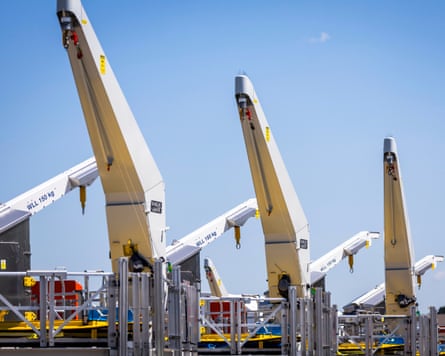 View image in fullscreenWind turbine components at the Revolution Wind construction hub in Providence, Rhode Island, last year. Photograph: Adam Glanzman/Bloomberg via Getty Images
That is why you can go on Reddit and find long exchanges about, say, how to keep jerrycans of diesel fuel fresh over the years. (It turns out that diesel can grow algae – the consensus on the forum is that if you store it in metal cans in the dark you are probably good for a couple of years, though you may want to buy some “diesel biocide” just in case. Here’s some available online, just $185 a gallon.)
But say you imagine the emergency might last a little longer – then things just keep getting harder. Here’s how one prepper on the forum outlined his dilemma:
I currently have three 275 gallon fuel oil tanks. 2 are in my basement and filled with diesel. One will be put somewhere outside with gasoline. I just picked up 3 70s-80’s vintage gas pumps that are supposedly in working order. What is everyone doing for home refueling? Concrete pads for the pumps and tanks? What are you doing to protect the pumps from getting run into or damaged from snowplows? How are you ensuring 250+ gallons of gas gets turned over and refilled before it goes bad? I was thinking of selling to close friends and neighbors either at cost or at a slight loss to make sure the fuel is always fresh.
I guess that might be workable – running your own gas station for your neighbors, albeit at a slight loss. (If they’re old like me, you could lure them in with free drinking glasses.)
But say the emergency goes on longer than that, and you have to refill your tanks. At some point you are likely to realize what an incredibly complicated system you have tied yourself into, with multiple failure points everywhere. To get oil these days you basically need a company sophisticated enough to drill a couple of miles below the ocean; to get natural gas you need drillers able to detonate explosives miles beneath the Earth’s surface to “frack” the deposits into flowing. And then you need to be able to pipe your crude to a massive refinery where it can be separated into various components, and then a fleet of trucks to carry it to gas stations and so on. Once you have it, the engine that it goes in has to be properly maintained – there’s a lot of engineering involved in making a flammable liquid burn at a steady pace and, say, move power to wheels, which is why there are about 2,000 parts in the drivetrain of an internal combustion vehicle. Any of them can and do break, at which point you would better have a pretty good stock in your bunker unless you are absolutely sure your local Pep Boys is going to be up and running.
Or – and bear with me here a minute – you could go solar. Again, I understand that Trump hates it. “It’s all steel and glass and wires,” he told a California gathering shortly before the last election. “It looks like hell. And you see rabbits get caught in it … It’s just terrible.” But maybe aesthetics is not your primary concern and maybe you hunt rabbits, anyway – in that case, solar has a lot to recommend it for us average paranoiacs. In fact, I think you could go so far as to say that it is the one form of power that matches up almost perfectly with a rational conservative outlook: if you look at it one way, it is energy for hyper-individualists.
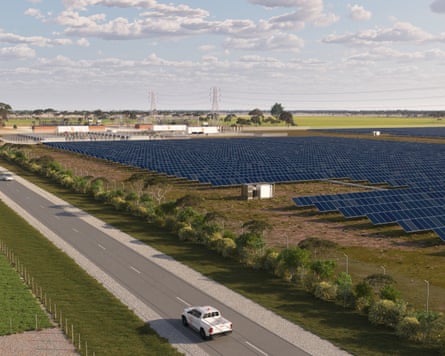 View image in fullscreenThe government in Victoria, Australia, announced last year it will spend $370m to build a huge solar and battery farm, which it said will be able to power more than 50,000 homes. Illustration: Rended image courtesy VIC government
For one thing, it works – for a really, really long time. My oldest solar panels have been up on the roof for a quarter century and they are still going strong; the oldest solar array in France was just tested and 30 years later it was still at 80% of its original output. And you can now easily connect solar panels to batteries – some even come from that Nazi-adjacent billionaire Elon Musk (though there are also plenty of competitors now, in case you want non-fascist electron storage). Once you have got a battery in the basement, the afternoon’s sunshine can last all day. Indeed, if you have thought ahead and bought, say, a Ford F-150 Lightning, the electric version of America’s most popular vehicle, you have battery enough to keep your house running for days and days.
But best of all there is no complicated system to plug into. It’s just you and the sun, and the sun is currently predicted to go on burning for 5bn years (after which, admittedly, you’re on your own).
We cannot stop climate change, but maybe we can stop it short of the place where it cuts civilization off at the knees
Similarly, the stuff you can get to use all that electricity to is super-duper simple. Take that Ford Lightning, or indeed any electric vehicle: it has about 20 moving parts in the drivetrain. I know that good red-hatted Americans are supposed to be a little suspicious of EVs – our president has explained that they “only drive for 15 minutes before you have to get a charge”. (You would think he would have more respect, the golf carts at his courses are electric and carry his considerable bulk for 18 holes). But in fact EVs are now high-performance vehicles (if you must, you can actually get an electric Hummer), and they are incredibly self-supporting. When I was buying mine – again, early on – the salesman offered me six free oil changes. I looked at him for a little while, and then he blushed and offered me free floor mats instead. Tires need changing, but that’s about it.
And here’s the thing: you just plug your EV into the solar panels and the batteries in your house. You never need to worry about the gas station running out of gas, or running out power. And you know, just in case, I would get an e-bike too; the manual backup (they’re called pedals) is already in place.
I think back often to the first couple of Mad Max movies, especially the ever popular Mad Max 2, which came out in 1981. Mel Gibson is wandering a post-apocalyptic Australian outback (energy crisis, environmental collapse, never really specified) and his main quest is for oil. In a major plot point, he helps defend a besieged refinery in return for some petrol (gyrocopters, deadly steel boomerang). Even in this desperate future, it is all about the oil.
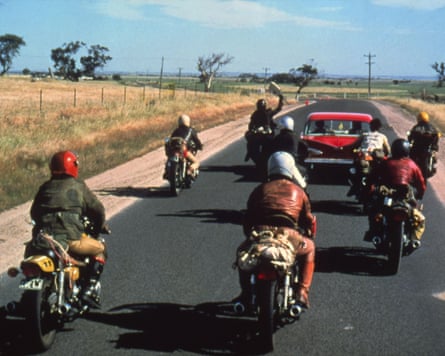 View image in fullscreen‘Mad Max was good entertainment but bad prepping’ … A still from Mad Max (1979) by George Miller. Photograph: Alamy
That made sense at the time, because when the movie was made, solar panels were still basically a toy – they were most likely to be found in calculators and wrist watches; a roof full of panels would have been prohibitively expensive. You had no choice in a 1980s-era apocalypse to try to live off whatever oil still remained (especially if you wanted to drive around the desert in a souped-up dune buggy). But since 1981, the price of a solar panel has dropped about 99% and so has the price of a battery. In Australia, as a result, about 40% of homes now have solar panels on the roof. It is so easy and cheap it is almost incredible. As the electrification guru Saul Griffith wrote recently:
Our rooftops generate over 10% of total energy supply. For an individual household with a large rooftop, it pays to install more than you need. My friend Fred’s house produces 141% of the electricity it needs in a year to run an entirely electric life including 2 cars and a heated pool. This is true abundance.
An Australian system costs a third of what it will currently run you in America. That’s largely because we raise the price with a lot of unnecessary permitting, which is another place where left and right could easily meet. Why should the government be keeping you from harvesting the electrons that fall on your roof? It’s a conspiracy! Actually, it kind of is: it suits the utilities to keep us hooked to the current ways of doing business.
That is why we are staging Sun Day later this month: a big nationwide celebration of clean energy with some pretty pointed efforts to make local governments change their ways. If we can’t move Washington right now, we can at least pressure blue city halls and state legislatures, and maybe some red ones too: earlier this spring deep-red Utah became the first state to allow European-style “balcony solar”, those apartment-scale solar panels you just hang from your veranda and plug into your wall.
What I’m saying is, Mad Max was good entertainment but bad prepping. Even if you find an oil tanker to hijack, you’re still going to run out of fuel pretty fast; it seems likely there is a finite number of old oil tankers. Whereas the sun, the sun just keeps rising. Why not just kick back and enjoy the easy life with your solar panels? No need to be Mad Max - you can be Chill Max, running your fridge and your piña colada machine and every other appliance you can imagine.
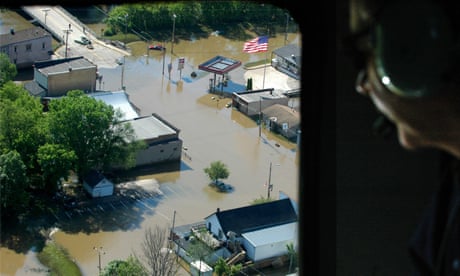
There were never any climate havens: floods in the midwest, hurricanes in Appalachia
Read more
Do I think prepping for a disaster is the best reason to put up solar panels? I do not. I think avoiding a disaster is the best reason: the rapid buildout of solar and wind and batteries is the first scalable solution to the climate crisis that has emerged in all these decades I have been at work. If we put up enough of it quickly enough (say, at the pace China is currently going), then we would take some of the sting out of global heating. We cannot stop climate change, but maybe we can stop it short of the place where it cuts civilization off at the knees.
But I know plenty of people who think more individually than societally, whose main concern is the fate of themselves and their families. So it pleases me that for them the answer is the same: a solar panel makes your home truly your castle. If you want to defend it with an AR-15 – well, now you have got something worth defending.
That is why, I think, that Sun Day seems to be drawing in all types, from unreconstructed hippies to entrepreneurs to evangelical pastors who are setting up hundreds of events across the country. In a moment when our incredibly polarized society makes it hard to do much of anything, that is worth at least a modest celebration. So come out on 21 September to celebrate the rise of clean energy, to make it easier to put up panels – and to meet your neighbors. And by the way, knowing your neighbors is a pretty good survival technology too.
Bill McKibben is the author of the forthcoming Here Comes the Sun, and the founder of Sun Day
This article was amended on 7 September 2025. An earlier version said that Donald Trump told a meeting in Florida that solar panels were “all steel and glass and wires”. In fact, it was in California.
댓글
댓글 쓰기