Bee Venom Could Help Treat a Type Of Cancer
Bee Venom Could Help Treat a Type Of Cancer
Ongoing investigation into whether bee venom could help treat a certain type of cancer has been making "important progress," the leading researcher has told Newsweek.
Experts at the Epigenetics Lab at the Harry Perkins Institute of Medical Research have been exploring since 2020 how the venom from honeybees could be used to kill aggressive breast cancer cells, without harming healthy cells.
Breast cancer is the most common cancer in women in the U.S., with the exception of skin cancers, accounting for about 30 percent of all new female cancer cases each year, according to the American Cancer Society.
The organization estimates that in 2025, around 316,950 new cases of invasive breast cancer will be diagnosed in women and roughly 42,170 women will die from the cancer.
Dr. Edina Wang, a postdoctoral researcher at the lab in Perth, Australia, and the University of Western Australia Medical School, told Newsweek that the team has now engineered a targeted form of melittin that can be safely injected directly into the bloodstream in preclinical studies.
Melittin is the main compound found in honeybee venom. It works by "punching holes on the cell membrane," Wang said.
"With just one injection, we observed cancer cell death within six hours and the therapeutic effect lasting for up to a week" while having minimal effect on normal cells, she said.
She added of developing the injection: "This is significant because melittin alone is highly toxic and can damage healthy tissues if not carefully controlled."
However, Wang said that more work was still needed, particularly in clinical settings, to ensure that it can be delivered safely and effectively.
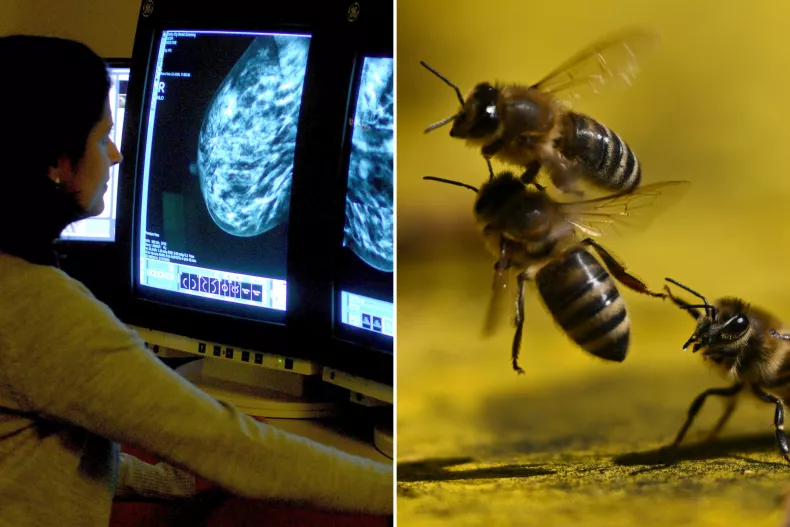
Using Bee Venom to Kill Cancer Cells
Wang told Newsweek that during the lab's research, they discovered that "whole bee venom appears to target breast cancer cells more effectively than melittin alone, with less impact on normal cells."
She said that this suggests there may be other components in the venom that help "guide melittin more specifically to cancer cells."
"We're still exploring how that works, but it's a promising direction," she added.
Wang noted that honeybee venom itself cannot be used directly as a treatment because it contains "allergenic and toxic components that make it unsafe in its natural form, but it gives us a valuable starting point for developing safer and more precise treatments."
"By adding specialized components to melittin, we've improved its precision allowing it to home directly to tumor sites and effectively kill cancer cells while sparing healthy ones," Wang said.
She added that this "targeted melittin" not only showed "strong anticancer effects causing cancer cell death within hours and lasting for days, but was also effective in facilitating the delivery of complex proteins and molecular cargoes that normally have poor ability to penetrate tumors, enhancing overall antitumor activity."
This is not the first time melittin has been studied for treatment of cancer, or that natural substances more generally have been used in the treatment of cancer.
"Drugs developed from natural products—honeybee venom would usually be thought of as a natural product—have been used to treat different cancers for many years," Dr. Robert Clarke, executive director of The Hormel Institute and professor of biochemistry, molecular biology and biophysics at the University of Minnesota, told Newsweek.
As such, Clarke said that this study is "not a 'one-off' report, but sits within a context of studies that also report broadly similar findings."
What separates this study from others is that it has found that some breast cancer subtypes may be more sensitive than others to the venom, Clarke said.
He added that this was particularly important for the triple-negative breast cancer subtype (TNBC)—an aggressive subtype that lacks estrogen, progesterone and HER2 receptors, making it harder to treat. There is currently no approved targeted therapy.
Melittin has already been found to "rapidly" destroy triple-negative breast cancer and HER2-enriched breast cancer cells, the lab shared in 2020.
"We really do need new options for patients who receive a TNBC diagnosis, so the activity reported is timely and relevant," Clarke said.
Treating Other Cancers
While the current research is primarily focused on breast cancer, particularly aggressive subtypes, Wang said that researchers have also started to investigate whether the same treatment could be used for ovarian cancer.
Initial findings from research involving ovarian cancer have showed that targeted melittin had a sixfold improvement in effectiveness against ovarian cancer cells compared to melittin alone, Wang said.
"Although it's still early, the initial results are promising," she said, adding: "We are continuing to optimize delivery methods and prepare for clinical trials to evaluate safety and efficacy, moving closer to developing more precise and less toxic cancer therapies."
While the research shows promise, Clarke said that "there are always limitations to consider, and this research is no exception to that rule."
"The use of normal breast cells doesn't really help in assessing toxicity or safety— effects in the breast epithelium is not an established driver of toxicity in patients," he said. Therefore, at this stage, "safety isn't clear from the work presented," Clarke said.
What Does This Mean for Breast Cancer Treatment?
Chemotherapy and radiotherapy are still the standard of care for many cancer patients, however they can have "significant side effects and aren't always effective against aggressive or resistant forms of cancer," Wang said.
The side effects of the usual treatment, which also includes hormone therapy, targeted therapy and surgery, are wide ranging, and patients may experience varying degrees of them, with both temporary and long-term impacts.
"Our goal is to develop a more targeted therapy that could potentially reduce the reliance on these traditional treatments or enhance their effectiveness," Wang said.
She added that at this stage, "we see the targeted melittin approach as something that could complement existing treatments rather than replace them entirely."
"It's too early to say whether it could replace them, but in the future, it might help create more personalized and less toxic treatment options for patients," she said.
Predicting whether or not the use of targeted melittin will ultimately become a new therapy option is difficult to know at this point in the research, Clarke said, "largely because many drugs that show promise fail in the translation from mice to humans or at other stages in the drug discovery and development pipeline."
He said that "it is generally accepted that many anticancer drugs are most effective when given in combination with others, and the best activity of the venom was when it was combined with the cytotoxic drug paclitaxel."
"So, it will probably not remove the need for other types of treatment like chemo or radiotherapy and could end up being given with paclitaxel," he said.
Although he added that if it was found to have less toxicity for patients, alongside more enhanced anticancer activity, "it could come to replace some existing drugs in current chemotherapy regimens."
Full Interviews Below
In interview with Dr. Edina Wang, a postdoctoral researcher at the Epigenetics Lab at the Harry Perkins Institute of Medical Research and the University of Western Australia Medical School.
Q1: Why can bee venom kill breast cell cells? And how are normal cells not affected?
"The honeybee venom can kill breast cancer cells because of a compound called melittin, which makes up about half of the venom's dry weight. Melittin works by punching holes on the cell membranes. In our research, we found that whole bee venom appears to target breast cancer cells more effectively than melittin alone, with less impact on normal cells. This suggests there may be other components in the venom that help guide melittin more specifically to cancer cells, or possibly reduce its effects on healthy cells. We're still exploring how that works, but it's a promising direction. Bee venom itself cannot be used directly as a treatment because it contains allergenic and toxic components that make it unsafe in its natural form, but it gives us a valuable starting point for developing safer and more precise treatments. Our goal is to improve melittin to make it more targeted and specific to cancer cells, without harming healthy tissue and to develop a safe and effective way to use it in future therapies."
Q2: Is this specific to breast cancer? Or can bee venom also kill other cancerous cells?
"So far, our research has primarily focused on breast cancer, particularly aggressive subtypes, where we've seen strong effects. We've also started looking into ovarian cancer, and although it's still early, the initial results are promising. Melittin has been shown in other studies as discussed in our publication, to affect various cancer types, suggesting there's potential for broader applications. But more research is needed to better understand how it works across different cancers. At this stage, our main focus remains on breast and ovarian cancers, and the findings so far are encouraging."
Q3: How close is the research coming to determining whether this could be a cure?
"The research is showing real promise, especially with the addition of specialized components to melittin, which help it target cancer cells more precisely. This has significantly improved its selectivity and potential as a therapeutic agent. In our preclinical studies, the results have been remarkable. With just one injection, we observed cancer cell death within six hours and the therapeutic effect lasting for up to a week. Of course more work is needed, particularly in clinical settings, to ensure that this targeted melittin can be delivered safely and effectively to tumor sites in breast cancer patients."
"We've made important progress by engineering a targeted form of melittin that can be safely injected directly into the bloodstream in preclinical studies. This is significant because melittin alone is highly toxic and can damage healthy tissues if not carefully controlled. By adding specialized components to melittin (we called it targeted melittin), we've improved its precision, allowing it to home directly to tumor sites and effectively kill cancer cells while sparing healthy ones. This targeted melittin not only showed strong anticancer effects causing cancer cell death within hours and lasting for days, but was also effective in facilitating the delivery of complex proteins and molecular cargoes that normally have poor ability to penetrate tumors, enhancing overall antitumor activity."
"While most of our work remains focused on breast cancer, the ovarian cancer studies are still in the early stages. We have yet to begin preclinical studies for ovarian cancer but that is our next step. The initial findings showing a sixfold improvement in effectiveness against ovarian cancer cells compared to melittin alone are particularly promising, given the common [resistance of] ovarian tumors to conventional treatments. We are continuing to optimize delivery methods and prepare for clinical trials to evaluate safety and efficacy, moving closer to developing more precise and less toxic cancer therapies."
Q4: How could it be used in a treatment? Would it remove the need for other treatment like chemotherapy and radiotherapy?
"At this stage, we see the targeted melittin approach as something that could complement existing treatments rather than replace them entirely. Chemotherapy and radiotherapy are still the standard of care for many patients, but they can have significant side effects and aren't always effective against aggressive or resistant forms of cancer. Our goal is to develop a more targeted therapy that could potentially reduce the reliance on these traditional treatments or enhance their effectiveness. It's too early to say whether it could replace them, but in the future, it might help create more personalized and less toxic treatment options for patients."
In interview with Dr. Robert Clarke, executive director of The Hormel Institute and professor of biochemistry, molecular biology and biophysics at University of Minnesota.
Q1: Do you think that bee venom could be a successful treatment of breast cancer?
"Drugs developed from natural products—honeybee venom would usually be thought of as a natural product—have been used to treat different cancers for many years. Cytotoxic drugs (drugs that kill cells) used to treat aggressive breast cancers and that have a natural product origin include vinblastine (Velban), originally derived from the Madagascar periwinkle plant Catharanthus roseus, and paclitaxel (Taxol), originally isolated from the Pacific yew tree Taxus brevifolia. So, there is a long and successful history of translating natural products into effective anticancer drugs. The honeybee venom paper included some data with the cytotoxic drug paclitaxel.
"For this work, there is a body of prior studies of honeybee venom from other labs and in breast and other cancers that also report anticancer activity, which is a strength. It means that it's not one a 'one-off' report, but sits within a context of studies that also report broadly similar findings. As I see it, what was reported here that is different from this earlier work is that some breast cancer subtypes may be more sensitive than others to the venom. There are three major subtypes: hormone receptor positive, HER2+, and triple negative (TNBC). Activity in TNBC is important, because TNBC lacks the estrogen and progesterone hormone receptors and HER2—hence triple negative—so it has no approved targeted therapy and has a poor 5-year survival rate. The venom would not be a targeted therapy. In principle, it would probably be another form of chemotherapy— technically it would be the use of a chemical, the venom peptide, used as a drug. We really do need new options for patients who receive a TNBC diagnosis, so the activity reported is timely and relevant.
"The data showing activity in TNBC cells growing in mice are the best indicator from the paper that there is potential for development and that additional studies are warranted. Predicting whether or not it will ultimately become a new therapy option is hard at this point in the research, largely because many drugs that show promise fail in the translation from mice to humans or at other stages in the drug discovery and development pipeline—for many different reasons that would not be predictable from the paper.
Q2: Do you have any concerns about the research?
"This research seems to have been nicely done, and the results are clearly presented. Given the other work and the broadly similar reports of activity against cancer cells, it's also very likely reproducible. There are always limitations to consider, and this research is no exception to that rule. The use of normal breast cells doesn't really help in assessing toxicity or safety—effects in the breast epithelium is not an established driver of toxicity in patients. I would have liked more clarity from the authors on if they found evidence of toxicity in the mouse study; e.g., a simple but useful measure is change in body weight where a loss of weight indicates toxicity. So, safety isn't clear from the work presented, but it may be presented in other studies. The authors don't seem to stretch too far beyond their results in their claims; they note the potential of the venom to be useful in the future and that further work is required, which I agree is the case here."
Q3: Do you think, if the studies are successful, it will remove the need for other therapies like chemotherapy and radiotherapy?
"It is generally accepted that many anticancer drugs are most effective when given in combination with others, and the best activity of the venom was when it was combined with the cytotoxic drug paclitaxel. So, it will probably not remove the need for other types of treatment like chemo or radiotherapy and could end up being given with paclitaxel. If it proved better, so safer, with less toxicity for patients, and better anticancer activity, it could come to replace some existing drugs in current chemotherapy regimens."
대화 참여하기