Ministry touts resistant bee strain
Ministry touts resistant bee strain
The Ministry of Agriculture has bred a disease-resistant, high-production strain of bees and made the strain and breeding method available to the private sector, promoting the sustainable development of the beekeeping industry.
The Miaoli District Agricultural Research and Extension Station has been researching bee strains for five years, aiming to address declining honey yields due to weakened strains and pests.
The station introduced its new breakthrough bee strain at a news conference at the ministry in Taipei yesterday.
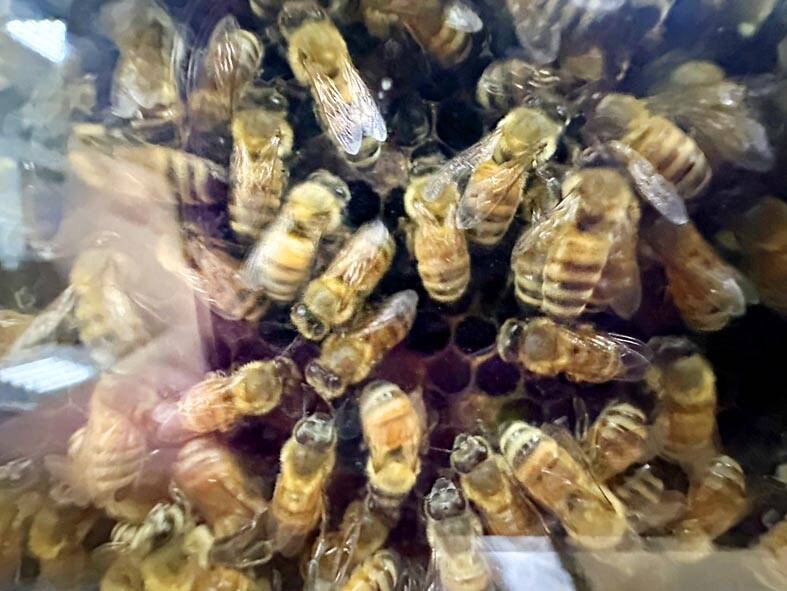
Bees bred by scientists at the Ministry of Agriculture are pictured at a news conference at the ministry in Taipei yesterday.
Photo: Yang Yuan-ting, Taipei Times
Domestic bee colonies primarily rely on beekeepers to help them reproduce within their own colony, but inbreeding has gradually weakened strains, station director Lu Hsiu-ying (呂秀英) said.
Coupled with the increasing difficulty of pest and disease control amid climate change, honey production has declined, Lu said.
After five generations of hybridization, the station bred a new disease-resistant, high-production strain of bees, helping the beekeeping industry to improve bee genetics and overcome the effects of climate change, she said.
To develop the strain, researchers bred bees that were good at keeping hives clean with bees that were strong honey gatherers, said Wu Tzu-hsien (吳姿嫻), director of the station’s beekeeping division.
After five generations of careful selection and crossbreeding, they produced a strain that combines both traits, Wu said.
Bees that tend toward cleanliness regularly clear out waste and dead bees, which makes the hive healthier and more resistant to diseases, she said.
To measure hygienic behavior, the station used liquid nitrogen to freeze bee pupae in the hive, then checked 24 hours later to see how much had been cleaned out, Wu said.
It also marked larvae and introduced a disease that affects them, then checked their survival rate to assess a colony’s disease resistance, she said.
The station measured the honey harvested during the longan flowering period to breed strains with high honey production, she added.
It put colonies close to longan trees then measured the weight of honeycombs before and after spinning out the honey to calculate the amount collected, she said.
The new strain of bees showed a hygienic ability of 90 percent, up from 70 percent, a 40 percent improvement in larvae survival and a 30 percent improvement in honey production, Wu said.
The station’s techniques are available under a nonexclusive license, so beekeepers can use it freely to improve their own breeding skills, helping to improve domestic bee quality and honey production, Lu said.
The station would use the technique to develop breeding farms and provide high-quality bees for beekeepers, helping the industry to face modern challenges and grow sustainably, she said.
The fee for the bee breeding technology is NT$130,000 and it is available to individuals, companies and other organizations, the station said.
The package includes 30 specially selected queen bees, six frames of carefully bred bee brood and a guide to the hybrid trait preservation technique, it said.
대화 참여하기