It’s bigger than your thumb, has immense jaws and is nicknamed the flying bulldog – Meet the largest bee on Earth
It’s bigger than your thumb, has immense jaws and is nicknamed the flying bulldog – Meet the largest bee on Earth
“It was absolutely breathtaking to see this ‘flying bulldog’ of an insect that we weren’t sure existed anymore, to have real proof right there in front of us in the wild,” says Clay Bolt, who took the first photos and video of the species alive.
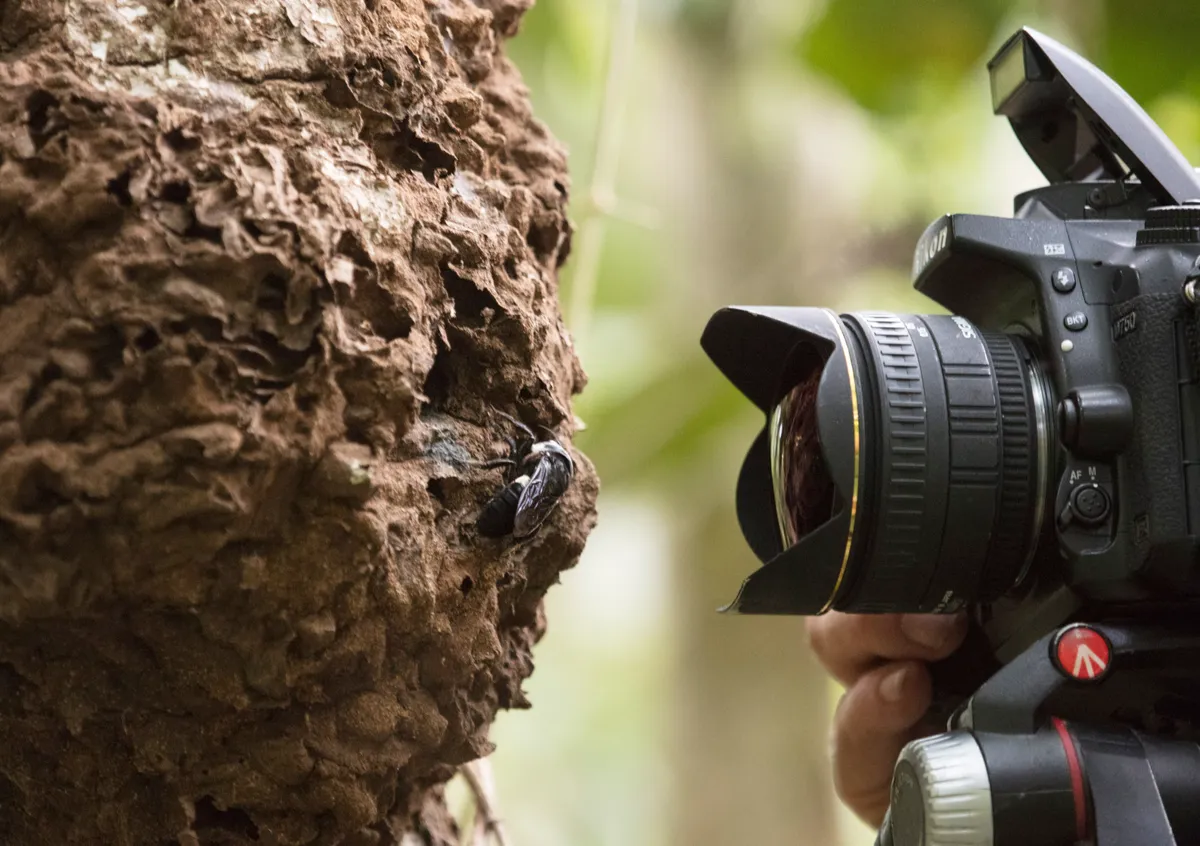 Natural history photographer Clay Bolt makes the first ever photos of a living Wallace’s giant bee at its nest, which is found in active termite in the North Moluccas, Indonesia. Simon Robson
“To actually see how beautiful and big the species is in life, to hear the sound of its giant wings thrumming as it flew past my head, was just incredible. My dream is to now use this rediscovery to elevate this bee to a symbol of conservation in this part of Indonesia, and a point of pride for the locals there,” he adds.Bee vs wasp: what's the difference between these two stinging insects?
This utterly surreal blue bee is like nothing you've ever seen before – unless you're from Australia
Prior to this rediscovery, there are only two published sightings of this species. The original sighting by Wallace in 1858, who described it as “a large black wasp-like insect, with immense jaws like a stag-beetle. Then again in 1981 by entomologist Adam Messer. Searches since 1981 have proved to be unsuccessful until now.
However, National Geographic reports that 20 to 30 of these bees were seen by Rich Desmier de Chenon, a French entomologist, in the 1990s. He was guided to the bees by locals, who were familiar with the species.
One of the bees was collected, but de Chenon didn’t publish his work as he feared this would encourage collectors to find and capture the bee.
In fact, the bee has been sold online with one specimen selling on eBay for $9,100 in 2018.
How big is Wallace’s giant bee?
Wallace’s giant bee can be up to 4.5 cm long with a wingspan of up to 6 cm.
Where does Wallace’s giant bee live?
It lives on the North Moluccas islands, IndonesiaMeet the deadliest and biggest wasp in the world - complete with its scary 6mm stinger - and learn why it's called the murder hornet
Why does a bee die after it stings you?
Bee and wasp stings: what they are, why they hurt and how to treat a sting
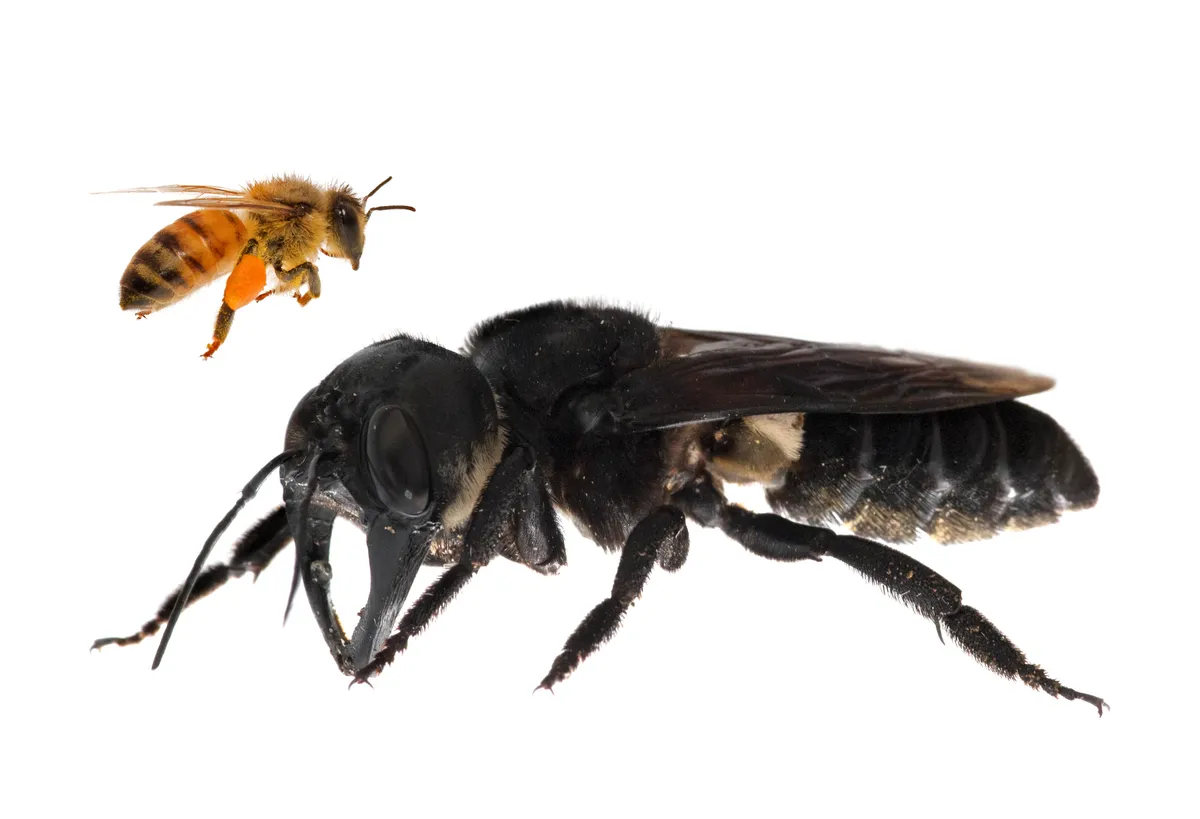 Composite image showing the size difference between a European honeybee work and the female Wallace's giant bee. Clay Bolt
The female Wallace’s giant bee is four times as large as the European honeybee worker, and almost twice as large as the male of her species.
Although little is known about the species, the female uses her giant mandibles to collect sticky tree resin to line her nest, which she makes in active arboreal termite mounds. The resin protects the nest from termites.
The team found dozens of termite mounds during the search, but it was only on the last day that a single female Wallace’s giant bee was found, in a nest about 2.4m off the ground.
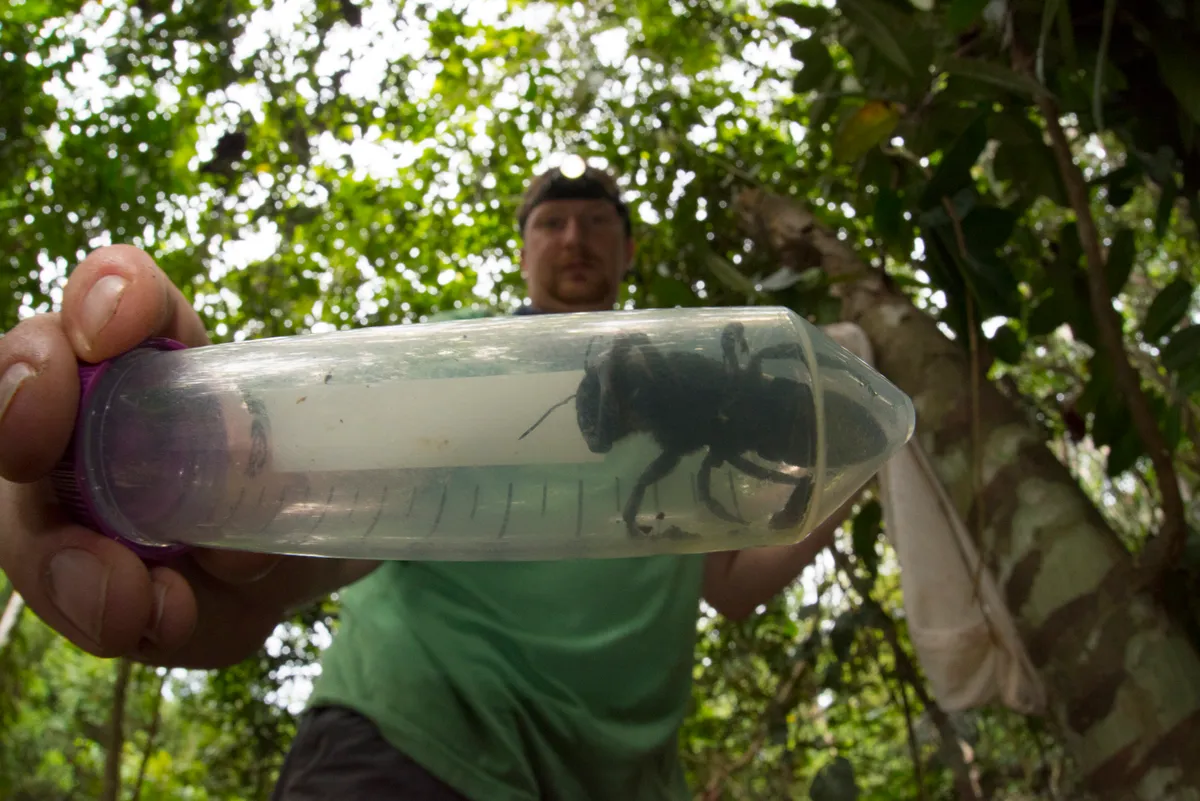 Entomologist and bee expert Eli Wyman with the first rediscovered individual of Wallace’s giant bee (Megachile pluto) in the Indonesian islands of the North Moluccas. Clay Bolt
Megan Shersby
Naturalist, writer and content creator
Megan is a naturalist, writer and content creator. She is also a bookworm and a keen board gamer. She is the former editorial and digital co-ordinator at BBC Wildlife, and wrote features and sections for both the print magazine and discoverwildlife.com, including the Q&A and Go Wild sections, Poo Corner and News Species Discovery, the weekly e-newsletter and the social media accounts. Her features have included olms (cave salamanders) in Slovenia, arapaima (very big fish) in Guyana, and the role of hippos as ecosystem engineers in Zambia. She has also contributed to the website and magazine of BBC Countryfile Magazine, and has hosted some its podcast episodes. Prior to joining BBC Wildlife in 2016, she gained a degree in BSc(Hons) Animal Science, undertook behavioural research on zebras and dwarf mongooses, and worked in environmental education for a number of conservation charities.
대화 참여하기