기본 콘텐츠로 건너뛰기

HEADLINE DESK

DKBEE.COM 최신 주요 리포트

최신 기사를 불러오는 중입니다...

LATEST INSIGHTS

분야별 심층 분석

Bees, like people, need each other


Bees, like people, need each other


“The bees were delivered to the wrong post office!” My other half, Peter, had called me from the car and I could hear an edge of panic in his voice. If he didn’t make it to the right post office before they closed, the bees would be trapped for the weekend at the Newton Highlands location, after having traveled for a week from North Carolina. Although I’m no apiarist, I understood the stakes. The bees could die.

Bees everywhere are at risk. According to Mass Audubon, three bumblebee species in the Eastern U.S. have declined 90% in the past 30 years. Maybe, in a small way, our two hives could help. Our neighbors thought so. They were thrilled when we told them our plans.

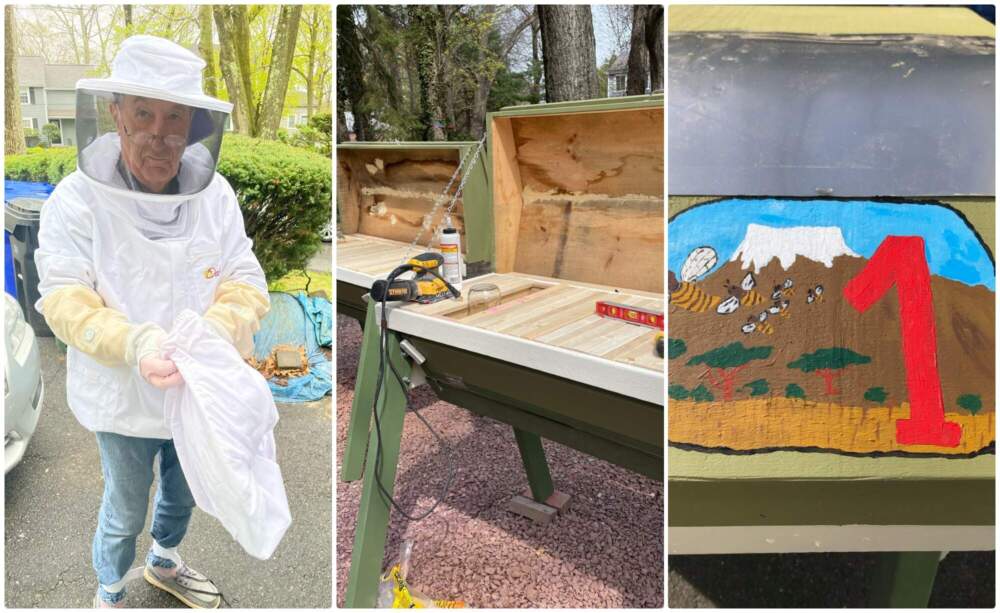
Since I first met Peter, he had talked of keeping bees like his father did. Now, as he settled into retirement, he had time. He attended a 10-week beekeeping class offered at the agricultural school in Walpole. We drove to Connecticut to pick up two special hives called top bar hives, a frameless beehive in which the comb hangs from removable bars. Top bar hives are commonly used in parts of South Africa and Zimbabwe, where Peter had grown up. He painted the hives, numbers one and two, with pictures of Mount Kilimanjaro to declare his heritage. And then he transformed our backyard — clearing a space for the hives, lining it with rocks and building trellises with flowering vines to guide the bees away from the kids next door.

This is who Peter is, a nurturer. It’s what drew me to him. When we met, I had just emerged from a marriage that had capsized into imbalance. Being a single mom had taught me to fill every role: I was used to being the cook, the cleaner, the organizer. The one who cracked the paint when hanging pictures.The author and her other half, Peter. (Courtesy Linda Button)

On Match.com, Peter had chosen a photo of himself with all five of his kids. Here was a man full of caring love, I thought. Turns out, my instincts were right. Even now, 12 years later, Peter drives me to work every day. He scans recipes to make Shrimp Mozambique or Gochung Burgers. He coaxes peonies, lilies and clematis to blossom in our front yard. He loves to take care of living things. Of me.

Bees are like that, too. Social creatures, they spend their lives caring for each other.

Peter arrived just as the post office was closing. But he convinced them to re-open and let him retrieve the package. He brought the two conjoined white boxes, which looked like milk crates, into our basement. They rattled with angry buzzing, the bees clearly ticked off from their odyssey. Peter had been assigned a mentor from the beekeeping school, but his mentor wasn’t available. He needed my help. What I know of apiculture could fit on a bee’s stinger. We suited up with our white suits and netted head coverings.

We tried to pry apart the plastic boxes with a screwdriver and poked a hole in one. Bees started leaking into our basement. “Did you even read the instructions?” I yelled. This was, I realize now, not helpful. We banged open the door into the backyard and huddled under the deck to open the crate. Rain was coming down in numbing sheets. Bees hate the cold and wet.

Peter finally released the lid of the first crate and turned it over to dump the bees into the hive, but they weren’t having any of it. They carpeted the inside of the white plastic box, massing over the small capsule where the queen was sequestered. I grabbed barbecue tongs to dislodge the capsule and dropped it onto the wet ground. Peter may have yelled at me. I may have screamed back.

The queen’s container, plugged with a sugar cube, which the colony feeds on while acclimating to her, was designed to insert into a vertical hive, not the top bar Peter had purchased. But as the rain soaked through our suits, Peter managed to tie her capsule inside the beehive. He placed the open white box, still writhing with bees, under the hive so they could find their way in. It had taken us over an hour to get this far with one hive and we were both exhausted.The author's other half, Peter, in his beekeeping gear; Peter's top bar hives; Peter's painting of Mount Kilimanjaro on hive 1. (Courtesy Linda Button)

“I’m going to wait for my mentor to install the other hive,” he said.

My stress evaporated. “Thank God.”

The next day Peter's mentor arrived and helped install the second hive in less than 10 minutes.

I knew that bees were born as either male drones, female workers or the queen. I didn’t know that a worker bee’s role changes over the course of her short life. At first she acts as custodian, cleaning out debris. Then she cares for the young larvae. Next, she may feed the queen or provide defense as a soldier for the hive. Finally, at the advanced age of two or three weeks, she explores the world, foraging first for pollen, then nectar.

In my relationship with Peter, I have found my role recast as sous chef, consultant on yard layout and décor, and the one who marks the spot where the pictures go, but doesn’t wield the hammer. I will help with hoisting plants or finding misplaced rakes. If pressed, I will assist with the bees even though, in the end, that first hive met calamity. The queen died. A few days later the colony, lost without her, swarmed our back deck and then took off, en masse, to their deaths. A hive cannot survive without a queen. They depend on every role.

“It’s OK,” Peter hugged me when he discovered the dead queen. “I’m learning too.”

We’re all learning. Bees, like people, need each other. Bees, like all of us, do best when they lean on each other’s strengths.

A few weeks later, a new box of bees arrived. Peter installed them without a hitch. Both hives are thriving.

댓글

이 블로그의 인기 게시물

From our August Home and Garden publication: Columbia Gorge Beekeepers: Megachilinae / Leafcutter

 From our August Home and Garden publication: Columbia Gorge Beekeepers: Megachilinae / Leafcutter From our August Home and Garden publication: Columbia Gorge Beekeepers: Megachilinae / Leafcutter Summer is in full swing! Hopefully you have ventured outside exploring the flora that brings beauty to the Columbia Gorge area. Have you seen any native bees visiting their grocery store — the flowers and plants? Native bees are out foraging for nectar and pollen to support their brood (babies). Each egg must have a bit of nectar and a splash of pollen. Honey bees, on the other hand, forage not only for their brood but sustenance for the long winter months ahead. The native bee’s queen hibernates through the wintry season, only surviving one year. Thus, the need for nectar stores is unnecessary. There exists a symbiotic relationship between pollinators and the flora surrounding their habitat. The plants and flowers rely on pollinators to move pollen from the flower’s anther (male part) to...

She Was Dying—Then a Swarm of Stinging Bees Healed Her

She Was Dying—Then a Swarm of Stinging Bees Healed Her One sunny day, Ellie Lobel, who had a Ph.D. in nuclear physics and three children, was attacked by a horde of Africanized bees, commonly called “killer” bees. Lobel shielded her eyes and expected to have a deadly anaphylactic reaction, she said in a 2015 BBC article describing her experience. The 45-year-old English woman was in palliative care in California because she was dying from Lyme disease. She had stepped outside to experience some sunshine and peace when the bees attacked. Swollen and in pain, Lobel expected the end was imminent. At least, that’s what she thought. Fifteen years earlier, Lobel had unknowingly endured a tick bite. The tick carried the bacteria Borrelia burgdorferi, which causes Lyme disease. If caught in time, Lyme disease is treatable with antibiotics, though the bacteria are known to sneak around the immune system and even cause flare-ups long after apparent recovery. Borrelia burgdorferi can travel e...

BeeArc Project: Pioneering a Sustainable Future for Bees and Humans

BeeArc Project: Pioneering a Sustainable Future for Bees and Humans In the picturesque village of Goathland, near Whitby, a groundbreaking initiative, the £5m BeeArc project, has taken flight. Designed for environmental activists, concerned citizens, and curious minds, this project delves into the intricate challenges faced by honeybees and, by extension, humanity. In an era of unprecedented change and instability, the honeybee finds itself at a critical juncture. Colony Collapse Disorder, where bees abandon their hives en masse, has wreaked havoc globally, with a staggering 40% disappearance in the US in 2014. The crisis is not just a distant woe; it's affecting honeybees locally, threatening their very existence. James Fearnley, founder and project director, passionately states, “The honeybee is at the end of its tether. The colonies are literally falling apart.” Drawing on 30 years of research, Fearnley proposes a revolutionary approach – harnessing natural medicines from honeyb...

Non-contact exposure to dinotefuran disrupts honey bee homing by altering MagR and Cry2 gene expression

  Non-contact exposure to dinotefuran disrupts honey bee homing by altering  MagR  and  Cry2  gene expression Dinotefuran is known to negatively affect honeybee ( Apis mellifera ) behavior, but the underlying mechanism remains unclear. The magnetoreceptor ( MagR , which responds to magnetic fields) and cryptochrome ( Cry2 , which is sensitive to light) genes are considered to play important roles in honey bees’ homing and localization behaviors. Our study found that dinotefuran, even without direct contact, can act like a magnet, significantly altering  MagR  expression in honeybees. This non-contact exposure reduced the bees’ homing rate. In further experiments, we exposed foragers to light and magnetic fields, the  MagR  gene responded to magnetic fields only in the presence of light, with  Cry 2 playing a key switching role in the magnetic field receptor mechanism ( MagR–Cry2 ). Yeast two-hybrid and BiFc assays confirmed an interactio...

10 deadliest bees you should never mess with

  10 deadliest bees you should never mess with Bees play a vital role in pollination and ecosystems, but not all are the gentle garden visitors we imagine. Some bees—and wasp-like relatives—pack a powerful sting, show extreme aggression, or defend their nests with deadly force.  Whether it’s their painful venom, swarming behavior, or territorial nature, these species are not to be taken lightly. From tropical rainforests to suburban backyards, they command respect. In this list, we explore the world’s top 10 deadliest bee and bee-like species you should never provoke, complete with their nicknames, regions, threat levels, and evolutionary origins. Dangerous bees  found across the world including  Yellow Jacket , Warrior Wasp, and more 1. Africanised  Honey Bee  – “The Killer Bee” One of the most dangerous stinging insects in the world, the Africanised honey bee is found across South and Central America and parts of the southern U.S.  These bees are ext...

What to do if you see a bee on the ground, according to an expert

What to do if you see a bee on the ground, according to an expert You've no doubt seen bees buzzing around flowers or even nestling among blades of grass, but when you spot them chilling on the pavement it can raise various questions – not least: "Are they okay?" Even if they are still alive – the average lifespan of workers is just four to six weeks – bumblebees occasionally end up on the ground for of a variety of reasons. Amy Ross, a senior ecologist for Kent Wildlife Trust , explains to Yahoo UK why this happens and, more crucially, what you can do to help them. What type of bees are they? There are more than 250 species of bees native to the UK. (Getty Images) It's important to note that there are more than 250 species of bees native to the UK – 24 of which are bumblebees. Bumblebees can be identified using this helpful chart from the Bumblebee Conservation Trust and are more than likely the kind you'll spot on the ground. What's more, around 70% of th...

Suncheon Bay: A Triumph for Environmental Stewardship and Migratory Bird Conservation

  Suncheon Bay: A Triumph for Environmental Stewardship and Migratory Bird Conservation Nestled in the heart of Haeryong-myeon, Suncheon-si, Jeollanam-do, the scenic 92m high hill on the 1st of January provides a breathtaking panorama of Suncheon Bay. The awe of around 10 tourists is palpable as they gaze down from two Yongsan observatories onto the vast expanse below, where approximately 400 cranes gracefully take flight over 2,800 ha of pristine mudflats and reed fields. The Suncheon Bay Eco-Friendly Project In 2006, Suncheon City, in collaboration with its citizens, embarked on an ambitious eco-friendly project when Suncheon Bay earned recognition in the Ramsar Convention—an international treaty for wetland protection. Over the years, the project has yielded remarkable results, with the number of whooping cranes doubling in just four years. Preserving Biodiversity Through Strategic Initiatives To safeguard the ecosystem, preventive measures were implemented against diseases like...

Giant hail threat increases for Australian cities as climate warms

Giant hail threat increases for Australian cities as climate warms In short: Hailstorms will become more frequent in Brisbane, Sydney and Canberra, while the risk of "giant" hail will increase for others, including Melbourne and Perth. The new study by the University of New South Wales shows the relationships between a warming climate and the severity of hailstorms across most major Australian cities. What's next? The study's lead researcher, Dr Tim Raupach, says it is imperative to reduce emissions, but Australia also needs to consider the increased risk from hail damage in its building codes. The frequency of "giant" hail and the number of hail days in a season could increase substantially for multiple Australian cities as the climate warms, a new study has found. The University of New South Wales study modelled the severity of hailstorms for the current and future climate across Australia's most hail-prone major cities, including Brisbane, the Sydney...

Decoding the Cold: Understanding the Dynamics of Cold Snaps and Waves

  Decoding the Cold: Understanding the Dynamics of Cold Snaps and Waves As we brace ourselves for an impending cold snap, it's crucial to demystify the nuances between a fleeting chill and a more prolonged, impactful cold wave. Meteorologically speaking, these are two distinct phenomena, each with its own characteristics and potential consequences. 🌬️❄️ Cold Snap vs. Cold Wave:  🔄🌡️ When the cold lingers for a brief period, typically 1-2 days, we label it a cold snap. It's transient and relatively mild. However, when the cold persists for three days or more, spreading its influence far and wide, we term it a cold wave. This distinction is pivotal as it helps us gauge the severity and duration of the impending chill. Siberian Cold Snap: A Tidal Wave of Cold Waves:  🌊❄️ Drawing a metaphorical comparison to a tidal wave, the Siberian cold snap ebbs and flows, resembling the rhythmic patterns of a tide. This upcoming cold snap is poised to be a formidable cold wave, impac...

“Global honey crisis”: Testing technology and local sourcing soars amid fraud and tampering concerns

  “Global honey crisis”: Testing technology and local sourcing soars amid fraud and tampering concerns The World Beekeeping Awards will not grant a prize for honey next year due to the “inability” to thoroughly test honey for adulteration. The announcement comes amid the rise of honey fraud in the EU, where a 2023 investigation found that 46% of 147 honey samples tested were likely contaminated with low-cost plant syrups.  Apimondia, the International Federation of Beekeepers’ Associations, organizes the event at its Congress, whose 49th edition will be held in Copenhagen, Denmark, in September 2025. The conference brings together beekeepers, scientists and other stakeholders. “We will celebrate honey in many ways at the Congress, but honey will no longer be a category, and thus, there will be no honey judging in the World Beekeeping Awards. The lessons learned from Canada 2019 and Chile 2023 were that adequate testing was impossible if we are to award winning honey at the Con...