Climate science and the case of the missing moisture
Expected air moisture is missing over drier areas worldwide, possibly because climate models undervalue the effects of plants and other life. This finding could be a fingerprint of human-caused land degradation, which would underscore calls to solve climate, biodiversity and water availability together.
Erica Gies
The unusual mid-winter timing of this year’s devastating and deadly Los Angeles fires caught many off guard. But meteorologists had seen the signature of approaching ‘fire weather’ in atmospheric conditions. In the days, weeks, and months ahead of the fires, the air was far drier than usual. With climate change, this phenomenon is becoming more common worldwide, bringing destructive fires to communities from Canada to southern Europe to the US Southeast.
The knowledge that climate change will parch some regions is not new. But there’s an as-yet-unexplained twist to this story, and getting to the bottom of it could help communities protect themselves against future extreme conflagrations and other climate impacts.
Erica Gies
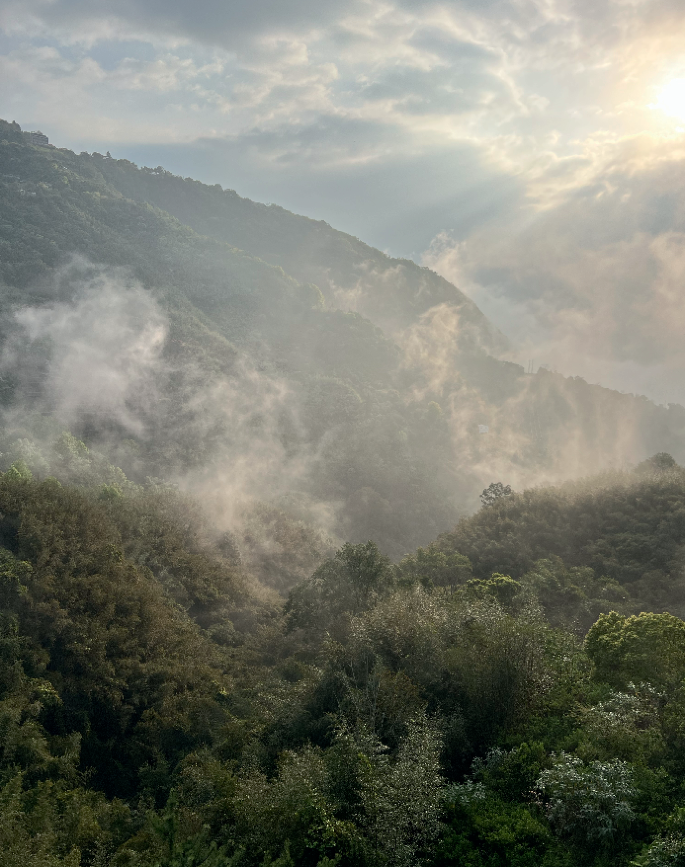
Evapotranspiration rises off the forest in the mountains of Ren'ai Township, Taiwan.
As the climate warms, the atmosphere can hold more water. The rate, according to the widely accepted Clausius–Clapeyron relationship, is about 7% more moisture for every degree Celsius of warming. We see its effect in the deluges that flooded Pakistan, Germany and New York City. Climate models represent this trend as increased atmospheric moisture the world over.
But here’s the kink in the line: over drylands, the atmosphere is not accumulating more moisture, as the models expect.
Isla Simpson, an atmospheric physicist for the Climate and Global Dynamics Laboratory at the National Center for Atmospheric Research in Boulder, Colorado, discovered this modelling misrepresentation in 20231. By looking at actual measurements over a recent 40-year period, she observed that humidity has not increased over arid and semi-arid areas. In fact, it actually decreased over the southwestern United States, which has been in a megadrought for decades.
The discrepancy across dry areas worldwide means that something is off with global climate models, admitted Gavin Schmidt, a climate modeller and director of NASA Goddard Institute for Space Studies. “There’s a systematic reason for this. It’s not a local reason.”
The real-world consequences of the drylands’ moisture deficit include not just extreme fires like those in Los Angeles, said Simpson, but also ecosystem stress and elevated risk of deadly heat. And when climate models show moisture that’s not actually there, communities may underestimate those risks and miss opportunities to make changes in land management that could buffer these climate impacts — and perhaps even slow climate change.
Simpson and her co-authors hypothesize that the moisture deficit may be due to plants and soil releasing less water into the atmosphere, which Schmidt calls “very likely”. Yet the reasons for their water withholding remain elusive and complex.
Bigger picture, the drylands moisture deficit Simpson discovered may reveal a larger blind spot for climate modelling. In grad school in the 1980s, Gordan Bonan, senior scientist at the Climate and Global Dynamics Laboratory, was taught that climate is an external force that affects ecosystems. “I think now we know that it’s a two-way system,” said Bonan. “Changes in the ecosystems are also themselves driving the change in climate.”
Global climate models lean heavily on geophysics: large-scale, ocean, land, ice, and atmospheric feedbacks that impact circulation and climate. What biology is included largely focuses on the carbon dioxide stored in plants and soil, and less on their dynamic influences, especially their role in the water cycle. Simpson’s finding bolsters a contention of climatologists like Bonan who lean into biology and ecology: that global models underrepresent plants’ and other living beings’ role in climate.
This scientific debate over the extent to which plants shape weather and climate goes back centuries, if not millennia, according to Bonan, who studies the interactions of land ecosystems. He wrote a book about it called Seeing the Forest for the Trees2. That conflict “set back our science by 100 years or so, because it just killed the concept that the vegetation matters for climate,” said Bonan.
In his view, the lack of interdisciplinarity in science has been a stumbling block. Ecologists and biologists understand that planting a single species of fast-growing tree in an attempt to store carbon will diminish biodiversity, fracture ecosystems, and disrupt the water cycle. Those dynamics are lost on many who come at climatology from an atmospheric perspective, said Bonan. “To be very crass about it, you probably don’t even understand there’s a difference between a pine plantation and the natural forest, because you probably have never taken a course in ecology.”
Global climate models’ oversimplifications in how they represent forests, grasslands and soil leave a general impression that climate affects life, but living beings — plants, fungi, microbes — don’t affect climate. That brush-off is reminiscent of a time when some thought humans are too puny to change the climate. Bonan’s 2024 paper, ‘Reimagining Earth in the Earth system’ is a clarion call to move biology toward greater equity in global climate models3.
Many climatologists now agree that living beings impact climate locally by regulating the exchange of energy and water with the atmosphere. The more provocative question is whether and to what extent those local impacts affect the global climate. And Simpson’s drylands insight may offer an important clue.
Water travelling through soil and plants
Part of the reason plants and soil have remained on the periphery of climate modelling is because their role in the hydrological cycle is complex and not fully understood. Plants open pores on their leaves called stomata to ingest CO2, releasing water vapour in the process. With warmer temperatures, they may grow bigger leaves, releasing more vapour. Or with more CO2 available, they may not need to open their stomata as much, releasing less water.
Water vapour cools local air much like sweating cools our bodies, and it forms clouds that have their own complex interactions with climate. Low clouds cool the Earth by reflecting sunlight away from the planet’s surface. But higher clouds can warm by reflecting thermal energy from Earth’s surface back to it. Then again, plants and soil also release fungi and bacteria that act as scaffolding for vapour in clouds to nucleate into liquid rain. When that phase shift occurs in the upper atmosphere, the heat energy released can escape the bonds of Earth, cooling it.
Simpson’s hypothesis that the missing moisture is due to plants and soil releasing less vapour into the atmosphere than climate models assume still leaves a variety of possibilities regarding how and why. Increased heat and water stress may compel plants to retain more water. Soil and plants may have less water to give. Higher temperatures may be depleting soil moisture over time, said Simpson.
Soil and plants may also have less access to water due to human activities such as draining wetlands, rivers, and aquifers; cutting forests; killing beavers; and overgrazing grasslands. Healthy soil is full of fungi, bacteria, insects, and other life that bind the non-living components into a matrix that absorbs orders of magnitude more water than soil with less life. That storage provides more water to plants and for soil evaporation over longer periods of time. And plant roots also increase water storage by helping rainfall move underground. Human activities that kill soil life thwart these water-holding processes and allow more precipitation to run quickly off the land.
When models fail to recognize soil degradation and decreased terrestrial water availability, they may be “estimating more or bigger leaves on plants than actually exist,” said Abigail Swann, an atmospheric scientist and ecologist at the University of Washington. Swann has devoted her career to understanding how plants influence Earth systems and arguing for the idea that biology matters for climate. “That’s been my crusade,” she said.
When Swann began her career, climate scientists used an oversimplified representation for how stomata functioned. She said, “Nobody went back and checked, ‘Oh, if we made a different assumption about what the plants did, would it change our estimate of water on land?’” Swann has done just that, showing “that these effects could be large”.
Still, nailing down these fluxes precisely is “a hard problem”, said Swann, because measuring real-life evapotranspiration globally is impossible. Scientists can physically weigh a clump of dirt with plants over time. Or they can measure fluctuations in the atmosphere, “but that gives you a footprint of maybe a kilometre,” she said. Or they can estimate it using surface temperature, incoming solar energy, and outgoing heat and evaporation. But none of these are as accurate as would be direct observations at larger scales.
Complexity of natural communities easily damaged
Simpson and colleagues found expected moisture missing over all of the world’s arid and semi-arid regions, an area covering about 20% of Earth’s land, including the US Southwest, South Africa, Somalia, Central Australia, and parts of Asia. The researchers were skeptical that land use degradation could be affecting nearly all of the world’s dry areas, given the variety in human cultures and practices. But degradation may be a common denominator. Humans have “severely altered” about 75% of land on Earth, according to the Intergovernmental Science-Policy Platform on Biodiversity and Ecosystem Services (IPBES)4. Naturally drier areas, such as grasslands, savannahs and certain forests, are at particularly high risk for human-caused desertification, an extreme form of degradation. Case in point: two millennia ago, Mesopotamia was part of the Fertile Crescent. Today, much of Iraq and Syria are desertified.
A growing body of research shows that healthy plant and soil communities help generate rain, recycle it inland, and cool temperatures locally and regionally — and land degradation can lead to drought and hotter temperatures. The changes degradation causes to the nearby environment are “a well-known, local feedback among soil moisture, evaporation, and precipitation,” said Bonan. “It’s why droughts reinforce droughts. If the soil is dry, it becomes hot, and then you decrease rainfall, and that reinforces these dry soils.”
Bonan, Swann, and other researchers with a foot in both climatology and ecology say soil and plant communities can also have a global climate impact.
Swann contributed to this work in a 2018 paper, modelling large tree die-offs in the United States5. Her simulations revealed that the die-offs changed plant productivity in far-off areas, including across the country. Plant cover losses change temperature and the amount of water transpired, which shift high- and low-pressure spots in the atmosphere. “When you change the pressure field in the atmosphere, you change the way the air is flowing, because it will always be trying to flow from high pressure to low pressure,” said Swann. These changes in the movement of air can divert rain from one place to another, she said, and also change temperature in distant areas. Compared with a phenomenon like El Niño, which famously alters these pressure fields, these plant-induced changes “are small”, acknowledges Swann. But they are measurable, and they are not reflected in climate models.
She’s working on an upcoming paper that will quantify how climate model assumptions about biology influence forecasts of future climate. “I want to understand which plant processes like photosynthesis or leaf growth are controlling the amount of water that passes from the land to the atmosphere in a hotter and higher CO2 world,” said Swann.
Schmidt said he still doubts that land degradation has sufficient scale to really move global modelling results. The impact of land cover change is “much smaller” than greenhouse gases, he said, in keeping with his view that major climate shifts “are due to bigger geophysical things, not biological things.” But, he acknowledges, “they clearly intersect”, and large-scale, land-use changes “can have multiplicative effects”.
Also questioning the potential scale of land degradation’s climate signature is Simpson’s co-author David Lawrence, head of the terrestrial sciences section in the Climate and Global Dynamics Laboratory. But he said there is much room for improvements in global climate models. Current models don’t include soil degradation at all, he said, so “drilling down into soil health could potentially be revealing.”
Other broad assumptions in climate models may also obscure the importance of intact living systems. For example, forests, which account for about 20% of land area in Simpson’s study, are represented generically, said Lawrence. But replacing a primary forest with, say, a palm oil or conifer plantation, disrupts the soil, drying it out and diminishing the life it holds.
In British Columbia, Canada, logging companies have clear cut 80% of the province’s primary forest and replanted commercial monocultures. They typically burn moisture-holding deciduous trees and spray herbicides from the air to limit their regrowth, simultaneously killing life in the soil. Primary forests can hold ten times more species of soil-binding, water-distributing mycorrhizal fungi than young plantations6. Heavy machinery used in industrial logging also compacts the soil. The end result may be a lot of trees on the land, but they are not absorbing, storing, and transpiring water as effectively as their ancient and diverse predecessors. So many community members are missing, in fact, that some ecologists refuse to call these plantations forests. But to global climate models, the two are interchangeable.
Today’s models do reflect tree removal, and large-area human impacts such as Amazon deforestation “have detectable signatures in the climate”, said Schmidt, adding that it leads to further drying of the rainforest. Reforestation, too, can have a visible impact in the models, he said, citing the cooling of land and air detected in the eastern United State due to forests’ regrowth during the twentieth century7.
Lawrence said climate models also lack nuance about the health of grasslands, which make up 24% of land area in the study he co-authored with Simpson. Yet about 70% of drylands, which are dominated by grasslands, are used for grazing, an activity linked with desertification, according to IPBES8. “Some models don’t include grazing at all,” Lawrence said. That could be a factor in his and Simpson’s finding, he acknowledged.
Additionally, 10% of land area in their study is covered by industrial agriculture (excluding grazing), which alters nutrients, soil, and water use, and “none of that is being captured” in global climate models, said Lawrence.
Still, the models are improving. Twenty years ago, they represented land as “a green slime, and there was a bucket for water”, Lawrence said. Today models capture some land-use change, snow processes, and “how plants mediate things”.
Continuing that progress will require more ground-level research. Because each place has a unique community of plants, animals, and fungi, generalizations don’t yield accuracy. What’s required is more data and study of the individuals’ interactions that make up each ecosystem. Computing power to handle the resulting complexity is another barrier.
Lawrence and colleagues are developing the next generation of models that could start to close these gaps. He predicted that they will account “for the size and age structure of forestry and ecosystems much more richly, which then allows you to capture the impacts of disturbance events — forest fires, logging — in a much more realistic way.”
A field in flux
Understanding better the role of biology and ecology in climate science has profound implications for climate policy and action. The climate crisis is frequently oversimplified to just a problem of carbon dioxide emissions. Getting off fossil fuels is critically important, but carbon myopia can breed counter-productive ‘solutions’, such as when solar farms degrade natural habitat, or when people cut intact forests to plant fast-growing pines or eucalyptus in a misguided attempt to store more carbon. In other words, ‘natural climate solutions’ are about more than carbon flux calculations.
Bonan warns that climate modellers — himself included — are at risk of overestimating the depth of understanding they can glean by gazing down from satellites and running mathematical models. “People who actually live on the land and experience it every day have a lot more intimate knowledge than we do. That is an important concept for people to understand.”
Ecologists who work at ground level and Indigenous peoples and others who care for and rely directly on the land often describe other-than-human beings as having agency, and their communities as having collective intelligence. From this perspective, all living beings seek what they need to survive, especially water, and their interwoven actions give rise to a self-reinforcing ecological stability. That idea, along with recognition of the vast scale of human disruption to land and water, has led to a growing chorus of researchers and international policy bodies advocating for solutions that address biodiversity, water, and climate together.
Land stewardship that protects or restores complex ecosystems and slows water on the land, correcting for human activities that tend to rush it away, will buffer communities from climate impacts such as extreme flooding, drought, heat, sea-level rise, and fires such as those in Los Angeles. And if the global community can embrace land care as a critical climate solution along with the energy transition, the cumulative impact may be greater than we can currently understand. Time, and better models, will tell.
댓글
댓글 쓰기